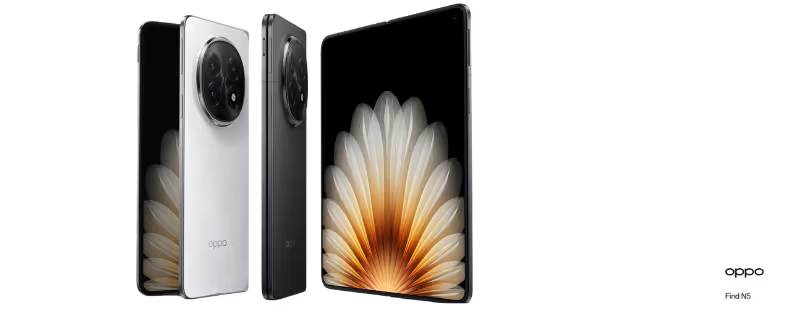
OPPO Find N5: The Foldable That Finally Feels… Normal?
Foldables have been “the future” for almost a decade.
And yet, until recently, they always came with a catch. Too thick. Too fragile. Too experimental. Or simply too niche.
Then the OPPO Find N5 shows up — and quietly changes the conversation.
Not by doing something radically new. But by removing almost everything that made foldables feel like a compromise.
The Design Shift Everyone Was Waiting For
The first thing you notice is not the screen.
It’s the thickness.
Or more precisely — the lack of it.
At just 8.93mm folded and 4.21mm unfolded, the Find N5 is officially one of the slimmest foldables ever made. And that matters more than it sounds.
Because for the first time, a foldable doesn’t feel like a “different category” of phone. It feels like… a phone.
This is where OPPO nailed the psychology of adoption.
People don’t want a futuristic device. They want something familiar that happens to be better.
And the hinge plays a huge role here. OPPO’s titanium-based hinge design isn’t just about durability. It’s about eliminating the biggest visual flaw foldables have had for years: the crease.
It’s still there, technically. But in real use, it’s barely noticeable.
That’s a turning point.
Big Screen, But Actually Usable
Let’s talk about the display, because this is where foldables often overpromise.
The Find N5 gives you an 8.12-inch inner display paired with a 6.62-inch outer screen.
Sounds standard for a foldable, right?
But here’s the difference.
The outer display is actually usable.
This has been a silent issue with many foldables. Either too narrow or awkwardly shaped, forcing you to open the device constantly. OPPO avoids that trap.
You can realistically use the phone closed most of the time. And then unfold it when you need space.
That small shift changes the entire experience.
You’re not adapting to the device anymore. The device adapts to you.


Performance That Matches the Form Factor
Foldables used to compromise on power or battery.
Not here.
The Find N5 runs on Snapdragon 8 Elite, paired with 16GB RAM and up to 512GB storage.
Translation: this is flagship-level performance, no excuses.
More interesting is the battery.
A 5600mAh battery inside a foldable this thin is not normal.
Add 80W wired charging and 50W wireless charging, and you start seeing OPPO’s strategy clearly:
They’re not just competing with foldables.
They’re competing with the best standard flagship phones.
And that’s exactly where the category needs to go.
Cameras: Good Enough, But Not the Headline
The Find N5 comes with a triple camera setup (50MP main + 50MP + 8MP) , co-developed with Hasselblad.
And yes, it’s good.
Very good for a foldable.
But here’s the honest take: it’s not trying to beat camera-first flagships.
And that’s actually the right move.
Because the real value of a foldable is not photography. It’s versatility.
Trying to win on everything usually means losing focus.
OPPO clearly decided what matters most here: form factor + usability.
The Real Innovation: It Feels Finished
This is the part most spec sheets won’t tell you.
The Find N5 doesn’t feel like a “Gen 1” product anymore.
It feels… finished.
That includes:
- Proper multitasking support
- Refined fold/unfold transitions
- Reliable durability (IPX6/IPX8/IPX9 ratings)
- A software experience that actually understands foldables
This is what separates early adopters from mainstream adoption.
Not features. But confidence.
The Problem No One Talks About: Availability
Here’s where things get interesting.
Devices like the Find N5 are pushing the foldable category forward faster than many global brands.
But they’re not always widely available.
This has been a recurring pattern with OPPO’s foldables.
And it creates a strange market dynamic:
The best foldables are not always the most accessible ones.
Meanwhile, brands like Samsung dominate globally simply because they’re everywhere.
This is less about product quality — and more about distribution power.
A pattern we’re also seeing in the eSIM world, by the way.

Where It Stands Against the Competition
Let’s zoom out.
If you compare the Find N5 to current foldable players:
- Samsung Galaxy Z Fold series → better ecosystem, global reach, longer software support
- Google Pixel Fold → stronger AI/software integration
- OPPO Find N5 → best hardware execution, best form factor balance
That’s the real positioning.
OPPO is winning the hardware game.
But the ecosystem war is still open.
And that matters more than ever.
The Bigger Picture: Foldables Are Finally Crossing Over
The Find N5 is not just another device.
It’s a signal.
Foldables are moving from:
“Interesting innovation”
→ to
“Real alternative to flagship phones”
The key shift?
They’re no longer trying to justify themselves.
They’re starting to replace something.
And that’s when markets change.
You can already see this in analyst discussions and reviews. Devices like the Find N5 are consistently described as pushing foldables “closer to mainstream appeal”.
Not because they’re revolutionary.
But because they remove friction.
Conclusion
The OPPO Find N5 doesn’t win by being flashy.
It wins by being realistic.
It understands that the future of foldables is not about adding more features. It’s about removing compromises.
Compared to competitors, it’s probably the closest thing we have today to a “no-excuses” foldable.
But here’s the bigger takeaway.
Hardware is no longer the main bottleneck in this category.
Distribution, ecosystem, and pricing are.
And that’s where the next battle will be fought.
If OPPO can solve that, devices like the Find N5 won’t just compete.
They’ll define the category.
For now, though, it does something arguably more important.
It makes foldables feel… normal.
And that might be the biggest breakthrough of all.