For years, a Netflix account felt almost casual. One subscription, a few profiles, a password shared with your parents, your partner, your student friend, maybe someone you had not spoken to properly since 2019. It was messy, generous, and very internet.
Netflix has turned the account into something much more controlled: a paid relationship tied to a household, a location, payment details, devices, profiles, and increasingly, advertising value. The password is still there, of course. But the real product is no longer just access to films and series. It is account ownership.
And that shift matters far beyond Netflix.
The Household Becomes the Border
Netflix now defines a household as the group of devices connected to the internet at the main place where you watch Netflix. Its official position is clear: a Netflix account should not be shared outside the household, unless the account owner adds an extra member where that option is available.
That sounds simple until real life gets involved.
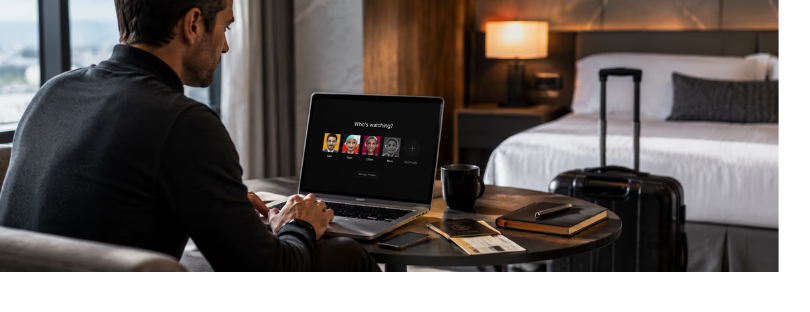
People travel. Students move between cities. Couples split time between two homes. Business travellers watch Netflix in hotels. Families share tablets, smart TVs, and mobile devices across different networks. The modern household is not always one sofa and one Wi-Fi router.
Netflix knows this, which is why it still allows members to use the service while travelling. Its help pages specifically discuss using Netflix outside the home and remind users to check payment methods before travel, especially because gift cards and cash-based payment options may vary by country.
That detail is small, but revealing. Streaming is no longer only a content service. It behaves more like a mobility service. Your account needs to follow you, but only within limits.
Password Sharing Became Paid Sharing
The big change is not that Netflix killed sharing completely. It monetised it.
Account owners on Standard or Premium plans in many countries can add an extra member who does not live with them. Netflix says extra members get their own account and password, while the main account holder pays for the slot.
That is clever. Netflix did not simply say: “Stop sharing.” It said: “Sharing has a price.”
This is the same kind of logic we see in telecom, software, travel platforms, and even fintech subscriptions. The old internet assumption was that access could be stretched. One login, many users. One account, many lives. But platforms now want each economic relationship counted properly.
For users, it feels like a crackdown. For Netflix, it is revenue recovery. For the wider market, it is a signal: the era of loose digital access is ending.
Netflix Plans
Netflix account plans compared
A simple comparison of Basic, Standard, and Premium plans.
Basic
5.99€ / month
✓ Unlimited ad-free movies, TV shows, and games
✓ Watch on 1 supported device at a time
✓ Watch in 720p HD
✓ Download on 1 supported device at a time
Best for most users
Standard
9.99€ / month
✓ Unlimited ad-free movies, TV shows, and games
✓ Watch on 2 supported devices at a time
✓ Watch in 1080p Full HD
✓ Download on 2 supported devices at a time
Premium
12.99€ / month
✓ Unlimited ad-free movies, TV shows, and games
✓ Watch on 4 supported devices at a time
✓ Watch in 4K Ultra HD + HDR
✓ Download on 6 supported devices at a time
✓ Netflix spatial audio
The Travel Problem Nobody Talks About
For Alertify readers, the interesting part is not only entertainment. It is mobility.
A Netflix account now has to understand where you are, whether you are at home, whether you are travelling, whether your device belongs to the household, and whether your payment method works in the country you are visiting. That puts Netflix surprisingly close to the same friction points travellers already face with roaming, eSIMs, banking apps, ride-hailing, and digital tickets.
Think about it. The traveller does not care about backend rules. They care about one thing: “Will this work when I land?”
The same question applies to mobile data, banking authentication, WhatsApp, airline apps, and now streaming accounts. A smooth travel experience increasingly depends on a persistent digital identity. Your services need to recognise you without punishing you for moving.
That is why the Netflix account story is bigger than streaming. It is part of a wider shift from “I bought access” to “the platform continuously verifies my right to access.”
Netflix Is Not Alone
Netflix moved early and aggressively, but the rest of the industry followed. Disney began limiting password sharing across Disney+ and Hulu in 2024, using a household model similar to Netflix, according to PCWorld. Max has also introduced paid account-sharing controls, including an extra member add-on reported at $7.99 per month.
This is now the new streaming playbook.
First, platforms tolerated sharing because it helped growth. Then growth slowed. Then investors wanted profitability. Then the “borrowed password” became lost revenue. What used to be treated as harmless consumer behaviour became a business leak.
Netflix has also leaned heavily into advertising. Its ad-supported plan has become a major part of its growth story, and recent reporting says the company is expanding advertising further, including into new formats and more markets.
So the Netflix account is now doing three jobs at once. It sells subscriptions. It limits unpaid sharing. And, for ad-tier users, it helps build a more valuable advertising audience.
That is a very different business from the old “watch what you want, when you want” streaming dream.
The Account Is the Product
Here is the uncomfortable truth: content is no longer enough.
Netflix still needs hit shows, films, live events, and documentaries. But the strategic asset is the account layer. Who is watching? Where? On which device? Under which plan? With ads or without? As a household member or an extra member? At home or travelling?
That account layer is where the economics now sit.
This is similar to what is happening across digital services. Airlines want the passenger relationship before, during, and after the trip. Banks want the app to become a daily utility. Telecom providers want connectivity to become persistent rather than one-off. Streaming platforms want accounts to become controlled, monetisable relationships, not shared passwords floating around family chats.
Netflix is simply one of the clearest examples because everyone understands the product.
Conclusion
The Netflix account has become a small case study in where consumer digital services are going.
The old model was relaxed: sign in, stream, share, forget about it. The new model is tighter: define the household, price the extra user, verify the device, personalise the ad experience, protect the revenue.
Compared with Disney+, Hulu, and Max, Netflix still feels like the company that set the direction rather than followed it. Others are now adopting similar household and paid-sharing logic, but Netflix proved that users may complain and still stay. That is the key lesson for the market.
For travellers, the question is more practical. We are entering a world where every service wants to know whether you are “really you” and whether you are in the “right” place. That can make platforms smarter, but also more annoying. The winners will be the companies that protect their business model without making legitimate users feel like suspects.
Netflix has not just changed how people share passwords. It has shown what happens when the account becomes the centre of the business. And once that happens, every login starts to look a little less casual.
Driven by wanderlust and a passion for tech, Sandra is the creative force behind Alertify. Love for exploration and discovery is what sparked the idea for Alertify, a product that likely combines Sandra’s technological expertise with the desire to simplify or enhance travel experiences in some way.