Melita Adds eSIM and Greener SIM Cards in Malta
Melita has added eSIM support to its mobile portfolio, giving customers in Malta a simpler way to activate mobile service without relying on a physical SIM card. It is a practical update, but also a symbolic one. eSIM is no longer a niche feature for early adopters or frequent travellers. It is becoming part of the normal mobile experience.
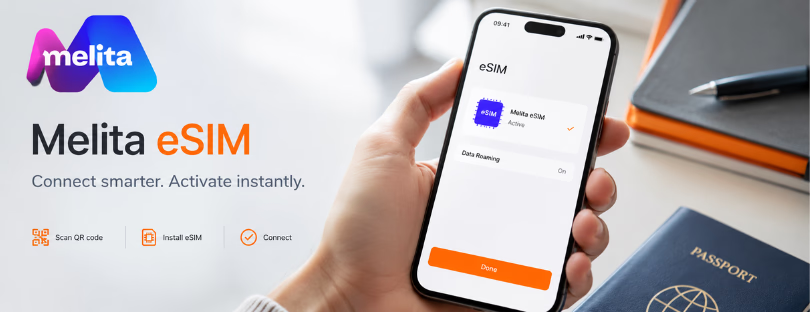
With Melita’s eSIM, customers can activate a mobile plan directly on a compatible smartphone using a QR code or activation link sent by email. That means no plastic card, no waiting for a SIM swap, and no need to visit a store just to get connected. Melita says eSIM is available across its mobile plans, including Endless Postpaid plans and the Prepaid Pockit option.
For users, the appeal is obvious. eSIM makes it easier to manage more than one number on the same phone, which is useful for people who want to separate personal and work lines, or keep a domestic number while using another plan abroad. It also improves security because the SIM cannot be physically removed, stolen or cloned in the same way as a traditional card.
A small sustainability move with real meaning
Melita is not only introducing eSIM. For customers whose devices do not yet support embedded SIM technology, the company has also introduced more sustainable physical SIM cards made from ABS, or Acrylonitrile Butadiene Styrene. According to Melita, these cards provide the same reliability as traditional PVC SIM cards, while generating less pollution when recycled.
Kevin Borg, Chief Commercial Officer at Melita, framed the move as part of the operator’s wider sustainability efforts:
“Offering eSIM options and introducing physical SIM cards made of ABS are small, but important, actions which support our goal of embracing sustainable practices across our operations.”
That “small but important” wording is probably the right way to look at it. A greener SIM card will not transform telecom sustainability overnight. But physical SIM production, packaging and distribution are still part of the industry’s environmental footprint. Thales, one of the major SIM technology suppliers, has also been pushing EcoSIM products made from recycled plastic, arguing that operators need better alternatives as billions of SIM cards are still produced globally each year.
In other words, Melita’s update fits a wider shift: operators are slowly moving away from plastic-first connectivity, while trying not to exclude customers whose devices are not yet eSIM-ready.

How customers activate it
The process is intentionally simple. Customers first need to check whether their phone supports eSIM. On many devices, that means going into the phone’s settings and looking for SIM Manager or the option to add a mobile plan or eSIM.
Once compatibility is confirmed, customers can request an eSIM from Melita. Existing mobile customers and new customers can choose it as part of their mobile plan.
Melita then sends an email with a QR code and activation link. The customer scans the code or clicks the link, follows the phone’s setup steps, and the eSIM is activated. It is the kind of onboarding mobile operators should have been moving toward years ago: cleaner, faster and less dependent on plastic logistics.
Getting your eSIM
Switching to eSIM is simple. Check your device, request your eSIM, then activate it with a QR code or link.
Check compatibility
Go to your phone settings. If SIM Manager gives you the option to add a mobile plan or eSIM, your device is ready. If you are still unsure, check your phone or device specifications to confirm it supports embedded SIM, or eSIM.
Ask for eSIM
Whether you are already a Melita mobile customer or looking for a new plan, you can choose eSIM with all Melita mobile plans, from Endless Postpaid plans to the budget-friendly Prepaid Pockit plan.
Scan or click
Melita will send you an email with a QR code and activation link. Scan the QR code or click the link to activate your eSIM. That’s it, you are ready to go.
Why operators are moving now
Melita’s eSIM launch comes at a time when eSIM adoption is becoming harder for operators to ignore. GSMA Intelligence reported that global eSIM smartphone penetration reached 5% at the end of 2025 and is expected to rise to 10% by the end of 2026. That still sounds modest, but the direction is clear, especially as newer smartphones increasingly support eSIM as standard.
The travel market has accelerated awareness too. Consumers now see eSIMs advertised by travel eSIM brands, fintech apps, airlines and roaming alternatives. That creates pressure on traditional operators. If customers become comfortable downloading mobile connectivity like an app, the operator relationship becomes more fluid.
This is where Melita’s move matters. It is not just about replacing a plastic card. It is about keeping the operator experience modern enough to compete with the convenience users are seeing elsewhere.
The bigger market signal
For Alertify readers, the interesting part is not that Melita now offers eSIM. That is becoming expected. The more important signal is how local operators are packaging eSIM: convenience, security and sustainability in one message.
That combination is smart. Travel eSIM providers often lead with price and destination coverage. Device manufacturers focus on simplicity. Enterprise eSIM players focus on control and fleet management. Traditional operators, meanwhile, have a different advantage: trust, local support, bundled plans and existing customer relationships.
Melita’s challenge now is to make eSIM feel less like a technical option and more like the default choice for compatible devices. The easier that journey becomes, the less reason customers have to stay attached to plastic.
Conclusion
Melita’s eSIM update is not revolutionary, but it is the right move at the right moment. The market is clearly moving toward digital-first mobile activation, and operators that delay risk making their own onboarding experience feel old-fashioned.
The sustainability angle is also worth taking seriously, but without exaggerating it. eSIM reduces the need for physical SIM production, while greener SIM cards help bridge the gap for customers who are not ready or able to switch yet. That balance matters because telecom transitions are rarely instant.
Compared with travel eSIM brands such as Airalo or Holafly, Melita is not trying to win on global roaming disruption. Compared with enterprise eSIM platforms, it is not selling centralised fleet control. Its opportunity is more grounded: make everyday mobile connectivity in Malta easier, cleaner and more secure.
And in 2026, that is exactly what a modern mobile operator should be doing.