Roamless eSIM: A Smarter Pay-As-You-Go Travel Option
Most travel eSIM brands still sell connectivity the old way: choose a country, pick a bundle, install a profile, use it, forget it, repeat next trip. Roamless is trying to make that feel outdated.
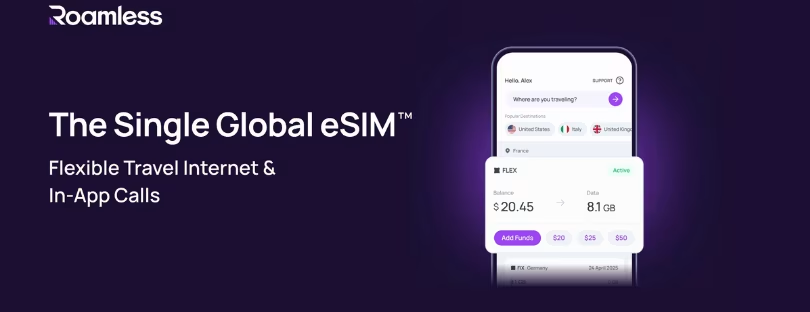
The company’s pitch is built around a Single Global eSIM, one eSIM profile that users install once and then reuse across trips. Instead of treating every destination as a separate purchase moment, Roamless wants to become the connectivity layer that simply stays on your phone. According to its own help center, Roamless data connectivity is available in 200+ countries and regions, with destination and operator details available inside the app or web app.
That sounds small, but in travel connectivity, it matters. The real frustration for many travelers is not only price. It is the tiny repeated admin: which eSIM do I need, is my phone compatible, when do I install it, why did I buy 10GB when I used 2GB, and why am I doing this again for the next country?
Roamless is interesting because it attacks that friction directly.
The pay-as-you-go angle
The most distinctive part of Roamless is not coverage. Plenty of eSIM providers now claim broad global reach. The sharper point is its pay-as-you-go model, where users can add credits and use them across destinations instead of buying a new country-specific plan each time.
On Google Play, Roamless describes its app as offering both pay-as-you-go credits and data plans on its Single Global eSIM, plus a second-number feature for staying reachable. TechRadar’s review describes two pricing models: RoamlessFlex, a pay-as-you-go option, and RoamlessFix, fixed data plans with set data amounts. It also notes that Flex pricing varies by country, with an average cited at around $2.45 per GB.
READ MORE: Roamless Adds Calls, SMS and Phone Numbers — Is This the All-in-One Travel eSIM?
This gives Roamless a different feel from the classic “Europe 10GB for 30 days” model. For a weekend traveler, a light user, or someone moving between several countries without a predictable data pattern, unused data is the enemy. Roamless turns that problem into its main selling point: buy what you need, use what you need, keep the account active for later.
It is not perfect for everyone. Heavy users may still prefer a big fixed bundle or an unlimited day pass from another provider, especially if they stream, work from a hotspot, or travel for longer periods. But for the traveler who wants a low-maintenance fallback connection on their phone, Roamless has a clean argument.
|
The product feels more persistent
There is a broader market signal here. Travel eSIMs are slowly moving away from one-off SIM replacement and toward persistent mobile services.
Roamless fits that shift. The company is not only selling data. It is adding communication features around the eSIM, including in-app international calling and, more recently, Roamless Numbers. Its Google Play listing says users can subscribe to one or multiple international numbers with UK, Canada, or Australia prefixes, aimed at professionals, freelancers, and remote workers abroad.
READ MORE: Roamless – Global Travel Connectivity Startup – Raises $12M to Fix Broken Roaming
That is important because the travel eSIM category has always had a weak spot: most products solve mobile data, but not reachability. Travelers still need WhatsApp, hotel calls, delivery apps, banking verification, work calls, or a number that does not look strange to clients. Roamless is clearly aware of that gap.
Still, it should be framed carefully. This is not the same as becoming a full mobile operator replacement for every user. TechRadar points out that Roamless’ in-app calling allows outbound international calls, but traditional inbound calling and SMS limitations remain part of the picture depending on the feature used. So the value is real, but it is not magic. It is a practical layer for travelers who need more than data, not a complete substitute for every mobile service.
Where it stands against rivals
Compared with Airalo, Roamless feels less like a marketplace of destination plans and more like a reusable wallet-style connectivity app. Airalo’s strength is scale, brand awareness, and very broad plan discovery. Roamless’ strength is the feeling that you are not starting from zero every time you travel.
Compared with Holafly, the contrast is even clearer. Holafly has built a strong consumer position around unlimited-style travel data and simple destination packages. Roamless takes a more measured route: flexible credits, fixed plans, and less drama around buying too much data. That makes Roamless attractive for people who hate waste, but less obvious for users who want the psychological comfort of “unlimited.”
READ MORE: Roamless eSIM: A Smarter Pay-As-You-Go Travel Option
Compared with Yesim, there is some overlap. Yesim’s Pay & Fly model also moves toward the idea of a persistent balance-based eSIM experience rather than a purely trip-based purchase. The difference is in the wider product framing. Yesim has been pushing a broader premium ecosystem around global packages, unlimited options, and B2B/API distribution, while Roamless feels especially focused on consumer app simplicity and repeat travel usage.
Saily, Nomad, Ubigi, GigSky and others all play in adjacent territory, but Roamless has chosen a clear identity: install once, top up when needed, travel without rebuilding the whole setup.
That clarity is valuable. In a crowded eSIM market, being “another cheap data plan” is not enough anymore.
 What travelers should watch
There are a few practical points users should still check before relying on Roamless as their only connection.
First, coverage is broad, but network quality depends on local operators. Roamless itself recommends checking coverage and operator options before travel, especially when manual network switching might be needed.
Second, pricing varies by destination. Pay-as-you-go sounds simple, but the actual value depends on where you are going and how much data you use. In cheaper destinations, it may feel excellent. In expensive roaming markets, a fixed bundle from another provider might still win.
Third, support matters. TechRadar praised Roamless’ coverage and app experience, but listed lack of telephone or live chat support among its drawbacks. For casual travelers, email and help-center support may be enough. For nervous travelers landing late at night with no connection, real-time support can be the difference between “great app” and “never again.”
Conclusion
Roamless is not important because it is simply another eSIM provider with 200+ destinations. The market already has enough of those.
It is important because it reflects where travel connectivity is going: away from disposable trip products and toward always-ready connectivity accounts that sit quietly on the phone until needed. That is the bigger story.
The winners in this category will not only be the brands with the cheapest gigabytes. They will be the ones who reduce thinking. Roamless does that well. It removes repeated installation, softens the pain of unused data, and adds communication features that make the app feel more useful between trips.
But it also has to compete with rivals that are moving fast. Holafly is pushing simplicity and unlimited-style comfort. Yesim is building a more layered ecosystem with persistent balance, global plans, unlimited products, and partner distribution. Airalo still has enormous recognition and destination depth. Roamless’ challenge is to prove that flexibility is not just a nice feature, but a habit travelers keep.
For Alertify readers, that is the signal: the eSIM market is maturing from “buy data before travel” into “keep a connectivity layer ready at all times.” Roamless may not be the only player moving in that direction, but it is one of the cleaner examples of the shift.