LG U+ Roaming Pass Upgrade: More Data, Same Price
Just as international travel demand ramps up again, South Korea’s LG U+ is making a clear move: more data, same structure, and a stronger push to keep roaming relevant in a world increasingly dominated by eSIM alternatives.
From next month, the operator is significantly upgrading its flagship Roaming Pass plans, effectively doubling data allowances across most tiers. It is a timely update, and not just a seasonal promotion. It signals something bigger about where traditional telecom operators are heading.
What’s actually changing
The headline is simple: more data for the same price.
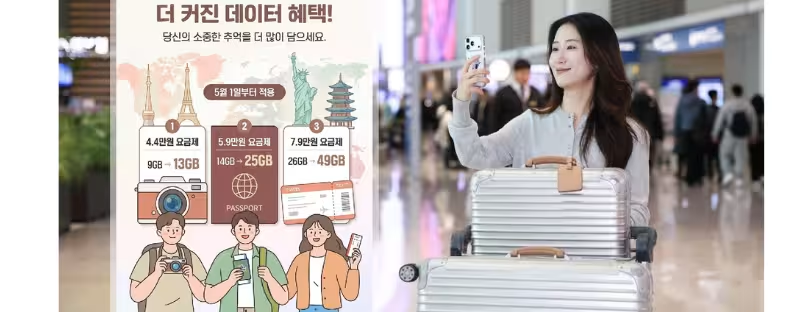
The ₩79,000 plan jumps from 26GB to 49GB
The ₩59,000 plan increases from 14GB to 25GB
The ₩44,000 plan moves from 9GB to 13GB
The ₩29,000 entry plan stays at 4GB
This is not a temporary campaign. LG U+ is locking in what used to be a promotional “double data” offer into its permanent pricing structure.
At the same time, the operator is adding extra perks:
- Free in-flight Wi-Fi access on selected plans
- Flight delay insurance coverage
- A simplified onboarding experience with clearer roaming information
This combination of data + services is key. LG U+ is not just competing on gigabytes anymore. It is trying to reposition roaming as a premium, bundled travel product rather than a basic connectivity add-on.
Why now?
Timing matters here.
Travel costs have gone up globally, driven by fuel surcharges, inflation, and currency shifts. For many travelers, roaming used to be the easiest cost to cut. That is exactly where eSIM providers built their momentum.
By doubling data without raising prices, LG U+ is clearly trying to remove one of the biggest objections to roaming: poor value per GB.
The move also aligns with a predictable seasonal spike. Early next month includes a “stepping-stone holiday” period in Korea, traditionally one of the busiest outbound travel windows.
But this is not just about seasonality. It is about defensive strategy.
Roaming vs eSIM: the real battle
Let’s be clear. LG U+ is not competing in a vacuum.
Over the past three years, players like Airalo, Holafly, and Yesim have reshaped how travelers think about connectivity.
They offer:
- Lower entry prices
- Instant activation
- No dependency on a home carrier
In many cases, they also outperform roaming on pure cost.
So LG U+ is doing something smart. Instead of trying to beat eSIMs on price, it is leaning into what eSIMs still struggle to match consistently:
- Network reliability through domestic carrier agreements
- Seamless billing within an existing mobile plan
- Customer support from a trusted provider
- Bundled services like insurance and Wi-Fi
This is classic telecom positioning. Not cheapest. But easiest, safest, and most integrated.
The bigger trend: roaming is evolving, not dying
There has been a lot of noise about roaming being “dead.” That is not entirely accurate.
What we are actually seeing is a repositioning of roaming.
According to insights from GSMA and recent operator reports, roaming revenues are stabilizing again post-pandemic. But the structure is changing:
- Operators are shifting from pay-per-use to bundled passes
- Data volumes are increasing significantly
- Value-added services are becoming part of the offer
At the same time, eSIM adoption is accelerating. GSMA Intelligence estimates that eSIM penetration continues to grow rapidly, especially among frequent travelers and premium device users.
This creates a dual market:
- eSIMs win on flexibility and price transparency
- Roaming wins on trust, simplicity, and ecosystem integration
LG U+’s move fits perfectly into this emerging balance.
What LG U+ is really trying to achieve
If you look beyond the numbers, this is not just a pricing update. It is a retention strategy.
Every traveler who switches to an eSIM provider is a potential long-term loss for the operator. Not just for roaming revenue, but for overall customer engagement.
By making roaming more competitive and more useful, LG U+ is trying to:
- Keep users داخل its ecosystem
- Reduce the need to download third-party apps
- Increase perceived value of its core mobile plans
The addition of shareable data is also important. It reflects a shift toward group travel usage, where one plan can serve multiple users. That is something eSIM providers have been experimenting with as well.
Where this leaves the market
LG U+ is not alone. Similar moves are happening globally, although often less aggressively.
European operators are refining roaming bundles. US carriers are pushing international day passes. Asian operators are increasingly bundling travel perks.
But doubling data at this scale is still a strong signal.
Conclusion
This update from LG U+ highlights a reality the industry does not always openly admit: the fight between roaming and eSIM is far from over, and neither side is clearly winning yet.
eSIM providers still dominate on price and flexibility. That is unlikely to change in the short term.
But operators like LG U+ are proving that roaming can still compete by evolving into something else entirely. Not just connectivity, but a packaged travel service built on trust, convenience, and integrated benefits.
The bigger picture is this: the market is not converging toward one model. It is being split into two.
And for travelers, that might actually be the best outcome.