Local 5G Just Got Easier with IIJ’s eSIM Model
Japan’s local 5G ambitions just became a lot more practical. Internet Initiative Japan Inc., one of the country’s most established internet and network solution providers, has announced the immediate availability of a new solution that enables the issuance of a single eSIM profile for local 5G usage.
That might sound technical. It is. But it is also strategically important.
Until now, issuing eSIM profiles for private or local 5G environments required infrastructure that only made sense at scale. If you were a factory, university, municipality, or systems integrator looking to deploy a handful of devices, the economics simply did not work. The barrier was not a spectrum. It was provisioning.
This announcement changes that equation.
The Hidden Bottleneck in Local 5G
Local 5G in Japan has been steadily gaining attention, particularly in industrial and municipal use cases. The promise is clear: dedicated, high-speed, low-latency connectivity without relying on public carrier networks.
But there has been a structural obstacle.
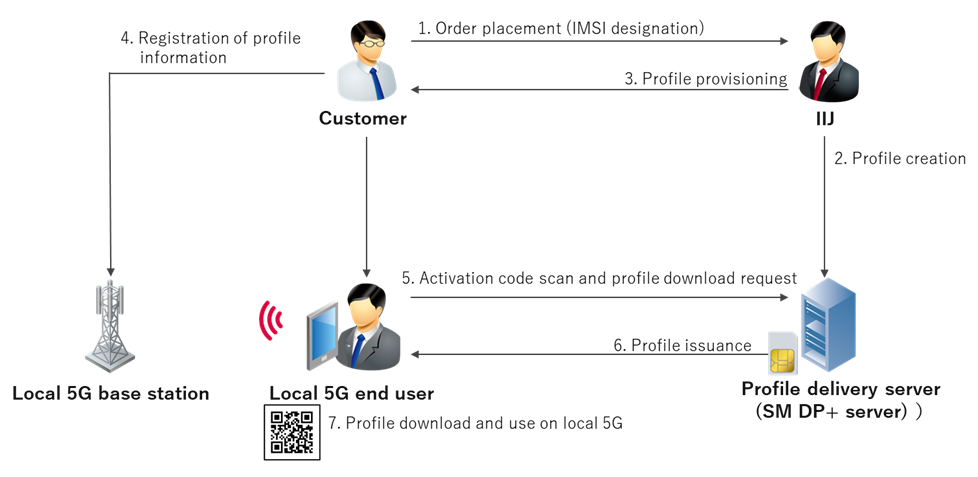
An eSIM profile for local 5G use must be issued using a dedicated server certified by the GSMAE (*), an industry organization. As noted in the original announcement:
“An SM-DP+ (Subscription Manager Data Preparation) server needs to be built and operated, it must be certified by the GSMA through ongoing auditing, and profiles have to be developed.”
For small-scale deployments, this has been economically prohibitive. Setting up and maintaining a GSMA-certified SM-DP+ environment is not trivial. It requires infrastructure, compliance, auditing, and ongoing operational oversight.
In other words, you needed enterprise-level budget even for pilot-level experimentation.
(*)GSMA (GSM Association): The world’s largest global industry-led organization made up of mobile operators and related companies, responsible for setting industry standards for mobile communication technology and devising rules for roaming and interconnection.
Why Device Trends Forced the Issue
There is another pressure point: hardware.
As iPhones and iPads increasingly adopt eSIM-only designs, the need for compliant, secure issuance of eSIM profiles has become unavoidable. In Japan, where Apple devices hold a significant market share, this transition is particularly relevant.
Physical SIM fallback is disappearing.
Local 5G operators and integrators can no longer rely on legacy SIM distribution models. They must provision eSIM profiles that meet 5G standalone requirements, including an encrypted subscriber identity.
This is where IIJ’s new model enters.
Thales Infrastructure Without the Heavy Lift
To address the economic and operational barrier, IIJ has adopted eSIM as a Service from Thales Group, leveraging its global leadership in connectivity management.
Instead of forcing each local 5G adopter to build and certify their own SM-DP+ server, IIJ provides a pre-defined eSIM profile format that works across a wide range of applications, from small-scale testing to pilot projects and full rollouts.
The key shift is this: no delivery server installation. No custom profile development. No massive upfront certification overhead.
Even a single eSIM profile can now be issued for local 5G use.
That is a meaningful structural simplification.
Issuing from One Profile Up
One of the most important features of this solution is flexibility.
eSIM profiles supporting local 5G SA (standalone) can be issued starting from just one profile. This sounds small, but in industrial and academic contexts it is transformative. A robotics lab, a logistics warehouse, or a municipal pilot project can begin with minimal commitment.
There is no forced bulk minimum.
This approach aligns local 5G experimentation with modern cloud logic: start small, scale if successful.
Mandatory Encryption for Apple Devices
Another critical element is support for SUCI, the Subscription Concealed Identifier introduced in 5G SA.
Apple devices require subscriber information encryption when used in local 5G environments. That means IMSI data must be concealed according to 5G security standards.
IIJ’s solution supports this out of the box.
For enterprises planning to deploy iPhones or iPads in private 5G networks, this removes another layer of complexity. Compliance is not optional in these environments, especially when devices move between public and private contexts.
Real-World Use Cases
The practical applications are broad.
Factories and warehouses can ensure stable connectivity for AGV and AMR autonomous robots without relying on dense Wi-Fi infrastructure.
Schools and municipalities can deploy wide-area connectivity using general-purpose devices without installing large numbers of access points.
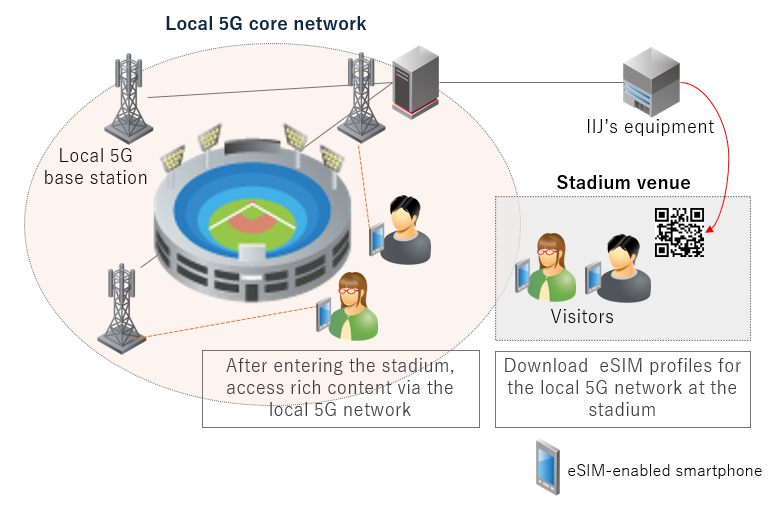
Event venues and stadiums can stream dedicated content across controlled environments with predictable performance.
The common thread is controlled mobility without public network dependency.
Pricing That Signals Accessibility
The pricing structure is relatively transparent.
The fee for eSIM profile issuance and basic handling is JPY100,000. Each profile issuance is JPY5,000, with no monthly use charges. The profile issuance price varies with the number issued.
The absence of monthly recurring fees suggests a model oriented toward infrastructure enablement rather than ongoing subscription monetization.
For small-scale deployments, the economics are dramatically different from building an in-house GSMA-certified SM-DP+ environment.
IIJ’s Position in the Japanese Connectivity Landscape
Founded in 1992, IIJ has long been a backbone player in Japan’s internet ecosystem. It operates one of the country’s largest internet backbone networks, connected to the United States, the United Kingdom, and across Asia. Listed on the Prime Market of the Tokyo Stock Exchange since 2022, IIJ primarily serves high-end corporate customers with internet connectivity, systems integration, cloud, security, and mobile services.
This move into simplified local 5G eSIM provisioning is consistent with its positioning: infrastructure-first, enterprise-oriented, standards-aligned.
Market Context and Broader Trends
Globally, private and local 5G deployments are expanding, particularly in manufacturing and logistics. Research firms such as IDC and GSMA Intelligence have repeatedly highlighted industrial 5G as one of the most commercially viable early 5G verticals.
However, provisioning and lifecycle management remain bottlenecks.
Many vendors focus on radio access and core network deployment. Fewer simplify the subscription management layer.
By leveraging Thales Group infrastructure rather than building a fully proprietary stack, IIJ is aligning with a broader market trend: platformizing complexity instead of reproducing it.
In Europe, several players are experimenting with managed private 5G models. In the United States, hyperscalers and system integrators are entering the space. The difference here is granularity. IIJ is not just enabling private 5G at scale. It is enabling it at micro-scale.
That distinction matters.
Conclusion
Local 5G has often been framed as an infrastructure story: spectrum allocation, radio coverage, edge computing. But this announcement reminds us that identity and provisioning are just as critical.
By enabling single-profile eSIM issuance for local 5G, IIJ is effectively lowering the experimentation threshold. Factories can test. Universities can prototype. Municipalities can pilot. Without building their own certified subscription management environment.
In a market where device manufacturers are removing physical SIM slots and 5G standalone security requirements are tightening, this move is less about convenience and more about inevitability.
Compared to other players in the private 5G ecosystem who still assume scale as a prerequisite, IIJ’s approach acknowledges a new reality: adoption often begins small.
If local 5G is to move beyond flagship deployments and into everyday operational environments, provisioning must become as flexible as the networks themselves.
This is not a headline-grabbing consumer story. It is something quieter.
But in infrastructure markets, the quiet changes are often the ones that reshape everything.