iBASIS Acquires Telstra Wholesale Contracts: Industry Impact
The global wholesale telecom market rarely makes headlines outside industry circles. Yet this week’s announcement from iBASIS and Telstra International is more than just another asset transfer. It is a signal.
iBASIS confirmed it will complete the acquisition of Telstra International’s wholesale voice, mobile, and messaging customer contracts on Friday, February 27, after securing all necessary regulatory approvals. On paper, this is a contract acquisition. In reality, it reshapes positioning in a wholesale landscape that is under pressure to modernize, consolidate, and scale.
For Alertify readers who follow the evolution of global connectivity, this move fits into a broader pattern: infrastructure players doubling down on operational control while digital players demand higher performance and tighter integration.
What Exactly Is Changing?
The transaction centers on Telstra International’s wholesale voice, mobile, and messaging customer contracts. That means iBASIS is absorbing not just traffic, but relationships, regional expertise, and long-standing commercial frameworks across Asia Pacific and beyond.
Patrick George, CEO of iBASIS, framed the deal clearly:
“We are very pleased to welcome Telstra International’s wholesale business and team into the iBASIS family,” said Patrick George, CEO of iBASIS. “Their deep expertise and regional knowledge will be a valuable asset in serving our customers and partners worldwide. Together, we are shaping the future of wholesale communications by combining global reach, cutting-edge technology, and a customer-first approach. Starting this Friday, we will start phase one of migration activities, focusing on delivering high end quality and reliability.”
The emphasis on “high end quality and reliability” is not accidental. Wholesale voice and messaging may seem commoditized, but performance, routing optimization, fraud control, and quality assurance remain decisive factors in B2B telecom relationships.
From Telstra International’s side, the tone is about continuity and performance:
“The completion of this transaction will ensure continuity and quality for our international wholesale voice and Retail customers, while maintaining quality outcomes across the Retail and mobility services. We look forward to our partnership with iBASIS in the coming years to drive quality, performance and new services,” said Roary Stasko, CEO of Telstra International.
In other words, this is structured as a transition, not a disruption.
Migration Without Friction
Wholesale transitions are complex. They involve signaling systems, interconnect agreements, routing tables, billing structures, fraud management layers, and service-level guarantees. Even minor misalignments can cascade into quality degradation or financial disputes.
iBASIS has stated it will work closely with Telstra International during the migration process, continuing service delivery under agreed transition arrangements to ensure continuity. Dedicated account representatives are being assigned to support onboarding.
This matters. In wholesale, trust is operational. Carriers do not tolerate uncertainty in traffic flow or settlement accuracy. A poorly handled migration can result in traffic rerouting, contract termination, or reputational damage.
By emphasizing phased migration and close collaboration, iBASIS is signaling maturity and confidence in execution.

Why This Deal Makes Strategic Sense
iBASIS positions itself as a leading communications solutions provider for operators and digital players worldwide. It describes itself as the first independent wholesale communications specialist and a Tier One IPX vendor. The company serves more than 1,000 customers across 33 locations.
Telstra International, as the global arm of Telstra, has long been a major connectivity force in Asia Pacific. Its wholesale relationships in the region are particularly valuable.
The strategic logic is clear:
- Geographic depth in Asia Pacific strengthens iBASIS’ global routing portfolio.
- Customer base expansion increases scale and bargaining power.
- Operational synergies can improve margin efficiency in voice and messaging traffic.
- Brand positioning reinforces iBASIS as a consolidator in wholesale markets.
In a market where margins are tightening and regulatory compliance is intensifying, scale and efficiency are no longer optional. They are survival strategies.
The Bigger Picture: Consolidation in Wholesale
This transaction is part of a wider industry trend. Over the past few years, the wholesale telecom segment has seen increased consolidation and repositioning. Traditional voice revenues have been declining globally, according to data from the International Telecommunication Union, while messaging and IP-based interconnect services are becoming more integrated into broader digital ecosystems.
At the same time, messaging monetization, fraud prevention, A2P traffic management, and IPX services are gaining importance. Operators are no longer looking for standalone voice transit. They want integrated platforms that combine:
- Voice and messaging routing
- IPX services
- Roaming enablement
- Security and fraud mitigation
- Analytics and performance optimization
iBASIS has been actively repositioning itself in this direction. Absorbing Telstra International’s wholesale contracts strengthens that trajectory.
We are also seeing similar consolidation logic across other global players. Wholesale divisions are being spun off, merged, or integrated into larger ecosystems to unlock efficiency and refocus strategic priorities. The market is gradually shifting from volume-driven wholesale to platform-driven wholesale.
MWC 2026: Signaling Ambition
iBASIS will participate in Mobile World Congress 2026, March 2–5, in Meeting Room 2A11, Hall 2. Senior executives will be available to discuss the strategic impact of the deal and the integration.
That timing is deliberate. Announcing completion just days before MWC ensures maximum visibility among operators, MVNOs, digital players, and infrastructure vendors.
MWC is not just a trade show. It is where positioning narratives are reinforced. By entering Barcelona with this acquisition finalized, iBASIS is effectively saying: we are not just a transit provider, we are a consolidating force in wholesale transformation.
Wholesale Is Not Boring Infrastructure
For those of us tracking travel connectivity, roaming economics, and the evolution of programmable networks, wholesale matters more than ever.
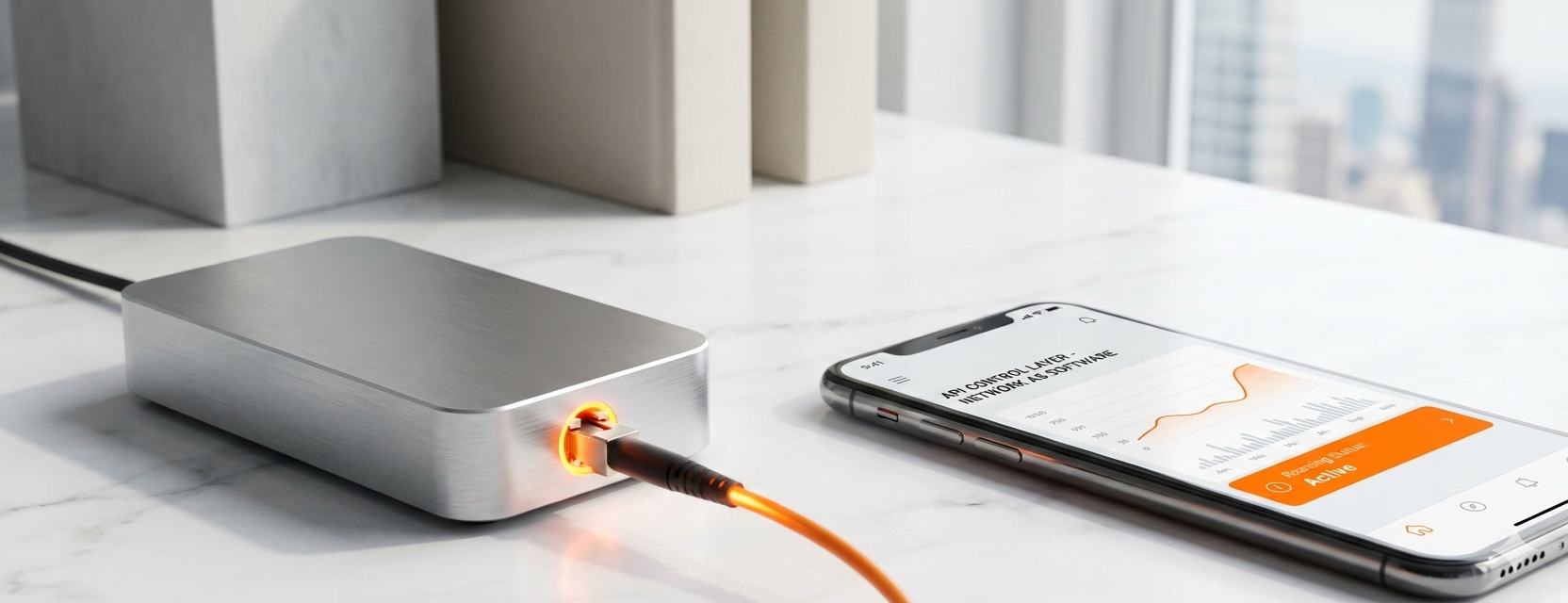
Every travel eSIM, every roaming agreement, every A2P authentication message ultimately depends on wholesale routing layers. When those layers become more integrated, resilient, and performance-driven, the downstream effects reach consumers and enterprises alike.
In the era of API-based connectivity, IoT orchestration, and real-time global communications, the wholesale backbone is becoming a strategic asset rather than a background function.
What This Means for the Market
This deal suggests three clear trends:
First, wholesale specialization is gaining value. Independent players with focused expertise can compete effectively against integrated incumbents.
Second, the Asia Pacific remains a critical region for growth and interconnect strategy. Control and partnerships in that region are strategic levers.
Third, customer experience in wholesale is no longer just about price per minute or per message. It is about quality assurance, fraud resilience, and operational continuity.
The market is gradually moving from commoditized traffic exchange to managed performance ecosystems.
Conclusion: A Consolidation Move with Structural Implications
This acquisition is not a flashy headline. It does not introduce a new device or consumer app. But it reflects a deeper structural shift in global telecom.
As voice volumes decline and digital traffic models become more complex, wholesale providers must evolve into integrated connectivity platforms. iBASIS’ move to absorb Telstra International’s wholesale contracts strengthens its scale, regional expertise, and competitive positioning at a time when consolidation is accelerating.
Compared with other market players that are either retreating from wholesale or rebalancing portfolios, iBASIS appears to be leaning in. That is a strategic bet on the idea that global connectivity infrastructure still matters and that controlling it more tightly is a long-term advantage.
According to multiple industry analyses and ITU reporting, the future of telecom revenue growth lies in data, messaging, IoT, and integrated digital services. Wholesale players that can align with that reality will remain relevant. Those that remain purely volume-driven may struggle.
For Alertify readers, the message is clear. Behind every seamless roaming experience or enterprise connectivity solution, there is a wholesale layer quietly consolidating, optimizing, and transforming.
And this week, that layer just shifted again.