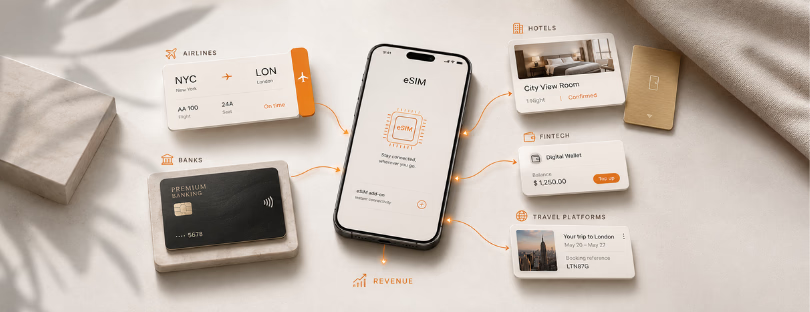
How Neobanks Are Disrupting the eSIM Market
For most of the eSIM industry’s short history, the competitive map was pretty straightforward. Providers fought over app store rankings, affiliate commissions, and Google’s first-page results. Distribution was a retail problem.
That’s changing — and the change isn’t coming from within the industry.
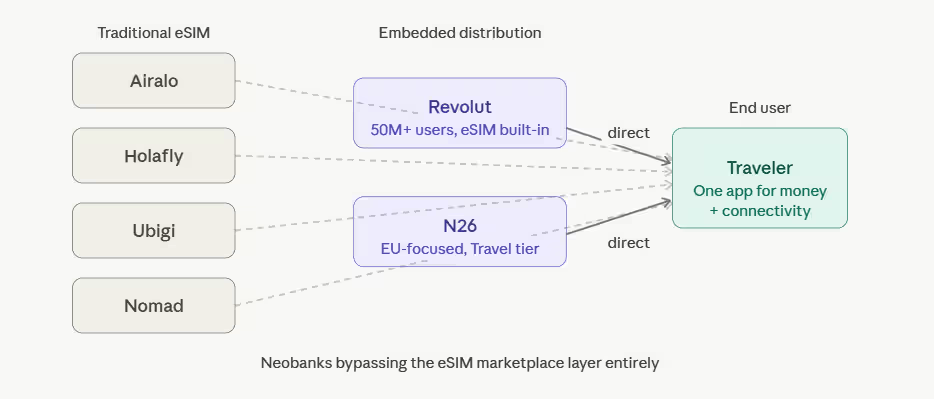
Revolut quietly rolled out eSIM functionality to its user base. N26 has been deepening its travel tier, bundling features that make it the obvious companion app for anyone crossing a border. Neither company is marketing itself as a connectivity provider. They don’t have to. When 50 million people open a single app to book travel insurance, exchange currency, and now activate data, the eSIM selection happens before the traveler even thinks to Google “best eSIM for Europe.”
That’s the competitive threat that should be keeping eSIM executives up at night.
The distribution war is the real war
The eSIM providers who’ve built strong consumer brands — Airalo, Holafly, Nomad, Ubigi — have done so by mastering D2C digital marketing. SEO, influencer partnerships, comparison site placements, targeted social. The whole playbook is optimized for capturing travelers at the moment of intent: someone searching for a data plan before a trip.
Neobanks play a completely different game. They don’t wait for intent. They’re already inside the app the traveler uses to pay for their Airbnb. They’re the currency conversion widget that pops up the moment a user’s location shifts to a new country. The eSIM nudge lands in that context — not against a competitor ad, but after a frictionless transaction that already built trust.
Revolut’s advantage here is structural, not just scale. The moment they position eSIM activation as a one-tap add-on during trip prep — between booking currency and setting travel notifications — the conversion funnel collapses to nearly nothing. No comparison shopping. No affiliate clicks. Just a tap.
N26 is playing a similar game, though with a more deliberate pace. Its travel-tier proposition targets the frequent traveler and
digital nomad segment that built the early eSIM market in the first place. These users are already primed to spend on premium connectivity. Wrapping it inside a premium banking tier isn’t a hard sell — it’s a logical extension.
What this does to pricing power
One underappreciated consequence: neobank distribution erodes the pricing transparency that eSIM comparison platforms have spent years building.
When a traveler lands on Alertify or any aggregator, they see multiple providers side-by-side. They can compare per-GB rates, coverage maps, and data caps. The market becomes legible. Providers compete.
That transparency disappears inside a banking app. There’s no comparison layer. Revolut’s eSIM offering is the offering. Whether the underlying rate is competitive with Airalo or not is irrelevant — the traveler never looks.
This matters for the broader market. If the dominant acquisition channel for the next generation of eSIM users is embedded in fintech, the comparison economy that sustains aggregators and independent media gets structurally smaller. The question isn’t whether Revolut’s eSIM is better. The question is whether the traveler ever bothers to check.
Who’s actually threatened here?
Not every eSIM provider faces the same exposure. Heavy D2C brands — particularly those built on Google traffic and price-comparison placements — are most vulnerable. Their entire moat is built on being found. If the finding stops happening, the moat disappears.
Providers who’ve gone deeper into B2B2C are in a stronger position. Ubigi has been methodical about enterprise and IoT distribution. Yesim has built an API infrastructure that makes it embeddable rather than just discoverable. These aren’t coincidentally safer plays — they’re structurally different bets on who controls the customer relationship.
There’s also a regional dimension. N26’s strength is overwhelmingly European. Its travel product naturally skews toward intra-EU mobility and frequent cross-border commuters. For providers with deep EU coverage and data throttling issues — Holafly’s unlimited model has faced criticism on this front — the N26 user base represents a specific cohort that demands reliability over novelty.
Revolut, by contrast, is genuinely global in ambition. Its user base spans the UK, continental Europe, and growing markets in Southeast Asia and Latin America. An eSIM rollout at Revolut scale isn’t a niche channel — it’s a mass distribution event.
The deeper play
Here’s what makes this particularly interesting from a market structure standpoint: Revolut and N26 aren’t building eSIM businesses. They’re building lifestyle infrastructure for the globally mobile person. eSIM is a feature, not a product. Travel insurance is a feature. Currency exchange is a feature. The goal is to make leaving your home country feel native to a single app.
That bundling logic is exactly what makes them formidable. eSIM providers compete on connectivity. Neobanks compete on presence — being the app you’re already in when the travel decision gets made.
The eSIM providers who navigate this well will be the ones who either get embedded (landing inside the fintech app as the infrastructure layer, invisible to the end user), or differentiate so clearly on product that comparison still matters. Annual subscription models like Fairplay’s, heavy-user pricing ladders, and Stop features that actually serve real nomad behavior — these are the kinds of differentiators that survive in a world where distribution gets increasingly captured.
The providers who sit in the middle — decent product, solid marketing, no moat — are the ones who should be watching Revolut’s roadmap closely.
The distribution war has started. It just doesn’t look like war yet.