Halal Travel Moves From Niche to Mainstream
Halal travel used to be treated like a niche. A quiet corner of tourism where the conversation was mostly about finding halal food, checking whether a hotel had prayer mats, and hoping the destination understood basic Muslim traveler needs.
That view now feels dated.
Halal travel has become one of the more serious growth stories in global tourism, not because every traveler wants the same kind of “Islamic holiday,” but because millions of Muslim travelers are asking for something very practical: travel that does not force them to compromise. According to the 2025 Mastercard-CrescentRating Global Muslim Travel Index, international Muslim arrivals reached 176 million in 2024, up 25% from 2023, and are projected to reach 245 million by 2030. Total travel spending is expected to hit about $230 billion by then.
That is not a niche. That is a market segment big enough to reshape how destinations, hotels, airports, booking platforms, and travel tech companies think.
More than halal food
The mistake many tourism brands still make is reducing halal travel to food. Yes, halal dining matters. It matters a lot. But the modern Muslim traveler is not simply asking, “Where can I eat?”
They are asking better questions.
Can I find prayer facilities without wasting half a day? Can I book a hotel where alcohol is not pushed into every part of the experience? Can I take my family somewhere that feels comfortable, safe, and respectful? Can I use an app that filters the right options without making me dig through 40 irrelevant results?
This is where halal travel becomes less about religion as a label and more about travel design. It is about removing friction.
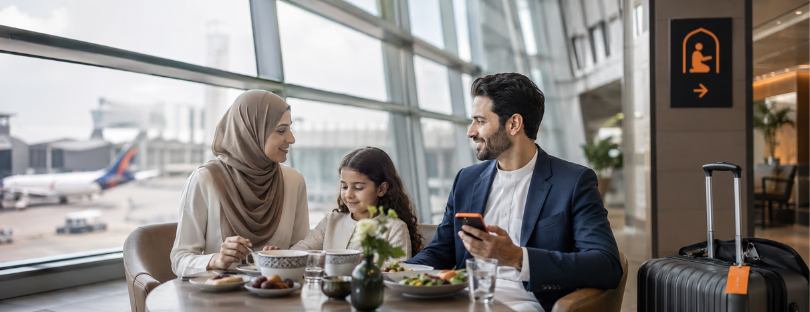
A Muslim family landing in Bangkok, Istanbul, London, Kuala Lumpur, or Dubai does not want a tourism brochure full of vague “welcoming destination” language. They want usable details. Halal restaurants near the hotel. Nearby mosques. Female-friendly wellness options. Family privacy. Transparent hotel policies. Reliable transport. Connectivity that works the moment they land.
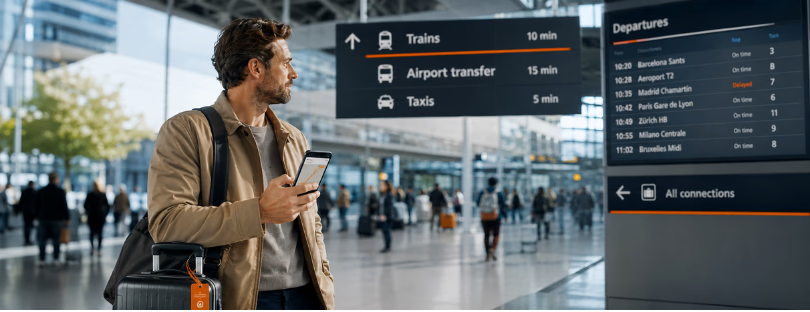
And yes, that last part matters more than many travel companies admit. A traveler searching for halal food, prayer times, Qibla direction, ride-hailing, hotel check-in details, translation, and family coordination needs mobile data. Halal travel today is deeply connected to digital travel behavior. Without connectivity, the “Muslim-friendly” experience quickly becomes a guessing game.
Destinations are competing now
The most interesting shift is that countries are no longer waiting passively for Muslim travelers to arrive. They are designing for them.
Malaysia remains one of the clearest examples. In the 2025 GMTI, Malaysia ranked first out of 153 destinations, with strengths including halal dining availability, prayer facilities, Muslim-friendly accommodation, and a safe, welcoming environment. That is not accidental. It is strategy.
Singapore, Türkiye, Indonesia, the UAE, Saudi Arabia, and Qatar have also built strong positions around Muslim-friendly infrastructure, airport experience, family tourism, and food confidence. But what is more interesting is the movement outside traditionally obvious destinations. Places like Thailand, Hong Kong, Germany, Japan, South Korea, and parts of Europe are starting to understand that halal travel is not only about attracting Gulf tourists. It is about serving a diverse global Muslim population from Southeast Asia, Europe, Africa, the Middle East, and North America.
CrescentRating has highlighted destinations such as Hong Kong, Thailand, Germany, and Macao as markets paying more attention to Muslim-friendly services. That tells us something important: halal travel is becoming a competitiveness issue. If two cities offer similar attractions, but one makes Muslim travelers feel understood and the other makes them do all the research alone, the choice becomes easy.
The new halal traveler
Another outdated assumption is that halal travel is only about large families or religious group tours. That segment still exists, of course, but the market is broader now.
There are solo Muslim travelers. Muslim women traveling independently. Digital nomads. Business travelers. Gen Z travelers who want faith-compatible experiences but still expect design, convenience, good coffee, fast Wi-Fi, and strong social content. There are luxury travelers looking for private villas and wellness retreats. There are budget travelers who simply want affordable, respectful options without awkward surprises.
This is why the travel industry needs to be careful. Muslim travelers are not one single persona. A Malaysian student on a city break, a Saudi family in London, a British Muslim couple in Japan, and an Indonesian executive attending a conference in Barcelona do not all want the same product.
What they share is not identical taste. What they share is the need for confidence.
That is the real product in halal travel: confidence before booking, confidence after arrival, and confidence when plans change.
Where travel tech fits
This is where Alertify readers should pay attention. Halal travel is not only a destination marketing story. It is a travel tech story.
The next layer of growth will come from better filtering, better maps, better verified data, better hotel attributes, better payment flows, and better mobile-first travel support. Booking platforms that allow travelers to search by halal food proximity, prayer facilities, women-friendly amenities, family privacy, alcohol-free environments, and verified reviews will have an advantage.
Specialist platforms already understand this. HalalBooking, for example, has positioned itself around accommodation discovery for Muslim travelers and reported strong 2025 sales momentum, including record booking days and year-on-year growth in gross booking value. That does not mean every traveler will use a specialist platform forever. But it does prove there is demand for curation, not just inventory.
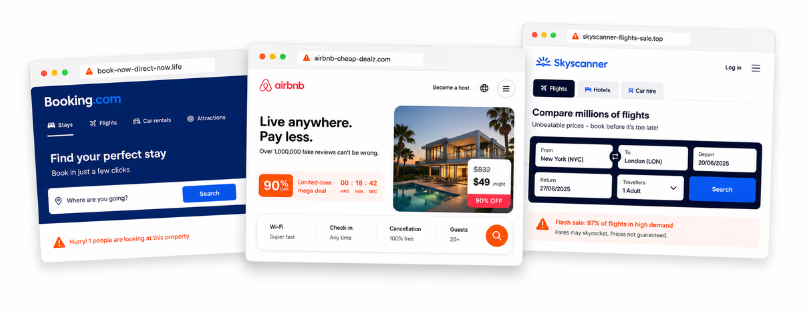
Mainstream OTAs still have a gap here. They have scale, but often lack nuance. A hotel may be “family-friendly,” but that does not tell a Muslim traveler whether halal breakfast is available, whether nearby halal restaurants are real or outdated, or whether the wellness area matches their expectations. Generic filters are not enough.
The opportunity is obvious: whoever structures this information properly can win trust.
Final boarding thought
Halal travel is entering the same phase that sustainable travel entered a few years ago. The industry first treated it as a label, then as a marketing angle, and finally as an operational requirement.
The winners will not be the brands that simply write “Muslim-friendly” on a landing page. The winners will be the ones that prove it in the details: verified halal food, clean booking filters, staff training, prayer access, family comfort, transparent hotel policies, and mobile tools that reduce uncertainty.
Compared with mass-market travel platforms, specialist halal travel companies understand the emotional side better. Compared with many niche players, large OTAs and hotel groups have the distribution power to scale it. The interesting middle ground is where this market is heading: mainstream travel infrastructure with Muslim traveler intelligence built in.
That is why halal travel matters beyond one audience segment. It shows where tourism is going generally. Travelers no longer want to adapt themselves to generic products. They expect the product to understand them first.