Flights to China: Routes, Prices and Trends
Flights to China are no longer the strange, limited, post-pandemic proposition they were a couple of years ago. Airlines are adding capacity, visa rules are friendlier, and China is trying to make itself easier to reach again.
But this is not a simple “China travel is back” story.
The market has returned with complications baked in: longer flight paths for some European carriers, uneven competition between Chinese and Western airlines, cautious corporate travel budgets, and travellers who now check more than the ticket price. Flying to China is less about finding any available seat and more about understanding which route, airline and arrival city actually makes sense.
Direct is not always simple
For travellers in Europe, the network looks uneven. Chinese carriers have been rebuilding aggressively across the continent, with routes into Beijing, Shanghai, Guangzhou, Shenzhen and Chengdu. European airlines are also restoring China links, but more carefully.
One reason is Russian airspace. Many European airlines still avoid it, which can make flights to China longer, more expensive to operate, and harder to price competitively. Chinese carriers, in many cases, can still use more direct northern routings. For passengers, the difference may appear as a shorter journey time, a lower fare, or simply more schedule options.
That does not automatically make the Chinese carrier the better choice. Service style, loyalty benefits, transit experience, seat comfort, refund terms and language support still matter. A business traveller loyal to Lufthansa, Air France-KLM or British Airways may accept a longer route if the schedule and corporate policy fit better.
China wants easier arrivals
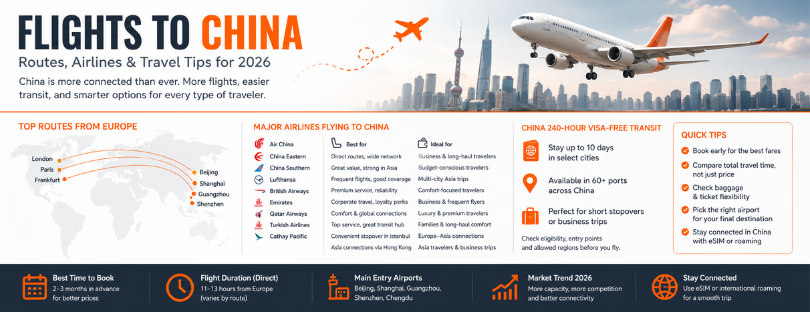
The other big change is policy. China’s expanded 240-hour visa-free transit rules have made short stays more attractive for eligible travellers, especially those connecting to a third country or region. China is not only selling itself as a destination again. It is trying to become a smoother transit and business-travel corridor.
This helps airlines because more flexible entry rules make routes easier to sell. A traveller flying from Europe to Japan, South Korea, Thailand or Australia may now look at Shanghai, Beijing or Guangzhou differently. Instead of treating the China connection as a hassle, they may see it as a useful city break.
Still, this is not for everyone. Visa-free transit rules are specific, and travellers need to check eligible nationalities, ports, onward tickets and permitted regions before booking. Anyone with a tight business schedule, unusual routing or separate tickets should be careful. China is easier than before, but it is not yet frictionless.
What travellers should compare
The smart way to book flights to China in 2026 is to compare the whole journey, not just the fare.
Check the route time honestly. A cheaper flight may land at an awkward hour, require a domestic transfer, or arrive at an airport that is not ideal for the final destination. Shanghai Pudong is useful for international connections, but Hongqiao may be better for domestic business travel. Beijing Daxing and Beijing Capital serve different airline networks. Guangzhou works well for southern China and onward Asia.
READ MORE: Cheap Flights to China Are Back, But Choose Wisely
Look at baggage and ticket flexibility too. China trips often involve trade fairs, supplier visits or multi-city itineraries. A rigid cheap fare can become expensive fast if plans change.
And do not ignore digital basics. Accessing maps, translation apps, messaging, payments and work tools can be just as important as the flight itself. A reliable roaming setup, travel eSIM or local connectivity plan should be arranged before departure, not after landing tired at 6 a.m.
Airlines are chasing different travellers
The flight market to China is splitting into several lanes.
Chinese airlines are strong on capacity, direct access and price competitiveness. Gulf carriers such as Emirates, Qatar Airways and Etihad remain useful for travellers who prefer one-stop journeys through polished hubs, especially from cities without direct China flights. Turkish Airlines is also a serious alternative because Istanbul works well as a bridge between Europe and Asia.
European flag carriers face cost pressure, but they still matter for corporate travel, loyalty programmes and premium passengers who value consistency. Cathay Pacific is worth watching too, especially for travellers who want Hong Kong as a gateway into mainland China.
What could improve is transparency. Travellers need clearer explanations of routing, flight time differences, aircraft type, baggage rules, refund limits and connectivity on arrival. Airlines sell “China” as if the destination were one simple market. It is not. Shenzhen, Xi’an, Qingdao and Hangzhou each create a different trip.
The real signal
Flights to China are not just returning. They are being rebuilt around a more competitive, fragmented travel market.
The winners will not simply be the airlines with the most seats. They will be the ones that remove uncertainty: fair pricing, logical schedules, clear rules, better transfers and fewer surprises after landing. Chinese carriers currently have a structural advantage on many Europe-China routes, but Gulf, Turkish and selected European airlines still have strong roles depending on the traveller profile.
For Alertify readers, the bigger message is familiar: travel is becoming a stack of small decisions. The flight is one layer. Entry rules are another. Airport choice, app access, payments, roaming and eSIM connectivity all shape the real experience.
China is easier to reach than it was. But the best trip is still the one planned with a little more intelligence than the booking engine gives you.