
Cheap Flights to China Are Back, But Choose Wisely
Cheap flights to China are back on travellers’ radar, but “cheap” needs context in 2026. This is not the old market where you waited for a flash sale, grabbed a bargain to Beijing or Shanghai, and assumed the rest would work itself out.
China is easier to visit again, airline capacity is rebuilding, and fare comparison sites are showing attractive entry prices. Skyscanner has recently shown UK return fares to China from around the low £400s, with Guangzhou often appearing as one of the cheaper arrival points. KAYAK’s UK data points to November as one of the cheaper months, while July, August, and December remain more expensive.
That sounds promising. And it is. But cheap flights to China are rarely just about the headline fare.
The China fare puzzle
The Europe-China flight market still has a strange shape. Chinese carriers have been rebuilding long-haul capacity aggressively, while several European airlines remain more cautious because of longer routings, higher operating costs, and Russian airspace restrictions. OAG has been tracking a broad return of international routes for summer 2026, but recovery does not mean every airline is competing on equal terms.
For travellers, this creates an unusual situation. A Chinese airline may offer a very competitive fare from a European hub, while a European carrier on a similar route may price higher because its aircraft takes a longer path. That does not automatically make one better. It means the cheapest option might involve a different airline, airport, layover pattern, or arrival city than expected.
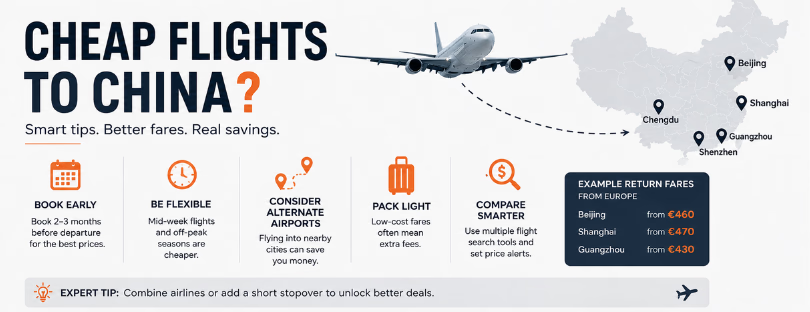
This is where China gets interesting. Beijing and Shanghai still dominate the imagination, but Guangzhou, Shenzhen, Chengdu, Xiamen, and Hangzhou can sometimes unlock better value, especially if your trip includes domestic rail or a second city.
Where cheap actually hides
The smartest searches start with flexibility. Not endless flexibility, because real people have jobs, school holidays, meetings, and visa timing to think about. But a few small moves can change the price.
A traveller from Zagreb, for instance, should not only search Zagreb to Shanghai. It is worth checking Vienna, Venice, Budapest, and even Milan if the saving is large enough to justify the positioning trip.
READ MORE: Flights to China: Routes, Prices and Trends
Still, that extra leg has to be honest economics. A cheaper ticket is not really cheaper if it adds a hotel night, airport transfer, luggage fees, and a stressful early bus. The best fare is not always the lowest fare. It is the fare that still makes sense after the boring costs are added.
Timing matters
There is no magic Tuesday. What works is watching prices early and moving when the fare is clearly good for your route.
For China, shoulder months tend to be more forgiving than peak summer and major holiday periods. Late autumn can be attractive from Europe. February can be cheaper from some US markets, but Chinese New Year can complicate that depending on the dates.
Fare alerts are useful because they stop you from relying on memory. Google Flights, Skyscanner, KAYAK, Momondo, and Hopper all have their strengths. Skyscanner is good for broad discovery. Google Flights is fast for calendar scanning. KAYAK has useful trend tools. Momondo can surface combinations others miss.
None of them should be treated as gospel. Prices move, baggage rules differ, and some third-party booking sites make support painful when flights change. For a simple city break, that may be acceptable. For a business trip or once-a-year family journey, booking directly with the airline after finding the fare can be calmer.
Cheap is not always comfortable
A cheaper China ticket often comes with compromises: long layovers, overnight connections, split tickets, basic baggage allowance, or airports far from the city centre. That may be fine for a solo traveller with cabin luggage and patience. It is less attractive for families, older travellers, or anyone arriving with meetings the next morning.
Also check what happens after landing. China’s high-speed rail network makes secondary airports more practical than in many countries, but not every “nearby” city is convenient. Guangzhou can work beautifully for southern China. Chengdu makes sense for western China. Beijing Daxing and Beijing Capital are not interchangeable if time is tight.
Travellers should also plan payments, maps, translation, messaging access, and mobile data before departure. China is not difficult to travel in, but it rewards preparation. A cheap fare loses some charm if your first hour is spent hunting for connectivity at the airport.
Final boarding call
Cheap flights to China are real again, but they are not evenly distributed. The winners will be travellers who search like editors, not bargain hunters: compare routes, question the layover, check the airport, read the fare rules, and think about the whole journey.
Compared with Japan, Thailand, or Vietnam, China can sometimes look less obvious as a leisure choice, partly because planning feels more technical. But that is also where the opportunity sits. As airlines rebuild China capacity and visa rules become more visitor-friendly, the destination is moving from “complicated comeback” to serious value contender.
The best alternative may not be another country. It may be another Chinese gateway. Beijing for politics and history, Shanghai for business and style, Guangzhou for price and southern access, Chengdu for food and western China. Cheap, in this market, is not one fare. It is choosing the route that fits the trip.