At What Point Does an eSIM Subscription Make Financial Sense?
There is a very specific type of traveler the eSIM market has never fully understood. eSIM subscription vs prepaid
Not the tourist landing in Rome for four days. Not the weekend city breaker. The real test case has always been the person who moves. The one who lands in Lisbon stays three weeks, jumps to Dubai, then spends a month somewhere in Southeast Asia without ever really “starting fresh.”
For that traveler, the biggest problem has never been price alone. It is friction. Constant resets. Buying new plans. Watching data expire at the wrong moment. Managing five different eSIMs is like opening browser tabs.
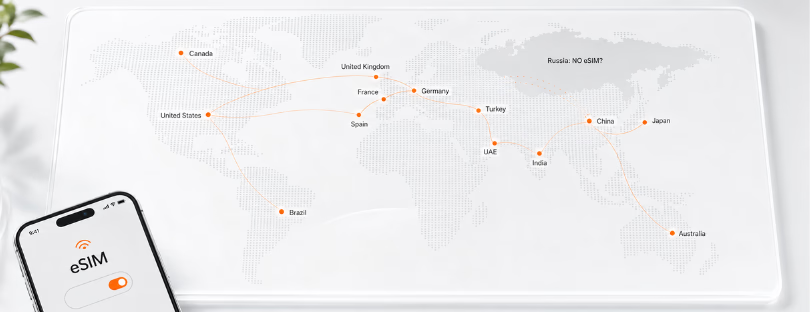
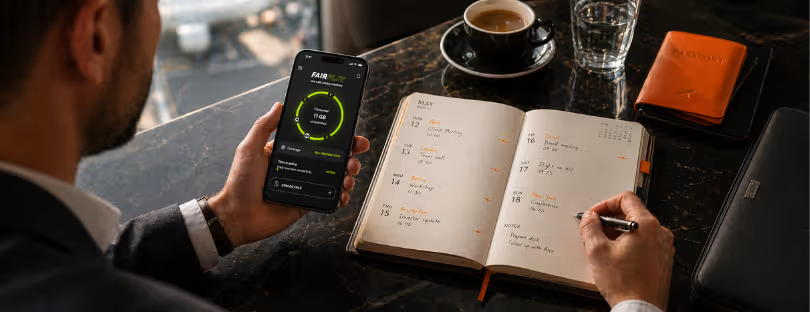
That is the context in which Fairplay is pushing a much cleaner idea: one eSIM, coverage in 185+ destinations, and a single balance that follows you.
No setup loops. No country switching logic. No bundles quietly expiring while you are on a flight.
On paper, it sounds like what the category should have built years ago.
The real question is whether it actually solves the problem or just repackages it.
What “one eSIM” actually changes
Most gIobal eSIM providers already claim broad coverage. That is not new.
What is different here is not the footprint, but the experience layer.
With Fairplay, the structure is intentionally simple:
You install once. You keep the same eSIM across countries. You manage one balance instead of buying separate plans. You add data when needed, not when geography forces you to.
That sounds obvious, but it is not how most of the market operates.
Typical flow today looks like this:
You land in Spain, buy a Spain plan.
You travel to France, buy a new plan.
You forgot you still have 1.2 GB left in Spain.
You repeat the same process in Turkey.
Multiply that across a three-month trip, and the inefficiency becomes real. Not just financially, but cognitively.
Fairplay removes that layer entirely. The traveler stops thinking in borders. Connectivity becomes continuous rather than segmented.
That shift matters more than most pricing debates.
The heavy user angle
Where this becomes more interesting is with heavy usage.
Fairplay’s model is built around a subscription base:
6, 12, or 24 months
€35, €30, or €25 monthly base
Each plan includes 5 GB
Additional 15 GB blocks cost €20
And then the key mechanic kicks in. After multiple top-ups, users reach a monthly cost ceiling that effectively unlocks true unlimited usage without throttling.
This is where the positioning diverges sharply from competitors.
Most “unlimited” plans in the travel eSIM market are not truly unlimited. They slow down after a threshold. Sometimes aggressively. Sometimes quietly.
Fairplay is making a different bet. Instead of selling the word unlimited, they are building a predictable path to it.
For a digital nomad running 40 to 80 GB per month, that predictability matters more than the initial headline price.
It also changes behavior. You stop micromanaging usage. You stop hunting for WiFi in cafés that should not be trusted. You use your connection like you would at home.
That is a subtle but important shift in user experience.
No setup, but also no reset
Another overlooked benefit is continuity over time.
Most eSIM plans expire. Even global ones. You buy 10 GB for 30 days, and that is it. If you do not use it, it disappears. If you travel less for one month, you lose value.
Fairplay’s approach leans more toward persistence.
Your balance stays. Your usage carries. Your relationship with the product becomes ongoing rather than transactional.
This is closer to how subscription platforms behave. Think Netflix, not prepaid SIM cards.
And for long-term travelers, that model aligns better with reality. Travel is not a single trip. It is a pattern.
Where the model still needs scrutiny
It is not perfect.
The pricing structure is not instantly intuitive. The combination of base subscription, add-on blocks, and cost ceilings requires explanation. That is already a barrier for mainstream adoption.
There is also a behavioral shift required. Travelers are used to comparing plans per destination. This model asks them to think in monthly usage instead.
That transition will not happen overnight.
Then there is the question of edge cases. Short trips, low data users, or occasional travelers may not extract full value from a subscription model. For them, a simple prepaid eSIM from players like Airalo or Nomad still makes more sense.
So this is not a universal solution. It is a targeted one.
How does this compare to the market
If you zoom out, the eSIM market is still largely divided into three camps.
The first is prepaid travel eSIMs. Most well known names. Easy to buy, simple to understand, but inherently fragmented and often inefficient for long-term use.
The second is “unlimited” positioning. Providers promise simplicity, but often rely on throttling policies that degrade experience after certain thresholds.
The third, smaller category is what Fairplay is moving toward. Persistent connectivity with predictable cost structures.
Parallels are emerging elsewhere.
According to reports from GSMA, eSIM adoption is accelerating globally, but usage patterns are diverging. Short-term travel use is growing, but so is demand for always-on, cross-border connectivity tied to remote work and digital mobility.
Data from Statista also shows a steady rise in digital nomad populations and long-duration travel behaviors, particularly post-2023. These users do not fit the prepaid model well.
This is the gap Fairplay is trying to occupy.
Not mass market. Not an occasional traveler. But the high-frequency, high-usage segment that quietly drives a disproportionate share of data consumption.

Where this could go next
If the model works, it will not stay niche for long.
Airlines are already experimenting with connectivity bundles at booking and check-in. Fintech apps are embedding travel features. Enterprise mobility platforms are rethinking roaming entirely.
In all of those cases, the same question appears:
How do you remove friction from cross-border connectivity?
A single, persistent eSIM tied to a balance rather than geography is one of the cleaner answers.
It also opens the door to deeper integrations. Not just selling data, but embedding connectivity into the product experience itself.
That is where this becomes more than a traveler’s tool.
Conclusion
Fairplay is not just offering another global eSIM. It is challenging a structural assumption that the market has relied on for years.
That connectivity should reset every time you cross a border.
For short trips, that assumption still works. For long-term travelers, it breaks down quickly.
What Fairplay is doing is closer to rebuilding the model around continuity. One eSIM, one balance, one relationship that persists across destinations.
Compared to some prepaid players, this reduces fragmentation. Compared to “unlimited” providers, it introduces more transparency and predictability.
It is not the simplest product on day one. It requires a shift in how users think about data. But it is arguably more aligned with how people actually travel today.
The bigger trend supports this direction. As eSIM adoption grows and travel patterns evolve, the market is moving from one-off transactions to ongoing connectivity layers.
The real question is not whether this model works.
It is whether the rest of the industry will follow or continue optimizing for a traveler who no longer exists.