Revolut eSIM: What It Is and If It’s Worth It
There’s something slightly ironic about the way fintech is eating telecom. You open your banking app to check your balance… and suddenly you’re buying mobile data for Japan.
That’s exactly what Revolut has done with its eSIM. No big splashy telecom campaign. No operator branding. Just a feature sitting inside an app millions already use.
And yet, it quietly signals a much bigger shift in how travel connectivity is evolving.
What Revolut eSIM actually is
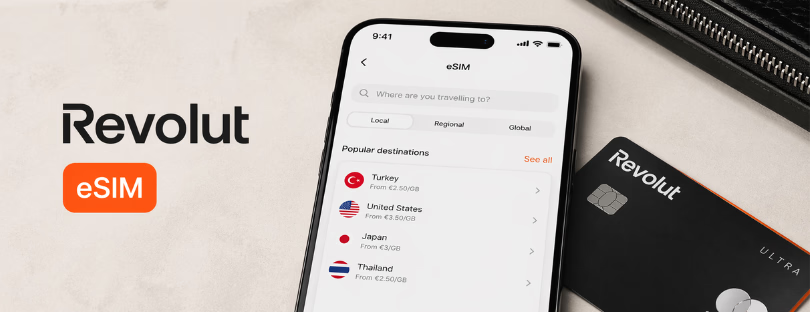
At its core, the Revolut eSIM is a data-only digital SIM embedded directly into your phone, activated inside the app. No physical card, no airport kiosks, no QR code emails from third parties.
You open the app, pick a country or region, choose a plan, and you’re online within minutes.
Technically, it behaves like most travel eSIMs:
- It connects you to local partner networks
- It gives you mobile data (not a phone number)
- It runs alongside your main SIM for calls and SMS
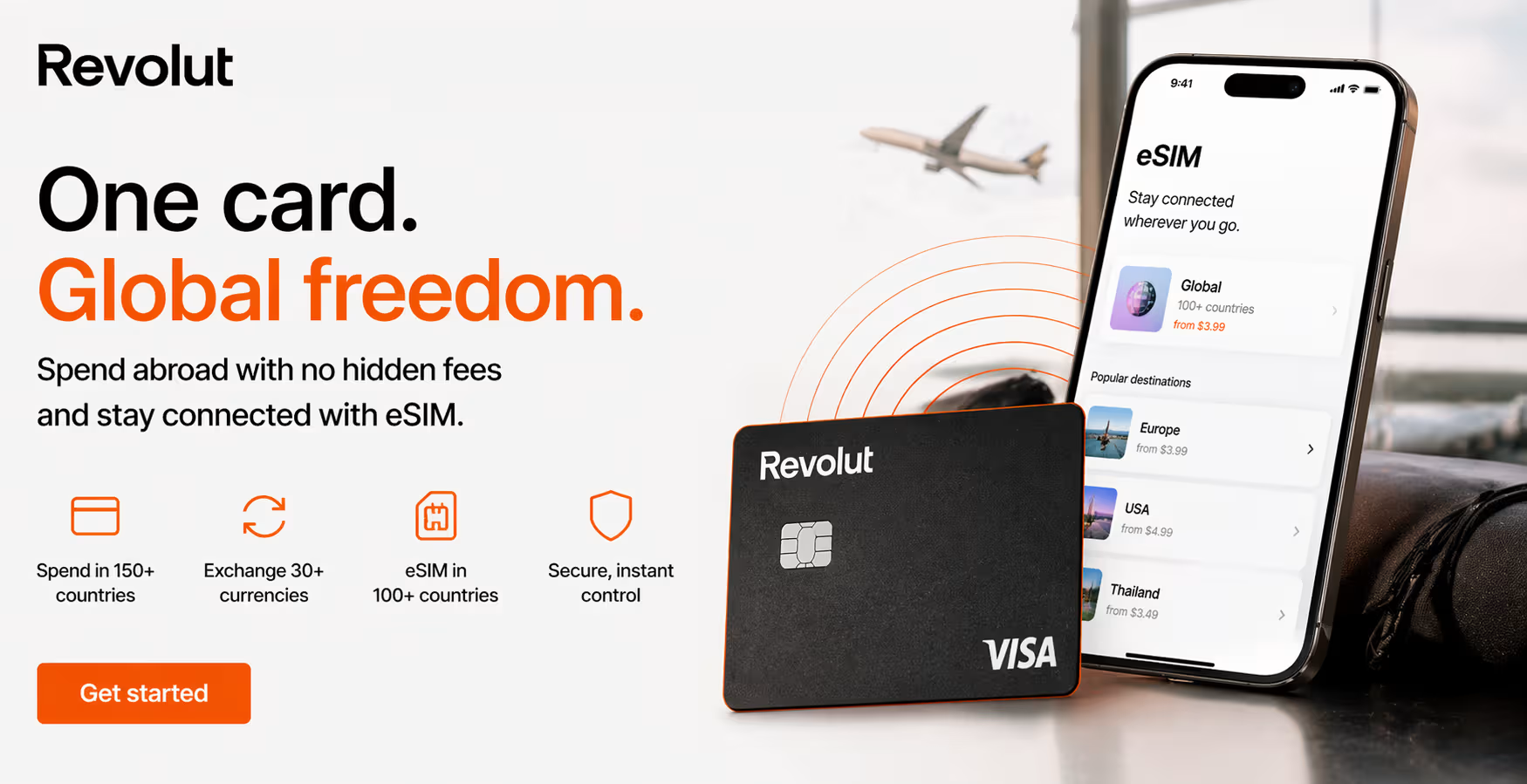
Coverage is broad. Revolut advertises access in 100+ countries, with regional and global plans available. In some integrations, that footprint extends even further through underlying telecom partners.
READ MORE: The Revolut Card: Still the Smartest Travel Money Tool?
Pricing starts low. Entry-level plans can begin around €2–€2.50 per GB, depending on the market. And if you’re on their premium tiers, like Ultra, you even get monthly data included (for example, 3GB globally) .
On paper, nothing revolutionary. In execution, very different.
Why does this feel different from typical eSIMs?
Here’s where it gets interesting.
Most travel eSIM providers still operate like… well, telecom products:
- You download a separate app
- You compare plans
- You manage top-ups somewhere else
Revolut flips that completely.
The eSIM is:
- Already inside an app you trust
- Connected to your payment method
- One tap away from activation
That friction reduction matters more than pricing.
There’s a reason users say things like:
“You can usually get better deals elsewhere but it is very easy to use”
That sentence basically summarizes the entire strategy.
Revolut is not trying to be the cheapest eSIM on the market. It’s trying to be the default one you don’t think about.
The real use case: convenience over optimization
Let’s be honest. If you’re a heavy traveler or someone deep into the eSIM ecosystem, you’re probably still comparing:
- regional vs global plans
- per-GB pricing
- network routing quality
You might go with a specialist provider instead.
READ MORE: Best Travel Fintech for Budget-Conscious Explorers: Curve, Revolut or Crypto.com?
But that’s not who Revolut is targeting.
This is built for:
- Someone landing in a new country with no data
- Someone who forgot to plan connectivity
- Someone who just wants “internet now.”
And in that moment, Revolut wins.
Because instead of:
- Googling “best eSIM Japan”
- downloading 2–3 apps
- comparing coverage
You just tap “Buy data” inside an app you already opened to check your spending.
That’s a completely different behavior pattern.
Where Revolut fits in the eSIM market
Let’s put this into context.
The eSIM space today has three clear layers:
Specialist travel eSIM providers
Players like Airalo, Nomad eSIM, and Yesim dominate here.
They compete on:
- pricing per GB
- destination coverage depth
- niche plans such as unlimited or regional bundles
This is where power users go.
Embedded ecosystem players
This is where Revolut sits, and it may be the most interesting layer.
Connectivity is embedded into:
- payments
- travel spending
- financial behavior
That’s a fundamentally different game. And it’s expanding.
With moves like Revolut Mobile launching in markets like the UK, offering full mobile plans with roaming and even bundled services like VPNs, the company is clearly testing the boundaries of becoming a telecom layer itself .
Limitations you should know
It’s not perfect. And it’s not trying to be.
A few things stand out:
- Data-only: No phone number, no native calls or SMS
- Not always cheapest: Dedicated eSIM providers often undercut pricing
- Limited customization: Fewer advanced options compared to specialist apps
- Device dependency: Only works on eSIM-compatible phones
Also, if you’re planning longer trips or heavy usage, you’ll likely find better value elsewhere.
But again, that’s not the core use case.
A subtle but important shift
The bigger story here isn’t pricing or coverage.
It’s distribution.
Revolut already owns:
- your wallet
- your travel spending
- your currency exchange
Adding connectivity is a natural extension.
READ MORE: Revolut Launches eSIMs in New Zealand to Cut Roaming Fees
And it points to something much bigger happening in the market:
Connectivity is no longer a standalone product.
It’s becoming a feature inside larger platforms.
We’re seeing this with:
- fintech apps
- travel platforms
- even airlines are experimenting with embedded connectivity
The winners won’t just be those with the best data plans.
They’ll be the ones closest to the user’s daily behavior.
Final thoughts
Revolut’s eSIM is not the best eSIM on the market.
And that’s exactly why it’s dangerous.
Because it doesn’t need to be.
It’s fast, frictionless, and already sitting in your pocket. For millions of users, that’s enough to make it the default choice, especially for short trips or last-minute travel.
Meanwhile, specialist providers still lead on pricing, flexibility, and performance. If you care about optimizing every gigabyte or need predictable heavy usage, you’ll likely look elsewhere.
But zoom out, and the trend is clear.
The eSIM market is splitting in two:
- experts optimizing connectivity
- platforms absorbing it
Revolut sits firmly in the second category. And if this model scales, the real competition won’t be between eSIM providers anymore.
It will be between ecosystems.