eSIM in the Gulf: A Different Market, Different Rules
If you’ve traveled across Europe or Southeast Asia with an eSIM, you’ve probably internalized a certain expectation: land, switch on data, everything works. The Middle East doesn’t fully honor that expectation.
Between tight telecom regulation, fragmented network coverage, and restrictions on specific app functions, connectivity in the Gulf is less forgiving and less predictable than travelers are used to. That’s not a criticism of the region — it’s a structural reality that shapes how you should prepare.
Dubai alone crossed 17 million visitors recently. Saudi Arabia‘s Vision 2030 is driving a genuine tourism boom in markets that barely registered on global itineraries five years ago. Infrastructure is growing fast, but user expectations and regulatory frameworks aren’t converging at the same speed. That gap is where most connectivity problems begin.
The VoIP Problem Is Real and Specific
This is the one that catches nearly everyone on their first trip.
In the UAE, VoIP services are restricted at the network level. That means WhatsApp voice and video calls, FaceTime audio and video, and Skype don’t function as expected. Text messaging works fine. Standard cellular calls work fine. But VOIP-dependent calling — which is how most frequent travelers communicate internationally — doesn’t.
This matters differently depending on your trip type. A leisure traveler will find it inconvenient. A business traveler needs to plan around it from day one. You can’t call your hotel, your client, or your team via WhatsApp audio. The workaround is adjusting your communication stack before you arrive: use voice notes and text through WhatsApp, lean on iMessage or Telegram for messaging, and route actual calls through your regular cellular number or a local SIM if call volume is high.
The restriction isn’t applied uniformly everywhere or equally on every network, but counting on exceptions is not a strategy.
Dubai Is Built Around Mobile Data
This isn’t hyperbole. Dubai is one of the most app-dependent urban environments in the world. Careem and Uber have effectively replaced taxis as the default transport. Navigation requires real-time data — the city’s layout doesn’t lend itself to intuitive walking directions. Restaurant bookings, hotel check-ins, boarding passes, and payments all run through apps.
Getting from Dubai International to your accommodation without mobile data is a friction point that can cost you thirty minutes on a bad day. Public Wi-Fi exists, but it’s not the kind of reliable fallback that justifies skipping an eSIM setup.
This is why pre-installed eSIMs have become the default choice for experienced Gulf travelers rather than buying a local SIM on arrival.
Saudi Arabia: Strong in Cities, Variable Everywhere Else
The coverage story in Saudi Arabia is more nuanced than in the UAE.
In Riyadh, Jeddah, and central urban zones, networks perform well, comparable to major European cities. On highways, it’s decent. But Saudi Arabia’s emerging tourism zones are in geographically challenging locations: AlUla‘s archaeological sites, the Red Sea coastal developments, and desert and off-grid experiences are where the network difference between operators becomes noticeable.
If your Saudi itinerary stays urban, coverage won’t be a meaningful differentiator. If it includes remote or emerging tourism zones, the underlying carrier on your eSIM plan can actually matter. Platforms that disclose network affiliation — most serious aggregators do — give you something to work with.
Network Choice in the UAE: When It Actually Matters
The UAE’s telecom market is effectively a duopoly: e& (formerly Etisalat) and du. Both perform well in central Dubai and Abu Dhabi. Beyond those zones, the picture diverges.
e& has historically held stronger coverage in more remote and rural areas. du performs well in dense urban zones. For a standard Dubai city break, this probably doesn’t matter. For cross-emirate travel, a desert safari, or time in less-developed areas, it can.
Most travelers pick an eSIM based on price and plan size without checking which local carrier it rides on. That’s usually fine. But it’s worth knowing the question exists, especially if your itinerary extends beyond the main tourist corridors.

Ramadan: A Connectivity Variable Nobody Warns You About
If your travel overlaps with Ramadan, your connectivity experience changes in ways that are predictable once you know to expect them.
Iftar — the evening breaking of fast — drives a massive, synchronized spike in network usage. Between roughly 6pm and 9pm, speeds drop noticeably as millions of people hit their phones simultaneously. Ride-hailing apps slow down, searches take longer, and anything requiring real-time data becomes less reliable.
The practical adjustment is simple: download offline maps before you travel, book key logistics earlier in the day, and build in more buffer time for app-dependent tasks during peak evening hours. It’s not a dealbreaker, but it’s the kind of thing that surprises travelers who weren’t warned.
Multi-Country Trips: Plan Two Separate Setups
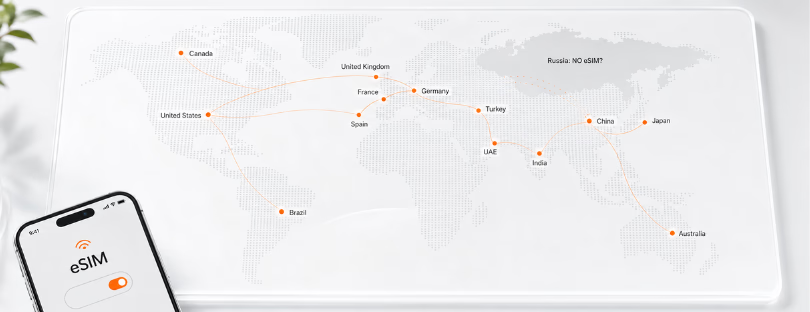
The UAE and Saudi Arabia are not part of the same connectivity zone. An eSIM that covers one does not automatically cover the other — most regional plans are scoped to individual countries or use aggregated regional bundles that may not include both.
If your trip includes both countries, install both profiles before you leave. Modern dual-SIM or eSIM-capable phones handle profile switching cleanly, but only if both are set up in advance. Trying to add a second eSIM at a border crossing or in an airport with poor Wi-Fi is an unnecessary stress point.
How the eSIM Market Actually Performs Here
This is where generic comparison articles fall short. The Middle East is a market where network selection, VoIP handling, and plan structure matter more than price. Here’s an honest read on the main players:
Airalo remains the most broadly distributed option. Its UAE and Saudi plans are reliable, and the app experience is consistent. It won’t be the fastest or cheapest, but it’s the safest default for travelers who want something they recognize and trust.
Nomad has improved its Middle East coverage significantly and positions well for travelers who want clean per-GB pricing without commitments. Solid for straightforward city-focused trips.
Ubigi is the right call when speed on premium network tiers matters. It connects to high-quality carriers in the urban UAE and performs above average for business travelers who need consistent throughput for video, large file transfers, or heavy app usage.
Holafly markets unlimited data, and its UAE product works — but “unlimited” here means throttled after a usage ceiling. It suits light-to-moderate users who want to stop counting gigabytes. For heavy users or anyone relying on consistent speeds for work, the throttling becomes a practical problem.
Fairplay Mobile is worth considering if you’re doing an extended stay. Its subscription model and structured unlimited approach — with a defined monthly spend ceiling and a genuine top-up mechanism — is better suited to longer trips or frequent returns to the region than a one-off data bundle.
Saily has built a clean app experience and covers the UAE well. It’s a solid mid-market option, particularly for travelers who want something straightforward with minimal setup friction.
Local SIMs from e& and du — both operators offer tourist SIM options, sometimes including promotional data on arrival. The catch is that buying and activating these on arrival takes time, requires going through a retail touchpoint, and eliminates the pre-travel setup advantage. Useful as a fallback; not the first choice for prepared travelers.
The underlying question across all of these: which local carrier does the plan actually route through? For most urban UAE use cases, the answer is academic. For Saudi Arabia’s more variable geography, it isn’t.
How Much Data Do You Actually Need
The tendency is to underestimate, because most travelers assume they’ll use Wi-Fi more than they actually do. In Dubai and Riyadh, you won’t. App-dependent navigation, ride-hailing, real-time bookings, and messaging add up quickly.
A rough framework based on typical usage patterns:
Light use (mostly messaging, occasional maps): 7–10 GB per week Standard use (navigation, apps, some video): 12–15 GB per week Heavy or work use (video calls where VoIP works, hotspot sharing, constant connectivity): 20 GB+
If your trip spans both UAE and Saudi Arabia, add those estimates separately — you’re running two distinct data pools, not one.
The Bigger Picture
Here’s what the Middle East is actually revealing about where the eSIM market is heading.
In Europe, connectivity has become nearly invisible. You activate an eSIM, it works, you forget about it. The Middle East forces the opposite: VoIP restrictions make you think about your communication stack. Network fragmentation in Saudi Arabia makes carrier selection relevant. Ramadan usage spikes make timing a factor. You can’t be passive about connectivity here.
That’s not a flaw. It’s a preview.
The next differentiation wave in eSIM isn’t cheaper data — that race has largely been run. It’s smarter infrastructure choices. Which operators does a provider actually partner with in specific markets? How does throttling actually behave on so-called unlimited plans, not just in theory but at 7 pm during Ramadan? Can the platform surface that information to the user before they buy?
Providers like Airalo and Nomad have built strong global distribution. Ubigi has invested in premium network partnerships. Fairplay is building around predictable cost structures for frequent travelers. These are different bets on what “better connectivity” means in the next phase.
The Middle East accelerates that question because it removes the safety net. When connectivity requires actual decisions — about networks, regulations, communication tools — it stops being a commodity and starts being infrastructure. And that’s exactly how the eSIM industry needs to start thinking about itself.