Singtel hi! Boosts APAC Roaming With Bigger Data Plans
Something interesting is happening across Asia’s telecom market right now. Plans are no longer just about local data. They are becoming regional, even global by default. And the latest move from Singtel under its “hi!” brand is another signal that this shift in roaming is accelerating. Singtel hi roaming plans APAC
The update itself is not flashy. No big rebrand, no dramatic pricing shake-up. But strategically, it says a lot about where mobile plans are going.
Shared Data Is Becoming the Standard
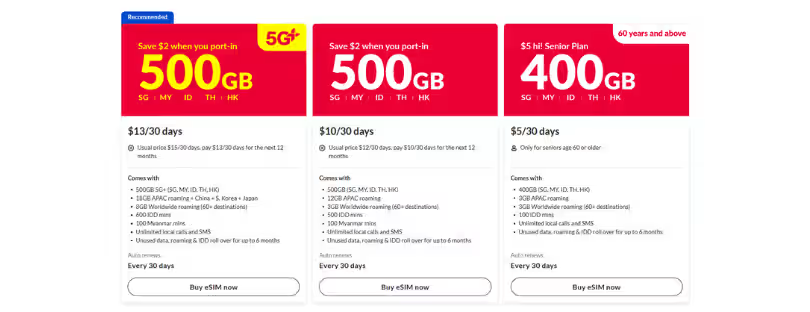
At the core of the new hi! postpaid plans is shared data across key neighboring markets. Users can now use their data not just in Singapore, but also in Malaysia, Indonesia, Thailand, and Hong Kong without thinking twice.
That matters more than it sounds.
For years, roaming felt like a separate experience. You crossed a border and suddenly had to manage a completely different pricing logic. What Singtel is doing here is flattening that experience. You stay connected across nearby countries as if nothing changed.
And this is exactly what frequent travelers expect in 2026.
Bigger Buckets for APAC Travelers
Where the update becomes more interesting is in the broader APAC roaming allocation.
The entry-level $13 plan now includes a surprisingly generous 18GB roaming bundle across major destinations like China, South Korea, and Japan. These are not fringe markets. These are some of the most traveled corridors in Asia, especially for business travelers and short-haul trips.
On top of that, all three plans include additional roaming data tiers. Users get between 3GB and 8GB of international roaming data across 60 destinations, along with IDD minutes.
This layered structure is very intentional. It separates “everyday regional usage” from “longer-haul or premium destinations,” giving users flexibility without overwhelming them.
Rollover Is the Real Differentiator
The feature that deserves more attention is not the data size. It is the rollover.
Unused local data, roaming data, and even IDD minutes can be carried forward and stacked for up to six months.
That changes user behavior.
Instead of rushing to use your data before it expires, you can accumulate it over time. This is particularly valuable for travelers who do not move every month but want a safety buffer when they do.
From a product perspective, this reduces what we call “roaming anxiety.” You are less likely to constantly check usage or worry about wasting value.
And honestly, this is where traditional telcos are starting to catch up with what eSIM providers have been doing for a while.
The Missing Piece: Voice Roaming
There is one clear gap.
Despite all the improvements, these plans still do not include voice roaming.
For some users, that will not matter. Messaging apps and VoIP have already replaced traditional calls in many scenarios. But for business travelers, enterprise users, or anyone dealing with authentication calls and reliability issues, voice roaming still has a role.
Competitors like SIMBA Telecom and Eight Telecom are offering similar structures, and this is where differentiation could still happen.
Right now, Singtel is prioritizing data experience over full-service roaming. That is a strategic choice, but not a complete one.
A Market Moving in One Direction
Zoom out, and this update is not really about Singtel alone.
It reflects a broader industry shift.
Telcos are slowly moving away from fragmented roaming charges toward bundled, predictable regional data. At the same time, they are borrowing ideas from digital-first players. Rollover mechanics, flexible usage, and multi-country coverage used to be the domain of travel eSIM providers.
Now, they are becoming standard.
This is also happening under pressure. Travelers have more options than ever. Providers like Airalo, Yesim, and Holafly have trained users to expect instant connectivity, transparent pricing, and no surprises.
Traditional operators cannot ignore that anymore.
What This Means for You
If you are a regional traveler within Asia, these plans are becoming genuinely competitive. The convenience of having one plan that works across multiple countries, combined with rollover flexibility, removes a lot of friction.
But if you are traveling globally, or need full control over your connectivity, the picture is different.
Telco plans still operate within predefined zones and structures. eSIM providers, on the other hand, offer more granular control, faster activation, and often broader global coverage without long-term commitments.
So the real question is not just “which plan is better?”
It is about your travel behavior.
Short, frequent regional trips? A plan like this makes sense.
Multi-country, unpredictable travel patterns? You might still lean toward eSIM.
A Transition, Not a Revolution
This is not a breakthrough product. It is a transition product.
And that is what makes it important.
Singtel is not trying to reinvent roaming. It is trying to make it less painful. And in doing so, it is quietly aligning itself with where the market is already going.
According to insights from GSMA and coverage from platforms like Light Reading, the industry trend is clear. Roaming is being absorbed into broader connectivity bundles, while user expectations are shifting toward seamless, borderless data access.
The gap between telcos and eSIM providers is closing.
But it is not closed yet.
And that is exactly where the next wave of competition will play out.
Driven by wanderlust and a passion for tech, Sandra is the creative force behind Alertify. Love for exploration and discovery is what sparked the idea for Alertify, a product that likely combines Sandra’s technological expertise with the desire to simplify or enhance travel experiences in some way.