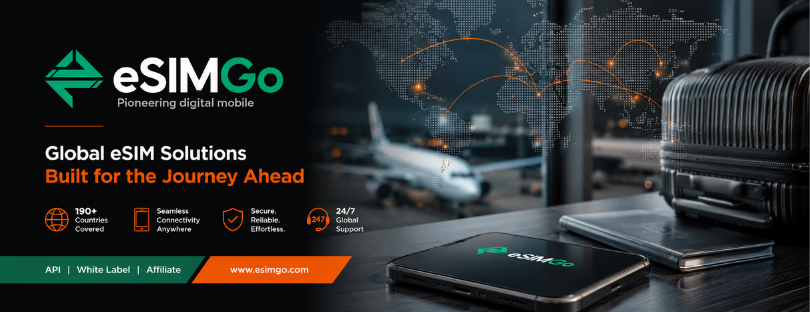
eSIM Go: The B2B eSIM Engine
eSIM Go is one of those companies that sits slightly behind the shiny consumer eSIM market, but probably understands the economics of it better than many brands selling directly to travelers.
Founded in 2020, the UK-based company has built itself around a simple but powerful idea: most businesses do not want to become telecom companies, but many of them would like to sell connectivity. Airlines, travel insurers, fintechs, hotels, booking platforms and mobility apps all touch customers at exactly the moment when data becomes useful. eSIM Go gives them the infrastructure to turn that moment into a product. Its own consumer-facing eSIM brand is Breeze, while its B2B offer includes API, affiliate and white-label routes for companies that want to add travel connectivity without building the telecom stack themselves.
That distinction matters. Breeze is not just “another eSIM shop.” It is also a proof point for eSIM Go’s wider platform. The company can show partners what the customer journey looks like, how bundles are sold, how activation works, and how support expectations play out in real travel situations. For a travel brand considering eSIMs, that is more convincing than a slide deck about “digital transformation.”
Breeze as the shop window
Breeze is eSlM Go’s travel eSIM brand, available across more than 190 countries according to its current Breeze affiliate positioning. The product is familiar to consumers: buy a data plan, install the eSIM, keep your normal SIM active for calls and SMS, and use Breeze for mobile data abroad. That sounds straightforward, but the bigger story is what sits behind it.
Breeze is designed to be partner-friendly. eSIM Go promotes it as an affiliate route with instant approval and a 20% commission, which makes it accessible not only to major travel brands but also to publishers, bloggers, comparison sites and niche communities that already influence travel decisions.
READ MORE: eSIM Go Investment Signals B2B eSIM Shift
This is where eSlM Go is smart. Many eSIM providers chase the traveler directly through paid search, app-store visibility and SEO battles. eSlM Go also understands distribution. If a customer is buying travel insurance, checking in for a flight, booking a hotel, or reading a destination guide, the eSIM offer is more contextual and less intrusive. It feels like part of the trip, not a random add-on.
That is why partnerships such as Confused.com joining the Breeze affiliate program are more interesting than they may first appear. A comparison platform does not need to become a telecom brand. It needs a relevant add-on that fits the user journey and creates extra value. Breeze gives it that route.

The B2B layer is the real story
For Alertify readers, the more important question is not whether Breeze sells travel data. Many companies do. The better question is whether eSlM Go can become a default infrastructure layer for travel brands that want connectivity revenue without operational complexity.
The company’s “Powered by Breeze” proposition is built for that exact gap. It gives brands a customizable, white-label way to sell eSIM services under their own brand while eSlM Go handles the technology, support and updates. That is a very different proposition from simply sending traffic to an eSIM marketplace. It lets the travel brand own more of the customer experience.
READ MORE: eSIM Go and Tekmoni Signal a New Era for UK MVNOs
Its API approach goes further. eSIM Go’s developer documentation says partners can use off-the-shelf data bundles to build their own propositions, with API access, control and 24/7 technical support. For a fintech, OTA, airline app or loyalty platform, that is where the commercial potential becomes serious. The eSIM stops being a link. It becomes a feature inside the product.
There is also a timing advantage. Travel eSIM is moving from “cheap data for tourists” into a broader embedded connectivity category. The winners may not only be the brands with the best consumer apps. They may be the companies that make eSIMs easy for other brands to sell, package and integrate.
Why the TNS Global investment matters
The latest strategic investment led by TNS Global adds weight to that direction. Reports say the funding is intended to support eSIM Go’s geographic expansion, technology development, connectivity evolution and ambitions in Travel eSIM and MVNO services. The announcement also points to a market expected to keep growing strongly, with a cited 37% CAGR through 2030.
This is not just “startup raises money” news. The investor profile matters. TNS Global is described as a Eurasian digital infrastructure and wholesale telecommunications provider, which suggests eSIM Go is not only chasing more retail volume. It is moving deeper into infrastructure, wholesale relationships and regional expansion.
READ MORE: AEGEAN Airlines Embraces eSIM Go to Power the Connected Traveler Experience
That could help eSIM Go compete in a market where network quality, routing, wholesale access and commercial flexibility are becoming harder to hide. Travelers may not know the phrase “tier-one network access,” but they notice when Maps loads slowly, a hotspot fails before a meeting, or an “unlimited” plan suddenly becomes unusable. For B2B partners, those moments create support tickets, refund requests and brand damage.

Where eSIM Go fits against competitors
Compared with Airalo, Nomad, Holafly or Saily, eSIM Go is less defined by consumer brand heat and more by enablement. Breeze gives it a consumer face, but the company’s stronger play is helping other businesses enter the category. That makes it closer in spirit to players such as Gigs, 1GLOBAL or eSIM Go’s fellow B2B connectivity platforms than to a pure travel eSIM storefront.
Still, the consumer side cannot be ignored. Breeze has to remain credible because it becomes the visible quality signal for many partners. If the purchase flow is clunky, coverage claims feel vague, or support disappoints, the B2B story weakens. This is the tricky part of infrastructure-led eSIM: the end user may never know who powers the service, but they will judge the brand that sold it to them.
Final take
eSIM Go’s strongest position is not that it sells eSIMs. It is that it understands where eSIMs are being sold next.
The first phase of travel eSIM was about apps fighting for individual travelers. The next phase is about distribution: airlines, insurers, fintechs, hotel groups, loyalty platforms and travel media embedding connectivity into moments where the need already exists. eSIM Go is clearly built for that world.
Breeze gives the company a consumer-facing product. Powered by Breeze and the API give it a B2B engine. The TNS Global investment gives it a stronger expansion story at exactly the time when travel connectivity is becoming less of a niche add-on and more of a standard layer in the travel experience.
The risk? This market is getting crowded fast. Strong claims are no longer enough. Partners will look for conversion, support quality, network performance, transparent economics and product flexibility. But if eSIM Go keeps improving the infrastructure while making distribution simple, it has a credible shot at becoming one of the quiet companies powering the next wave of travel eSIM growth.