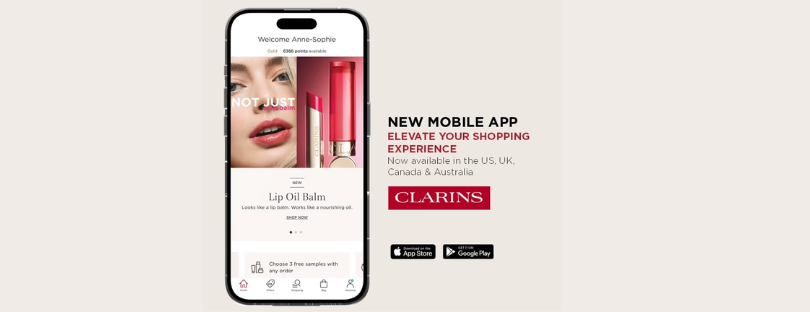
Clarins Launches a New Mobile App With Merkle, Pushing Prestige Beauty Deeper Into DTC
Clarins — the iconic, family-owned French beauty house — has officially rolled out its new mobile app across the United States, Canada, Australia, and the UK, with France and additional markets close behind. Developed with long-time digital partner Merkle, the app signals a major acceleration in the brand’s direct-to-consumer (DTC) strategy—and a notable first for the prestige beauty category, where mobile apps have historically lagged behind fast-moving retail peers.
The move comes after a highly successful UK pilot, where nearly 30% of loyal customers adopted the app early on and awarded it an impressive 4.7-star rating on the Apple App Store. In an industry where customer relationships and brand loyalty are everything, that early traction is hard to ignore.
A smoother, faster way to shop Clarins
Clarins has spent 70 years building a reputation for listening to customers—across spas, beauty counters, and more recently, online. The new app extends that philosophy into a space consumers already use daily: their phones.
And crucially, it isn’t just a copy of the website. It layers in native features designed to reduce friction at every step:
Key customer-facing features
- Fast browsing of the full product catalog
- Persistent login and one-click checkout
- Access to Clarins’ AI Skin Observer and generative-AI chatbot
- Exclusive in-app promotions
- Push notifications for launches and member offers
- A barcode scanner for quick product lookups
For a prestige beauty brand, these aren’t add-ons—they’re strategic tools. Push notifications, for example, ranked highly in the UK pilot, with the majority of users opting in, validating the app as a stronger communication channel than email or social.
The entire experience is built on a hybrid framework: web-based flexibility combined with native capabilities like one-tap payments and permanent login. It’s a development approach that has become increasingly popular for brands balancing cost-efficiency with premium UX expectations.


A DTC milestone for the prestige beauty category
While mass-market retailers and fast-beauty brands have embraced mobile apps for years, prestige beauty has been slower to adopt. Many still rely heavily on retail partners like Sephora or department stores for customer access, data, and loyalty relationships.
Clarins’ CEO Jonathan Zrihen made the strategic intent clear: the app strengthens the brand’s ability to “support customers every day, wherever they are,” bridging online and in-store experiences. It’s a relationship-first strategy, leveraging Clarins’ historic connection with consumers—but modernized with technology that keeps them within the Clarins ecosystem.
Laurent Malaveille, Clarins’ Chief Digital, IT & Business Support Officer, underscored how central the app is to their broader DTC acceleration, calling it “a key milestone” for the markets where it has launched.
For a brand that generates nearly 95% of its sales internationally, offering a scalable, unified mobile solution is also a significant operational win.
Merkle’s role in the digital growth story
Merkle, Clarins’ long-term partner and a leader in customer experience transformation, positioned this launch as more than a technical build—it’s a strategic differentiator.
Peter Stein, Merkle Global President, emphasized that while many retailers have mobile apps, few beauty brands—particularly in the U.S.—have really leaned into the channel. Given that the U.S. beauty and personal care market alone is projected to exceed $130 billion in 2025 (Mordor Intelligence), the opportunity is massive.
This is especially true for recurring-purchase categories like skincare, where Clarins’ subscription business stands to benefit from easier reordering, faster checkout, and always-on engagement.

What this means for the future of beauty retail
The Clarins app hits at a time when the broader beauty industry is shifting on multiple fronts:
Trends influencing the move
- Subscription models are becoming core revenue drivers
- Brand-owned channels are rising as CAC costs on social platforms climb
- AI-assisted beauty tools are accelerating adoption across premium brands
- Mobile-first shopping continues to dominate, especially for Gen Z and millennials
Competitors have made various digital investments—Estée Lauder has built strong AR try-on tools, L’Oréal has been aggressively acquiring beauty tech companies (Modiface being the biggest), and Sephora remains the benchmark for mobile retail in beauty—but few prestige skincare brands have a standalone app with this level of integration.
Clarins’ hybrid approach also mirrors successful strategies in other sectors. For example, luxury fashion houses like Chanel and Dior have invested heavily in mobile content apps, though not necessarily in end-to-end commerce. In beauty, Avon and Mary Kay have apps—but their models are fundamentally different, with sales driven by representatives rather than direct channels.
That puts Clarins in relatively uncharted territory: a premium skincare leader creating a mobile ecosystem that blends commerce, AI services, loyalty, and brand content into one unified experience.
The bigger picture: why this matters
Clarins’ mobile app isn’t just another digital channel—it’s a strategic blueprint for where prestige beauty is heading. While other major players have focused on AR try-ons, improved websites, or retailer partnerships, Clarins is carving out a direct path to its consumer base. In a high-LTV category like skincare, owning that relationship—and the data that flows with it—is increasingly critical.
Reliable industry sources like McKinsey’s Beauty Market Report and Euromonitor repeatedly highlight that DTC-driven customer retention delivers the strongest margins in beauty. By creating a mobile experience that feels personal, fast, and loyalty-oriented, Clarins is positioning itself ahead of a trend that’s only going to accelerate.
If the UK pilot momentum carries over to the U.S., Canada, and Australia, Clarins won’t just have launched an app—it may have redefined what a prestige beauty brand can look like in a mobile-first world.