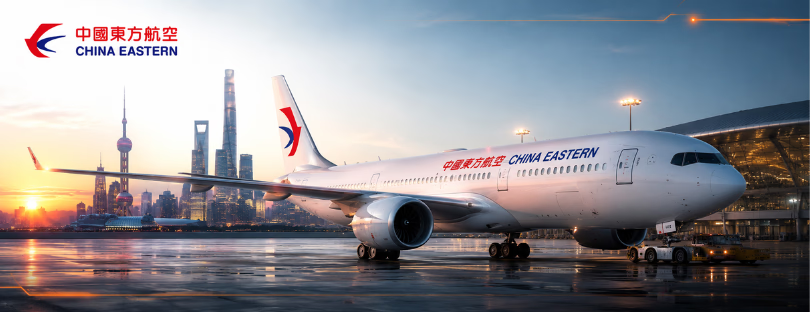
China Eastern Airlines and the New China Travel Boom
China Eastern Airlines is not always the loudest name in Asian aviation, and that is exactly what makes it interesting. While some airlines sell themselves through luxury cabins, giant marketing campaigns, or big personality branding, China Eastern feels more like a strategic machine built around one very important idea: Shanghai is becoming one of the world’s most important travel and business gateways again.
That matters for Alertify readers because airlines are no longer just transport companies. They are distribution platforms, data companies, loyalty engines, payment channels, airport partners, and increasingly, digital service sellers. Connectivity, roaming, app experiences, airport retail, lounge access, bundled travel services, these all sit around the flight now. And China Eastern sits in a market where that ecosystem is getting bigger fast.
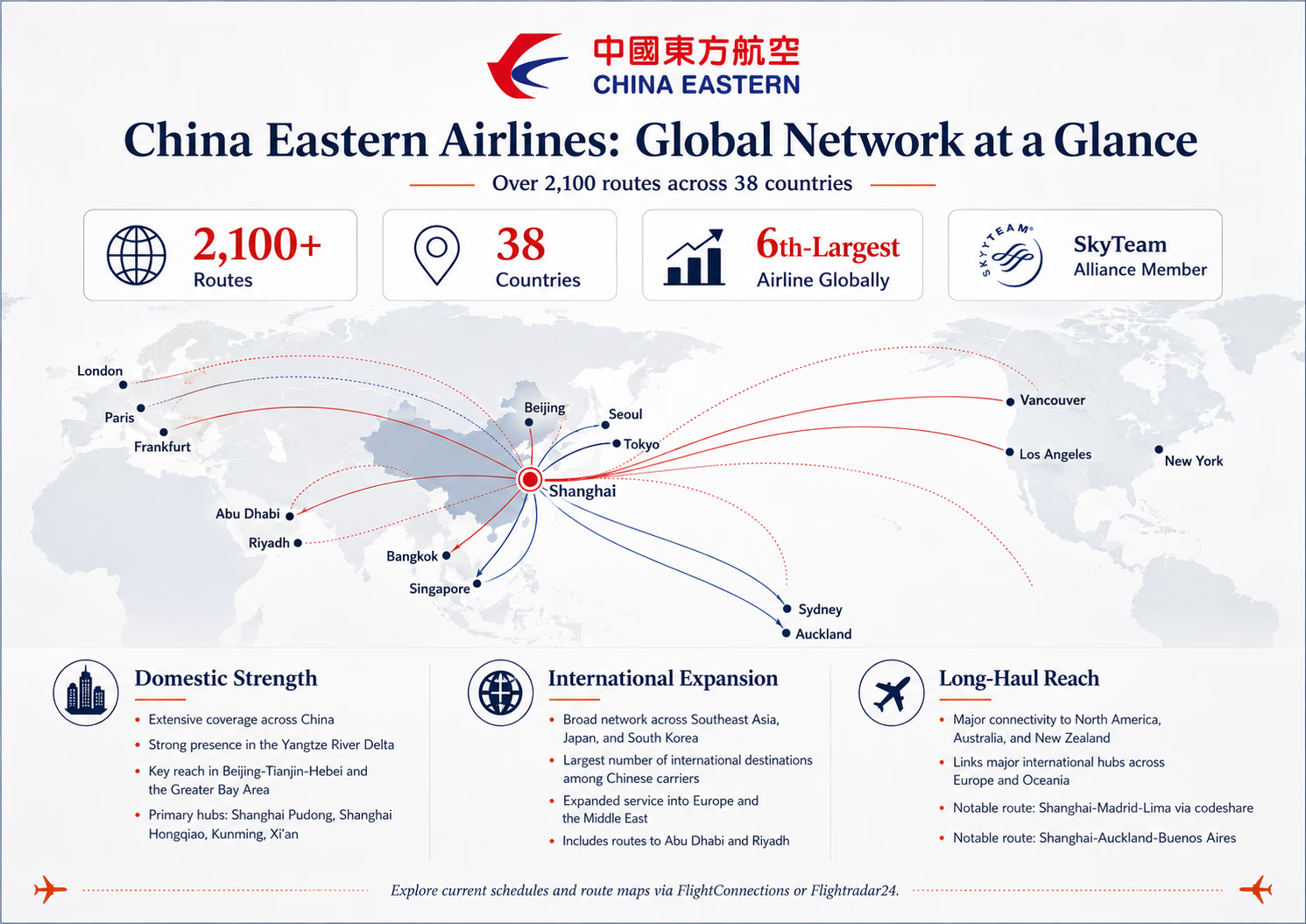
China Eastern is one of China’s “big three” state-owned carriers, alongside Air China and China Southern. Its natural power base is Shanghai, with key operations at Pudong and Hongqiao, giving it exposure to both international long-haul traffic and domestic business movement. Routesonline describes the airline as serving hundreds of domestic routes and dozens of international destinations across Europe, North America, Southeast Asia, Korea, Japan and Australia.
Why China Eastern matters now
The timing is important. China’s aviation market is still in a post-pandemic rebuild phase, but it is no longer simply about “recovery.” It is about reshaping capacity, rebuilding international demand, and deciding which airlines can turn passenger volume into profitable, modern travel ecosystems.
Reuters reported that China Eastern returned to a first-quarter profit in 2026, posting net profit of 1.63 billion yuan, after a difficult period for China’s major carriers. In the same broader market update, Reuters noted that China’s three big state-owned airlines all swung to profit in Q1 2026, helped by strong Lunar New Year demand and recovering global travel.
READ MORE: Trip.com and China Eastern Airlines Unveil ‘Beyond Shanghai: Experience China’ Campaign
That sounds like a neat comeback story, but aviation rarely works that cleanly. Fuel costs, exchange rates, geopolitics, aircraft supply delays, route approvals and weak long-haul yields can quickly turn a recovery into a margin problem. China Eastern is benefiting from demand, yes, but it is also operating in a market where price sensitivity is brutal. Chinese consumers are travelling again, but they still compare fares aggressively. That makes premium digital upselling and smarter ancillary revenue more important.
The C919 signal
One of China Eastern’s most symbolic roles is its connection to the C919, China’s domestically manufactured passenger aircraft. The airline has been described as the global launch customer for the C919 and as operating the largest C919 fleet in the world.
This is not just an aircraft story. It is an industrial strategy with wings.
For China, the C919 represents reduced dependence on Airbus and Boeing over time. For China Eastern, it gives the airline a visible role in China’s aviation self-reliance push. The practical impact will take years, because global aircraft ecosystems are complex and certification outside China remains a long road. But the brand signal is already clear: China Eastern is not merely flying passengers. It is helping showcase a national aviation project.
That gives the airline a different kind of relevance compared with Cathay Pacific, Singapore Airlines or Korean Air. Those carriers often compete through service reputation, transit efficiency, and premium brand trust. China Eastern’s strategic advantage is tied more directly to Shanghai, state-backed infrastructure, domestic scale, and China’s manufacturing ambitions.
The digital travel angle
For travel tech, China Eastern is worth watching because Chinese airlines are operating in one of the world’s most mobile-first consumer environments. Travellers expect app-based booking, QR payments, digital service recovery, loyalty integration, real-time notifications and smooth airport flows. In China, the airline app is not just a booking tool. It can become part of a wider travel operating system.
This is where airlines globally are heading. Lufthansa, Emirates, Singapore Airlines and Qatar Airways have all invested heavily in digital customer experience, loyalty ecosystems and premium ancillary services. China Eastern has a different profile, but the direction is similar: the flight is becoming the entry point into a bundle of services.
READ MORE: China Eastern Airlines opens direct flights between Shanghai and Istanbul
For eSIM and roaming players, this is exactly where the opportunity sits. A passenger flying from Shanghai to Europe, Australia or Southeast Asia does not want to think about roaming charges after landing. They want mobile data to work before the taxi queue. Airlines that understand this moment can sell connectivity naturally, not as an afterthought. China Eastern has the international passenger base and digital channels to make that kind of bundled travel service relevant, especially as Chinese outbound travel normalizes.
A tougher comparison set
Compared with China Southern, China Eastern feels more internationally polished through Shanghai, but less massive in southern China’s outbound leisure machine. Compared with Air China, it has less national-flag prestige, but arguably a sharper commercial position through Shanghai’s business and international travel base. Compared with Cathay Pacific, it lacks the same premium global brand perception, but has far more direct exposure to mainland China’s domestic scale.
That mix makes China Eastern a strange but important competitor. It may not win every service ranking, and it may not dominate Western aviation headlines, but it sits close to several major trends: China’s international travel rebound, Shanghai’s gateway role, domestic aircraft development, and the airline-as-platform model.
Conclusion
China Eastern Airlines should not be read as just another big Chinese carrier adding routes back after the pandemic. It is a useful signal for where aviation is going in China: more state-aligned, more digitally mediated, more connected to industrial policy, and more dependent on turning travel demand into higher-value services.
For Alertify, the interesting question is not whether China Eastern becomes “the best” airline in Asia. That is too simple. The better question is whether it can turn Shanghai’s scale into a smarter travel ecosystem. If it does, it will compete not only with Air China and China Southern, but with the broader Asian aviation players that already understand the next phase of travel: the airline is no longer just the carrier. It is the gateway.