Inside ESA’s Iris Programme for BVLOS Drone Connectivity
Viasat, alongside partners including Thales, Dimetor, TTP plc, and the European Space Agency, has just wrapped a set of flight trials that, on the surface, look technical. But zoom out a bit, and this is actually about something much bigger: proving that drones can safely operate beyond visual line of sight in real-world airspace.
The tests took place at Cranfield University using a Bulldog light aircraft, part of the broader Iris RPAS programme. The goal is not flashy demos or one-off success stories. It is something far more valuable in aviation: evidence.
Because in BVLOS operations, nothing moves forward without it.
Why Connectivity Is the Real Bottleneck
There is a tendency to think that autonomous aviation is mostly about hardware or AI. It is not. The real constraint is connectivity.
Once a drone leaves the pilot’s visual range, everything depends on command-and-control links. Lose that link, even briefly, and you lose situational awareness. That is a non-starter for regulators.
This is where the Iris programme comes in. It is designed to answer a simple but difficult question: can we build connectivity that is reliable enough, consistent enough, and trusted enough to support BVLOS at scale?
Not in theory. In messy, real-world conditions.
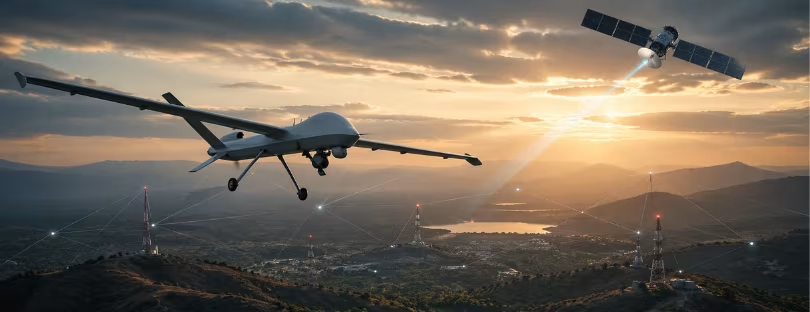
These trials focused on multi-link connectivity. In practical terms, that means combining satellite and terrestrial networks rather than relying on a single connection. It is the same logic we are starting to see in advanced travel connectivity, just applied to aviation at a much higher level of risk.
Multi-Link Is Becoming the Standard
The key idea emerging from these trials is that no single network can do the job alone.
Satellite communications, led here by Viasat, provide coverage where terrestrial networks simply cannot reach. But they are not always enough on their own. Terrestrial networks offer lower latency and strong performance in populated areas. The future is clearly hybrid.
That is exactly what the Iris RPAS trials are testing: how these layers behave together under operational stress.
The programme is structured deliberately as an evidence-building exercise. Each flight is not just a test, but a data point. Over time, this builds a case for regulators and industry stakeholders that multi-link connectivity can meet the required thresholds for safety, integrity, and availability.

As Joel Klooster, SVP Aircraft Operations and Safety at Viasat, puts it:
“Satellite communications play a critical role in providing that assurance, particularly beyond the reach of terrestrial networks. Through Iris RPAS, we are working with our partners to build evidence around how satcom can contribute to resilient, safety-oriented multi-link architectures that support the next phase of uncrewed aviation.”
A System-Level Approach, Not a Single Product
One of the more interesting aspects of this initiative is how ecosystem-driven it is.
Thales is acting as the system integrator, coordinating a structured, safety-first approach. Dimetor contributes airspace intelligence through its AirborneRF platform, offering real-time visibility into connectivity conditions. TTP provides compact satcom terminals designed specifically for UAVs. Cranfield University brings testing infrastructure and aviation expertise.
This is not about a single vendor winning. It is about proving that a system can work.
Thomas Neubauer, CEO of Dimetor, highlights a key operational reality:
“For remotely piloted aircraft systems, situational awareness on knowing where, when and at what quality terrestrial and non-terrestrial connectivity are available in the airspace is critical to safe and scalable operations.”
That line matters. Connectivity is no longer just about being connected. It is about knowing the quality of that connection in real time and making decisions based on it.
That is a shift we are also starting to see in telecom more broadly, especially in enterprise and IoT use cases.
From Trials to Regulation
The aviation industry does not move quickly, but it moves decisively once evidence is in place.
These trials are part of a broader effort to build a regulatory foundation for BVLOS operations in non-segregated airspace. That is the real prize here. Not just proving that something works, but proving it in a way that regulators can trust.
Davide Tomassini from ESA frames it clearly:
“Beyond Visual Line of Sight (BVLoS) operations represent most of the future market value potential in the RPAS domain and they are highly regulated.”
That is the tension. Massive commercial opportunity, but equally high safety requirements.
The Iris programme is effectively trying to bridge that gap.
What This Means for the Market
If you look at where the industry is heading, this is not happening in isolation.
Players like Iridium Communications and Inmarsat have been pushing aviation-grade connectivity for years. Meanwhile, low-earth orbit constellations like Starlink are changing expectations around latency and coverage.
At the same time, regulatory bodies such as the European Union Aviation Safety Agency are actively working on frameworks for integrating drones into shared airspace.
What Iris adds to this landscape is structure. It is not just another connectivity solution. It is a coordinated attempt to define how connectivity should work for BVLOS operations.
That distinction matters.
Where This Is Going
There is a bigger trend playing out here that goes beyond aviation.
Connectivity is becoming infrastructure for autonomy. Whether it is drones, autonomous vehicles, or remote industrial systems, the requirement is the same: always-on, resilient, multi-layer connectivity.
The telecom industry is starting to respond with hybrid architectures, API-driven control layers, and real-time network intelligence. The aviation sector is simply one of the most demanding environments where these ideas are being tested.
Bottom line
What these trials really show is not that BVLOS is coming. That part is already clear. The more important takeaway is how it will be enabled.
The industry is moving away from single-network assumptions toward multi-link, system-level architectures. That mirrors what we are seeing in advanced eSIM and enterprise connectivity, where redundancy, visibility, and control are becoming core differentiators.
Compared to standalone satellite solutions or purely terrestrial approaches, the Iris model feels more realistic. It acknowledges complexity instead of trying to simplify it away.
The challenge now is execution. Scaling this from controlled trials to real-world deployments, aligning stakeholders, and navigating regulation will take time. But the direction is set.
And if you are watching the future of connectivity, this is one of those signals that is easy to miss but hard to ignore once you see it.