Amazon Leo Lands on Delta: A New Connectivity Era
Delta Air Lines and Amazon are taking their partnership to a different altitude. The two companies just announced a long-term collaboration that goes beyond incremental Wi-Fi upgrades and moves straight into something more structural: redefining what “connected travel” actually means. Delta in-flight Wi-Fi
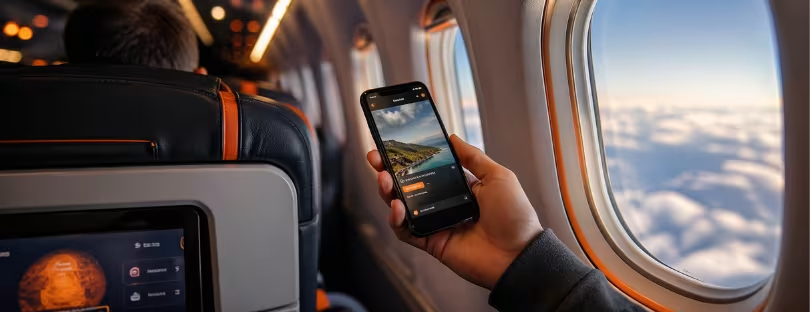
At the center of this is Amazon’s low Earth orbit satellite network, referred to here as “Leo,” which will power next-generation in-flight connectivity across Delta’s fleet. If you’ve been following the evolution of airline Wi-Fi, you already know this isn’t just about faster browsing. It’s about turning the aircraft into a fully connected digital environment.
From Wi-Fi to a full digital experience
The promise is straightforward on paper: high-speed, low-latency internet that actually behaves like the connection you expect on the ground. Streaming, real-time uploads, cloud access, and even sending large business files mid-flight without friction.
But the interesting part is not the speed. It’s the upload capacity.
Most in-flight systems historically struggled with uplink performance. Downloading a movie was one thing. Uploading a video or joining a stable video call was another story entirely. That’s where Amazon’s satellite architecture changes the equation.
“The unmatched upload capacity of Amazon Leo enables customers to instantly share life moments — from uploading vacation photos and videos in real time to securely sending presentations or business files after a high-stakes meeting — without waiting until they land.”
That line matters more than it sounds. It signals a shift from passive consumption to active connectivity. Not just watching content, but participating in it.
500 aircraft, starting 2028
Delta plans to begin rolling out the system in 2028, starting with 500 aircraft. That timeline tells you two things.
First, this is not a pilot project. It is a fleet-level commitment.
Second, the industry still needs time to mature the hardware layer. Aviation-grade satellite antennas, like Amazon’s “Leo Ultra,” are not plug-and-play upgrades. They require certification, integration, and long testing cycles.
Still, Delta is clearly betting on this as a long-term differentiator.
“Delta’s future is global,” said Ed Bastian. “This agreement gives us the fastest and most cost-effective technology available to better connect the world today, and it deepens our work with a global leader that shares our ambition to build what’s next — creating even stronger human connection for our people and our customers for years to come.”
Not just connectivity, but ecosystem
What makes this move more strategic is how deeply it ties into Amazon Web Services.
Delta is not just buying connectivity. It is aligning its entire digital stack with Amazon. Cloud infrastructure, AI, onboard systems, customer experience layers. All of it starts to converge.
READ MORE: Delta introduces fast, free onboard Wi-Fi
This is where the story shifts from “better Wi-Fi” to “experience platform.”
Amazon CEO Andy Jassy framed it clearly:
“We’ve designed Leo to provide high-speed internet to the billions of people on Earth without reliable connectivity, and this agreement with Delta is a great example of the impact and scale of the technology — bringing even faster in-flight Wi-Fi to tens of millions of passengers who fly Delta every year.”
And then the key insight:
“People increasingly want to stay connected wherever they are in the world… it’s going to change what’s possible while traveling.”
That’s not marketing language. That’s a directional statement.

Delta is not starting from zero
It’s worth remembering that Delta has been ahead of the curve here for a while.
Back in 2023, the airline made a bold move by introducing free Wi-Fi for SkyMiles members, supported by T-Mobile. Since then, it has scaled streaming-quality connectivity across more than 1,150 aircraft.
Over 163 million users have already connected to Delta Sync Wi-Fi. That’s not experimentation. That’s mass adoption.
What this Amazon deal does is build on that foundation and push it into a new performance tier.
At the same time, Delta is hedging its bets. It continues to work with satellite providers like Viasat and Hughes Network Systems. Multi-provider architecture is becoming the norm, not the exception.
The bigger industry shift
Zoom out, and this fits into a much larger trend.
Low Earth orbit satellite networks are reshaping aviation connectivity. Amazon is entering a space already occupied by SpaceX (Starlink) and traditional players like Viasat.
Airlines are no longer choosing between “Wi-Fi providers.” They are designing connectivity stacks.
At the same time, passenger expectations have changed. According to IATA and other industry studies, connectivity is now one of the top decision factors for travelers, especially business users.
Free Wi-Fi is quickly becoming the baseline. The real competition is shifting toward quality, consistency, and integration.
And increasingly, monetization through ecosystem partnerships. Delta’s collaborations with brands like American Express, YouTube, and Uber show where this is going. Connectivity is becoming the gateway to a broader digital experience.
What this actually means for travelers
In practical terms, this deal pushes the industry closer to something that has been promised for years but rarely delivered.
A flight where you don’t think about connectivity at all.
No switching modes. No worrying about data limits. No hesitation before sending a file or opening a call.
Just seamless, always-on access.
That’s the ambition. Whether it fully materializes depends on execution.
Bottom line about Delta in-flight Wi-Fi
This partnership is not just another airline Wi-Fi upgrade. It is part of a deeper shift toward “connected travel infrastructure,” where airlines, cloud providers, and satellite networks merge into a single experience layer.
Compared to competitors, Delta is taking a more platform-driven approach. While others focus on connectivity as a feature, Delta is positioning it as a foundation. That aligns more closely with what players like SpaceX are enabling through Starlink Aviation, but with a stronger integration into cloud and customer ecosystems.
The broader trend is clear. Connectivity is no longer a differentiator on its own. It is becoming an expectation. The real differentiation will come from what airlines build on top of it.
Delta seems to understand that.
The question now is whether the rest of the industry will follow at the same depth or just match the speed.