BuyNumber.io Launches Crypto eSIM in 180+ Countries
Cryptocurrency has spent the last decade fighting for legitimacy beyond speculation. Trading platforms, NFTs, memecoins, wallets. But what happens when crypto quietly steps into something practical, even boring — like mobile data?
That is exactly what is happening now.
BuyNumber.io, a platform originally known for privacy-focused virtual phone numbers, has launched a crypto-powered eSIM purchasing service. In simple terms, you can now buy mobile data for more than 180 countries using digital assets and activate it within minutes.
For frequent travelers, digital nomads, privacy-first users, and crypto-native customers, this is more than a technical upgrade. It is another small but meaningful shift in how connectivity is being delivered and paid for.
And it signals something bigger happening at the intersection of telecom and decentralized finance.
Why eSIM Is Quietly Becoming the Default
eSIM technology is no longer a futuristic concept. It is already embedded in most modern smartphones, tablets, and even laptops. Instead of inserting a physical SIM card, you download a mobile profile digitally.
No plastic.
No store visit.
No waiting for shipping.
After purchasing an eSIM, users receive a QR code. You scan it from your device settings, the data profile downloads, and within minutes you are connected.
It sounds simple because it is.
For international travelers landing in a new country, that difference matters. Instead of hunting for a local SIM kiosk at the airport, you can switch networks the moment your plane touches down.
For remote workers and digital nomads who move across borders regularly, it removes friction. And for users who prefer not to register their identity at a local telecom counter every time they cross a border, it offers a cleaner digital workflow.
The growth trajectory supports this shift. According to industry forecasts from GSMA and IDC, eSIM adoption continues to accelerate globally, driven by device compatibility and operator support. What was once a niche travel hack is now part of mainstream mobile infrastructure.
Crypto Payments Meet Mobile Connectivity
Where BuyNumber.io differentiates itself is not just in offering eSIMs, but in how they are paid for.
Users can complete purchases using cryptocurrency rather than traditional banking methods. No card processing. No cross-border payment blocks. No currency conversion headaches.
For crypto-native users, that matters.
Many traditional telecom operators still rely on rigid payment systems tied to local billing infrastructure. Crypto removes those borders. A digital asset wallet works the same whether you are in Berlin, Bangkok, or Buenos Aires.
This model aligns closely with the broader decentralized ethos: permissionless payments, reduced reliance on banks, and faster settlement times.
And in this case, the result is practical. You pay. You receive a QR code. You connect.
No KYC and Privacy Appeal
One of the more notable aspects of this launch is that purchases can be completed without the standard identity verification procedures typically required by telecom providers.
In many countries, SIM card registration involves ID checks, paperwork, and regulatory compliance. That is understandable from a national telecom perspective. But it also creates friction.
Digital eSIM distribution through online platforms changes that dynamic.
By removing mandatory KYC for the purchase itself, BuyNumber.io is clearly positioning the service toward privacy-conscious users and crypto communities that prioritize anonymity.
It is important to note that regulatory environments differ by country, and telecom compliance rules still apply at the network level. However, the purchasing process itself becomes significantly simpler.
For some users, convenience is the draw.
For others, privacy is the priority.
 How the Process Works
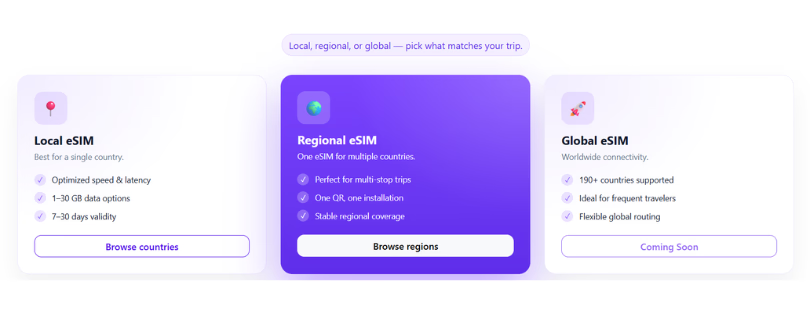
The user flow is designed to be straightforward:
Step-by-step purchase
• Visit the eSIM section on BuyNumber.io
• Select a country, region, or global data plan
• Choose the data volume and validity period
• Complete payment with supported cryptocurrencies
• Receive QR code and activation details instantly
Once scanned, the data plan activates according to the selected package terms.
There are no shipping delays, no SIM trays, and no physical logistics involved.
From a telecom architecture perspective, this is the natural progression of digital provisioning. From a user perspective, it simply feels efficient.
A Broader Industry Trend
BuyNumber.io is not alone in experimenting with crypto payments for telecom services. Several travel-focused eSIM providers have started accepting digital currencies over the past few years.
However, crypto payments remain a minority feature in the mainstream telecom space.
Why?
Because telecom infrastructure is traditionally conservative. Large mobile operators operate under heavy regulation, strict compliance frameworks, and legacy billing systems. Integrating cryptocurrency into that environment is not trivial.
But smaller digital-first platforms can move faster.
We are seeing a pattern:
- Hosting providers accept crypto.
- VPN services accept crypto.
- Cloud services accept crypto.
Now, mobile data is joining that list.
This is part of a broader normalization of digital assets in functional, real-world services.
According to data from Chainalysis and other blockchain analytics firms, global crypto adoption has expanded significantly over the last five years, particularly in emerging markets where access to traditional banking systems can be limited.
In that context, crypto-funded connectivity makes practical sense.
The Travel Use Case
Let us look at this from a traveler’s perspective.
You land in a new country. You do not want to exchange currency. Your bank occasionally flags foreign transactions. Roaming fees are unpredictable. Local SIM registration may require ID and paperwork in a language you do not understand.
Now imagine this alternative:
You open a website.
You select a data plan.
You pay from your crypto wallet.
You scan a QR code.
You are online.
For digital nomads who already earn, transact, and save in crypto, this workflow feels natural.
It removes one more dependency on traditional banking systems.

Is This a Niche or the Beginning of a Shift?
That is the more interesting question.
At the moment, crypto-powered eSIMs are still a niche segment. The majority of travelers still use cards, Apple Pay, Google Pay, or local operator plans.
But infrastructure shifts often begin at the margins.
Ten years ago, eSIM itself was considered experimental. Today, it is built into flagship devices from Apple, Samsung, and Google. Some markets are already moving toward eSIM-only models.
Crypto payments may follow a similar curve. First optional. Then normalized.
As digital identity, decentralized finance, and borderless work continue to expand, payment flexibility becomes part of the connectivity conversation.
The telecom sector is slowly becoming software-driven. And software ecosystems evolve faster than traditional carriers ever did.
What This Means for the eSIM Market
From a competitive standpoint, BuyNumber.io’s move strengthens its positioning as a privacy-forward digital utility platform.
Originally focused on virtual numbers, it is now expanding into data connectivity. That bundling makes strategic sense. Communication services are converging.
Compared with mainstream travel eSIM brands, the differentiator here is not necessarily pricing or data volume. It is the payment philosophy and privacy angle.
Other eSIM providers have focused on unlimited plans, predictable usage models, or multi-network performance. Crypto-native connectivity is a different narrative entirely.
If adoption grows, we may see more hybrid models emerge: platforms combining virtual numbers, eSIM data, VPN services, and crypto payments under one digital identity layer.
Conclusion
Crypto-powered eSIMs are not about hype. They are about convergence.
Telecom is becoming a digital infrastructure. Payments are becoming decentralized. And users increasingly expect borderless services that activate instantly.
BuyNumber.io’s launch is a small but meaningful signal of that transition. It demonstrates how connectivity can align with crypto-native behavior without reinventing the underlying telecom stack.
Will crypto payments replace traditional methods in telecom? Not anytime soon. Regulatory frameworks, volatility concerns, and mainstream user behavior still favor conventional systems.
But as reports from GSMA and blockchain analytics firms consistently show, both eSIM adoption and crypto usage are growing in parallel. When two growth curves intersect, innovation tends to follow.
The real story is not whether crypto eSIMs will dominate tomorrow. It is that connectivity itself is becoming programmable, portable, and payment-agnostic.
And in a world where mobility is constant, that combination feels less like a niche experiment and more like a preview of what digital infrastructure looks like next.