Something interesting is happening at the intersection of fintech and telecom. Brubank, Argentina’s largest digital bank, has just introduced BruFon, its own international eSIM. On paper, it looks like another product launch. In reality, it signals something much bigger: banks are no longer just competing on payments, but on everyday digital infrastructure.
With BruFon, Brubank becomes the first Argentine bank to offer international mobile connectivity as a fully integrated, native feature inside its app. No partnerships slapped on top, no redirects. Just connectivity, embedded.
From banking app to travel companion
If you zoom out, this move fits a broader pattern. The most ambitious fintech platforms are quietly expanding beyond finance. They are becoming ecosystems.
Brubank has been heading in this direction for a while. Payments, cards, travel perks, and now connectivity. The logic is simple: users don’t experience life in categories. They don’t separate “banking” from “travel” or “connectivity.” It’s all one flow, one device, one interface.
And that’s exactly where BruFon fits.
Travel is still one of the last friction-heavy moments in an otherwise digital lifestyle. You land, and suddenly you’re dealing with roaming charges, unreliable WiFi, or the awkward process of buying data from a third-party app you don’t fully trust.
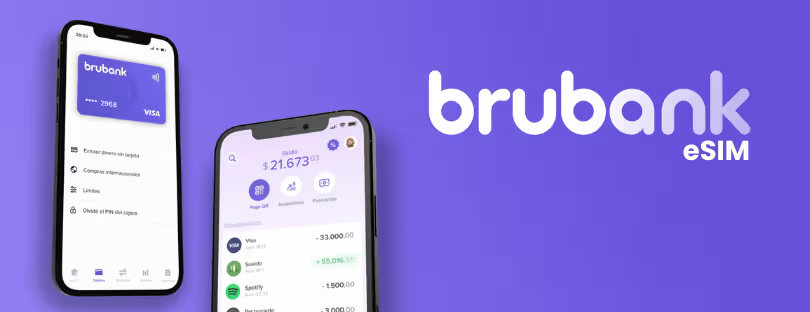
BruFon removes that layer. The eSIM lives inside the banking app. Activation, usage tracking, and top-ups happen in the same place where users already manage their money.
No switching contexts. No extra decisions.
Built on embedded telecom infrastructure
Under the hood, BruFon runs on Gigs, one of the key players in the emerging “connectivity-as-a-service” space.
This is important.
We’re entering a phase where telecom capabilities are no longer tied to traditional operators. Instead, they’re becoming programmable infrastructure that companies can embed into their own products. Just like payments APIs transformed fintech, connectivity APIs are now doing the same for mobile services.
Gigs essentially provide the rails. Brubank builds the experience.
And that’s what makes launches like this scalable. You don’t need to be a telecom operator to offer telecom services anymore.
BruFon doesn’t exist in isolation. It’s part of a larger push to turn Brubank into a travel-ready platform.
The bank already offers PIX payments in Brazil directly from the app, travel assistance through its Ultra plan (via Pax), and international Visa cards. Adding connectivity completes the stack.
Payments, coverage, and data. All in one place.
From a product strategy perspective, this is clean. Each piece reinforces the other. And more importantly, it keeps users inside the ecosystem.
What users actually get
On the user side, the offer is straightforward.
BruFon is included for premium tiers. Ultra users get 2GB of free data, while Plus users receive 1GB. Coverage spans more than 150 countries, and the eSIM is reusable across destinations.
There’s no physical SIM, no roaming dependency, and no need to install another app. You buy data directly from Brubank, monitor usage in real time, and even use the hotspot for other devices.
The usual eSIM benefits are all there. But the difference is where they live.
Inside a banking app.
That’s the shift.
Why this matters beyond Argentina
This isn’t just a local story. It’s part of a global trend.
We’ve already seen early versions of this model in Europe and Asia. Banks like Revolut have experimented with eSIM offerings. Travel-focused fintech apps are bundling connectivity into premium plans. Even some neobanks are exploring partnerships with eSIM providers.
But Brubank’s move feels more native. Less like an add-on, more like a core feature.
And that’s where the market is heading.
Connectivity is becoming just another layer of the digital product stack. Invisible, integrated, and expected.
What Brubank says
“At Brubank, as a technology company, we offer financial experiences that go beyond traditional finance. Traveling is one of the moments when users face real friction, and our goal is to solve it from a single place. With BruFon we are taking another step in building a digital ecosystem that expands into mobile connectivity and supports our customers before, during, and after their trip, with a simple, transparent experience designed for their everyday lives.”
says Pablo Sánchez, co-founder and CIO of Brubank.
Standalone eSIM providers built their value on convenience, pricing, and global coverage. And they still dominate that space. But when connectivity becomes embedded into platforms users already trust and use daily, the competitive landscape shifts.
Banks, airlines, and even travel apps now have a distribution advantage.
They don’t need to acquire users. They already have them.
That doesn’t mean independent eSIM providers disappear. It means they move further into infrastructure, partnerships, and API-driven models. Exactly where companies like Gigs are positioning themselves.
Conclusion
The real story here isn’t that a bank launched an eSIM. It’s that connectivity is quietly becoming a default feature of digital ecosystems.
Brubank didn’t just add another product. It removed a layer of friction that travelers have been dealing with for years. And it did it in a way that feels almost obvious once you see it.
Compared to standalone eSIM apps, this approach trades breadth for integration. Compared to early fintech experiments like Revolut’s eSIM, it feels more tightly woven into the core experience.
And that’s likely the direction of travel.
As GSMA data continues to show rapid global eSIM adoption and as embedded telecom platforms mature, we’ll see more brands turning connectivity into a native feature rather than a separate purchase.
In a few years, the idea of downloading a separate app just to get mobile data abroad might feel outdated.
Driven by wanderlust and a passion for tech, Sandra is the creative force behind Alertify. Love for exploration and discovery is what sparked the idea for Alertify, a product that likely combines Sandra’s technological expertise with the desire to simplify or enhance travel experiences in some way.


 What users actually get