That’s not a cop-out. It’s just how this market works.
The best eSIM depends entirely on how you travel. A weekend city break is not the same as a three-week work trip across multiple countries. A heavy data user is not the same as someone who just needs Google Maps and WhatsApp.
Yet most “best eSIM” lists pretend there’s one winner. There isn’t. What actually matters is how well a provider fits your behavior.
So instead of throwing random rankings at you, here’s how to think about it properly.
The Three Types of eSIM Users
If you want to pick the right eSIM, start here. Which one are you?
01
Short-trip, low-stress traveler
You just want your phone to work when you land. No thinking. No monitoring data every hour.
This is where Holafly stands out. Unlimited data, fixed days. You pay, activate, forget about it.
You’re buying peace of mind.
02
Value-driven traveler
You care about price per GB. You’re fine checking usage. You want flexibility.
Airalo, Ubigi, and NomadeSIM dominate here with affordable packages and solid coverage.
This is the sweet spot for most travelers.
03
Heavy user or frequent traveler
You stream, hotspot, and work remotely. Running out of data is not an option.
Fairplay Mobile structures plans differently with predictable costs and real scalability.
Built for reliability, not guesswork.
And then you have platforms like Yesim that sit somewhere in between, offering flexible plans, global coverage, and increasingly interesting B2B integrations.
Different mindset. Different use case.
Coverage Is Solved. Experience Is Not.
A few years ago, coverage was the main differentiator.
Not anymore.
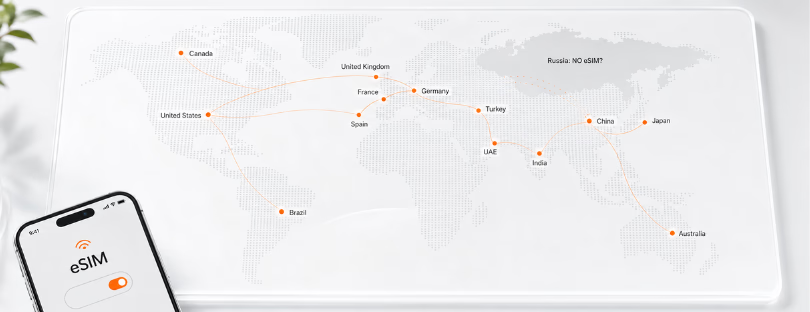
Most serious eSIM providers now offer data in 150 to 200+ destinations. The gap has narrowed significantly. Whether you go with Airalo, Yesim, or Nomad eSIM, you will likely get decent connectivity in major travel regions.
So what actually matters now?
01
Activation experience
If the QR code fails or the setup is unclear, nothing else matters.
The best providers make onboarding almost invisible.
02
Network quality and switching
Some eSIMs connect to stronger local partners or switch networks more intelligently.
You feel it when speeds stay stable, not inconsistent.
03
Transparency
This is where the industry still struggles. “Unlimited” often comes with throttling.
“Regional plans” can hide real network limitations.
The best providers are the ones that don’t play games with definitions.
The Real Problem: Roaming Anxiety
Even with eSIM, people still behave as if they are on expensive roaming.
They check usage constantly. They turn off data. They avoid using maps unless necessary.
That’s not a technology problem. It’s a psychological one.
Some providers are starting to address this directly.
Fairplay Mobile, for example, leans heavily into predictability. Not necessarily the cheapest option, but designed so you stop thinking about data altogether.
Others, like Holafly, solve it through simplicity. Fixed duration, unlimited use.
And then there are flexible models like Yesim, where you can combine different plans depending on how you travel.
Different approaches, same goal: remove the mental load.
Where Most People Get It Wrong
The biggest mistake people make is choosing based on price alone.
Buying an eSIM based on price is like booking a hotel based on the lobby. It tells you almost nothing about the actual experience.
Cheap plans often mean:
Limited speeds after a certain threshold
Fewer network partners
Less reliable performance in crowded areas
That doesn’t mean expensive is always better. It just means price is not the right starting point.
A better question is: what kind of usage do you want to forget about?
The Shift Toward Embedded Connectivity
Here’s something most travelers don’t see yet, but it matters.
The “best eSIM” will increasingly not be something you actively buy.
It will be embedded.
Banks, airlines, and travel platforms are starting to integrate connectivity directly into their products. Instead of searching for an eSIM, you will just get one as part of your experience.
It is no longer about who has the cheapest data or the biggest coverage map. Those are baseline expectations now.
The real competition is happening around experience, predictability, and integration.
Some providers are optimizing for simplicity. Others for price efficiency. A few are building entirely new models around usage behavior and embedded connectivity.
If you zoom out, it looks a lot like what happened with streaming platforms. At first, it was about content libraries. Then it became about user experience and ecosystem control.
eSIM is heading the same way.
And that’s why the idea of a single “best eSIM” is slowly becoming irrelevant.
The better question is this: which one fits how you actually move?
Driven by wanderlust and a passion for tech, Sandra is the creative force behind Alertify. Love for exploration and discovery is what sparked the idea for Alertify, a product that likely combines Sandra’s technological expertise with the desire to simplify or enhance travel experiences in some way.