The eSIM Industry Is Growing Fast — But Not in the Way You Think
If you’ve been watching the eSIM space closely, you’ve probably noticed something odd. On the surface, it looks like a classic growth story. More providers. More plans. More countries covered. Everything is scaling nicely.
But underneath, the industry is shifting in a much more structural way. It’s not just about replacing plastic SIM cards. It’s about redefining how connectivity is built, distributed, and monetized.
The numbers support that momentum. The global eSIM market is projected to reach around $3 billion by 2027, driven largely by IoT, smart devices, and connected infrastructure. But those numbers only tell part of the story.
What actually matters is where that growth is coming from and who is controlling it.
From Consumer Convenience to Infrastructure Layer
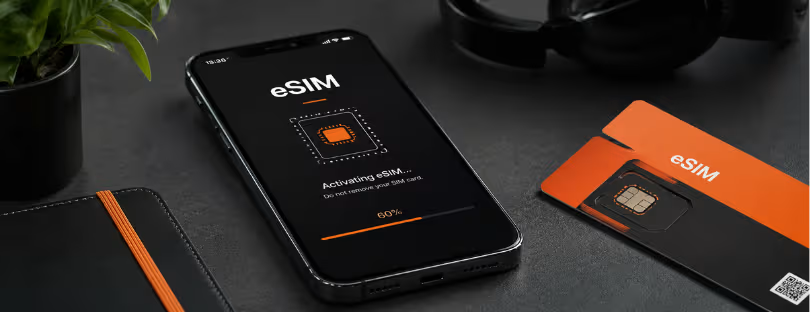
Most people still associate eSIM with travel. You land, scan a QR code, and you’re online. That’s the visible layer.
But the real growth is happening deeper, in infrastructure.
Companies like Arm Limited and its subsidiary Kigen are pushing eSIM and iSIM into billions of devices. Not phones. Machines.
Factories. Cars. Smart meters. Logistics fleets.
Kigen alone has already enabled over two billion SIMs in IoT devices. That’s not a consumer story. That’s a systems story.
eSIM is becoming a default component of connected hardware. Invisible, embedded, and remotely programmable. And once you look at it this way, the “travel eSIM market” starts to feel like just a small front-end layer sitting on top of something much bigger.
IoT Is the Real Growth Engine
If you strip away the marketing noise, IoT is driving this industry.
Machine-to-machine communication is expected to dominate the market share. And it makes sense. Physical SIM cards simply don’t scale when you’re deploying thousands or millions of devices across regions.
eSIM solves that operational problem instantly.
You can provision devices remotely. Switch networks without touching hardware. Manage connectivity centrally.
That’s why industries like manufacturing, logistics, and utilities are moving fast here. The cost savings alone justify the shift.
And then there’s automotive.
Electric vehicles and connected cars are quietly becoming one of the most important eSIM use cases. Governments pushing EV adoption are indirectly accelerating eSIM adoption too. Every connected vehicle needs reliable, flexible connectivity. eSIM is the cleanest way to deliver it.
Consumer Electronics Still Own the Volume
While IoT drives growth logic, consumer electronics still dominate volume.
Smartphones, tablets, wearables. That’s where adoption is most visible.
Apple played a major role here. With dual SIM functionality and eSIM-only models in some markets, devices like the iPhone normalized the concept. Users can now store multiple eSIM profiles and switch between them without thinking too much about it.
That sounds simple, but it changes behavior.
Instead of being locked into one operator, users start thinking in layers. Home plan. Travel plan. Backup plan.
And that opens the door to a new type of provider. Not traditional telecom operators, but digital-first connectivity platforms.
The Quiet Power Shift in the Industry
This is where things get interesting.
Traditional telecom operators like Vodafone Group plc and Deutsche Telekom AG still control the infrastructure. They own the networks.
But they’re no longer controlling the user relationship in the same way.
The presence of strong telecom players, regulatory frameworks, and cross-border mobility makes it a natural environment for eSIM growth.
But what’s more interesting is how different regions are approaching the same technology.
In the US, it’s device-driven. In Europe, it’s travel and roaming optimization. In Asia, it’s deeply tied to manufacturing and IoT scale.
Same technology. Completely different use cases.
The Industry Isn’t Mature Yet — It’s Fragmenting
At this point, it’s tempting to say the eSIM industry is “maturing.”
It isn’t.
It’s fragmenting.
You now have multiple parallel markets:
Consumer travel eSIM providers
Enterprise and IoT connectivity platforms
Embedded telecom APIs
Device-level SIM technology (eSIM vs iSIM)
Each has different economics, players, and priorities.
Companies like Infineon Technologies AG, NXP Semiconductors N.V., and STMicroelectronics are shaping the hardware side.
Meanwhile, connectivity providers and platforms are fighting for distribution and user ownership.
It’s not one industry anymore. It’s an ecosystem.
Conclusion: The Real Question Isn’t Growth — It’s Control
Everyone agrees the eSIM market is growing. The projections, the adoption curves, the device integration. That part is clear.
The more important question is who ends up controlling it.
Is it the telecom operators who own the networks?
Is it the platforms embedding connectivity into their products?
Or is it the infrastructure layer quietly enabling everything behind the scenes?
Right now, the answer is: all of them. But not equally.
What we’re seeing is a gradual shift away from traditional telco dominance toward a more distributed model. One where connectivity is programmable, embedded, and increasingly invisible.
And that’s where the industry gets interesting.
Because once connectivity becomes invisible, it stops being something you buy.
Driven by wanderlust and a passion for tech, Sandra is the creative force behind Alertify. Love for exploration and discovery is what sparked the idea for Alertify, a product that likely combines Sandra’s technological expertise with the desire to simplify or enhance travel experiences in some way.