Looking for the best eSIM for Europe travel?
There was a time when landing in Europe meant one of two things: either you paid your home operator absurd roaming fees, or you queued at an airport kiosk for a plastic SIM card you’d probably lose before your return flight. That entire flow is quietly disappearing.
eSIM has become the default for a certain type of traveler. Not everyone yet, but the shift is obvious. Frequent travelers, business users, digital nomads. The people who care about staying connected without friction.
And Europe is where this shift feels most complete.
Why? Because Europe is fragmented geographically but unified digitally. You cross borders every few hours, but connectivity is expected to just work. That creates the perfect environment for eSIM to prove its value.
But here’s the catch. Not all eSIMs are built the same. And “best eSIM for Europe travel” is not as straightforward as Google results might suggest.
What actually matters in Europe
Most comparison articles focus on price per GB. That’s useful, but it misses how people actually use connectivity while traveling.
In Europe, what matters more is consistency.
You might start your trip in Paris, take a train to Brussels, then fly to Rome. The network experience shouldn’t collapse every time you cross a border. And yet, with some eSIM providers, it does.
The difference usually comes down to two things:
- Multi-network access vs single network reliance
- Core network infrastructure vs reseller dependency
If your eSIM can dynamically connect to strong local networks in each country, you barely notice the transition. If it cannot, you start noticing slow speeds, unstable connections, or random drops.
That’s why the “best” eSIM is not always the cheapest one.
The rise of bundled Europe plans
Another shift worth noticing is how providers package Europe itself.
Instead of selling country-specific plans, most leading eSIM providers now offer regional bundles covering 30, 40, sometimes 50+ European destinations. That aligns better with how people travel across the region.
But even here, there’s nuance.
Some providers include a long list of countries but rely on weaker partner networks in certain markets. Others offer fewer countries but stronger, more consistent performance.
You don’t see that difference in a product page. You feel it when your Maps app stops loading in the middle of a city you don’t know.
Where Orange Travel eSIM stands out
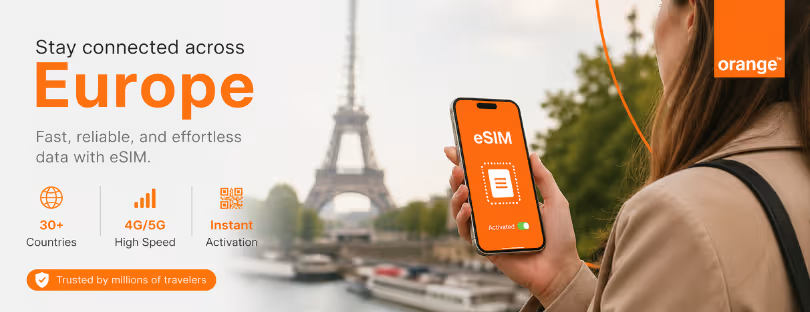
One of the more interesting players in this space is the Orange Travel eSIM.
It does not try to compete purely on being the cheapest option. Instead, it leans on something most travel eSIM brands cannot replicate easily: infrastructure.
Orange is a major European telecom operator, not just a reseller. That changes the experience.
Instead of routing everything through third-party agreements, Orange Travel eSIM benefits from direct network relationships across Europe. In practice, that means more stable speeds, better latency, and fewer edge-case issues.
For travelers who rely on connectivity for work, not just browsing, that difference matters.
You can check the current plans here: https://www.anrdoezrs.net/click-100516938-17230919
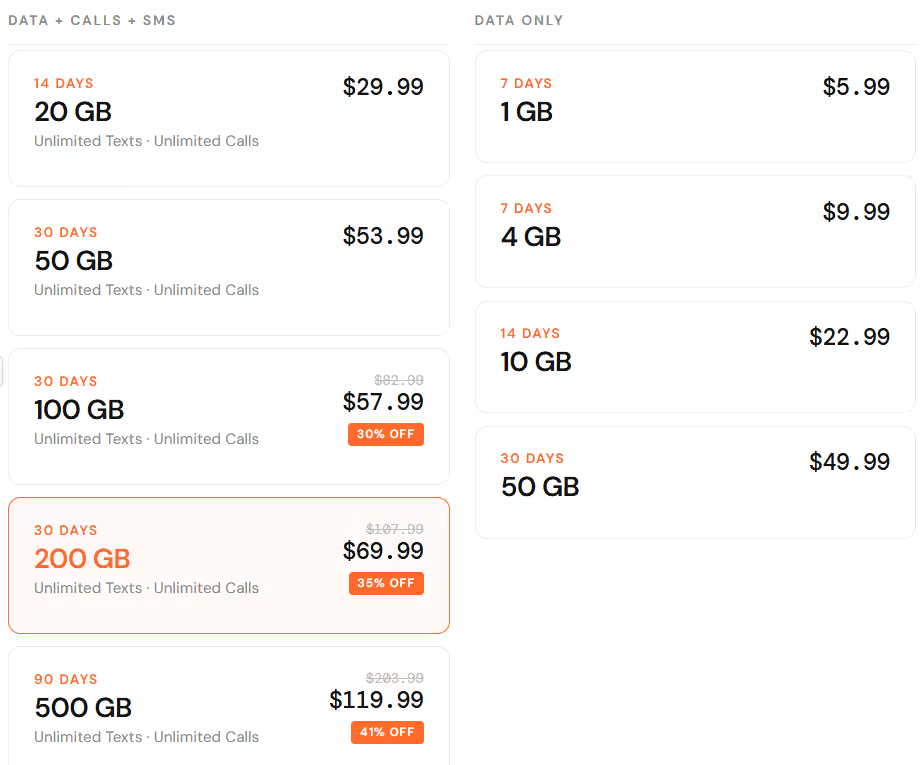
What also stands out is how straightforward the offering is. No overly complex pricing ladders, no confusing “unlimited but actually capped” structures. You get a defined data package, solid coverage, and predictable performance.
It’s not trying to be clever. It’s trying to be reliable.
How it compares with typical travel eSIM brands
Most well-known travel eSIM providers follow a different model.
They aggregate connectivity from multiple partners and package it into consumer-friendly plans. That allows them to scale quickly across regions, but it also introduces variability.
Take the typical experience:
You might get excellent speeds in Spain, decent performance in Germany, and noticeably weaker connectivity in parts of Eastern Europe. Not because those markets lack infrastructure, but because the underlying agreements differ.
This is where operator-backed solutions like Orange Travel eSIM tend to feel more consistent.
That doesn’t mean aggregator-based providers are bad. In fact, they often win on flexibility, pricing options, and ease of use. For short trips or light data usage, they are perfectly fine.
But if your trip involves multiple countries and heavier usage, consistency becomes more valuable than marginal price savings.
The “unlimited” illusion
Another trend worth calling out is the growing use of “unlimited data” messaging in eSIM plans.
On paper, it sounds ideal. In reality, most of these plans include fair usage policies, speed throttling, or hidden limits after a certain threshold.
This is not unique to eSIM. It exists across telecom. But it becomes more problematic when travelers rely on these plans for work or navigation.
In Europe, where networks are generally strong, the issue is not availability. It is transparency.
Some providers are starting to push back against this by offering capped but honest plans instead of “unlimited” with fine print. Orange Travel eSIM sits closer to that camp.
And for many users, especially professionals, predictability beats marketing.

Who should choose what
Not every traveler needs the same type of eSIM.
If you are visiting one or two countries, using moderate data, and want the lowest possible cost, aggregator-based travel eSIMs can be a good fit.
If you are moving across multiple countries, relying on hotspotting, video calls, or constant connectivity, then operator-backed options like Orange Travel eSIM start to make more sense.
There is also a middle ground emerging. Some newer providers are trying to combine aggregator flexibility with better network intelligence. But that space is still evolving.
What the data says about eSIM adoption
According to GSMA Intelligence, eSIM adoption is accelerating rapidly, with hundreds of millions of devices already compatible and growing year over year. Europe is one of the most active regions due to high cross-border travel and strong network infrastructure.
Juniper Research has also pointed out that travel eSIM usage is expected to grow significantly as more consumers move away from traditional roaming.
What is interesting is not just the growth, but the segmentation.
Casual travelers are adopting eSIM for convenience. Frequent travelers are adopting it for control and cost optimization. And enterprise users are starting to treat connectivity as part of a broader mobility strategy.
This is where the market is heading.
Conclusion: Europe is exposing the real eSIM winners
The European travel environment is unforgiving in a subtle way. It doesn’t break connectivity completely. It exposes inconsistencies.
That’s why Europe has become a kind of testing ground for eSIM quality.
If a provider can deliver stable, predictable performance across multiple European countries, it can likely do the same elsewhere. If it cannot, the gaps show quickly.
What we are seeing now is a quiet split in the market.
On one side, high-scale, flexible eSIM aggregators are optimizing for accessibility and price. On the other hand, infrastructure-backed solutions like Orange Travel eSIM focus on reliability and performance.
Neither approach is inherently better. But they serve different types of travelers.
The interesting trend is that as eSIM matures, the conversation is shifting away from “how cheap is the data” toward “how dependable is the connection.”
And that’s a much harder thing to fake.
For travelers who treat connectivity as essential rather than optional, that shift is long overdue.