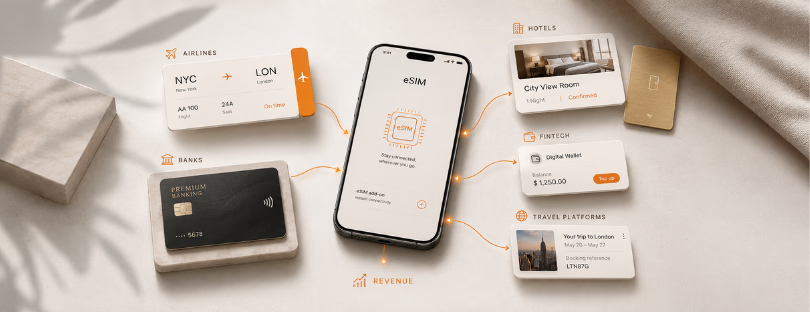
Beeline Uzbekistan Slashes eSIM Number Prices by 95%
From December 17, 2025, Beeline Uzbekistan quietly rolled out one of the most aggressive eSIM promotions we have seen in the Uzbek market so far. Customers can now connect an eSIM and choose a so-called “beautiful number” with a 95 percent discount, turning what is normally a premium purchase into a surprisingly affordable upgrade.
This is not a limited flash deal. The offer runs until June 30, 2025, giving users plenty of time to switch, test eSIM, or finally upgrade their number without paying full price.
For a market that is steadily moving away from physical SIM cards, this promotion feels less like a short term campaign and more like a strategic push.
What exactly is being discounted
Beeline’s promotion applies to premium number categories with face values of 100,000, 250,000, and 500,000 soums. Under the campaign, customers pay only 5 percent of the original price, while the eSIM connection itself remains completely free.
That means a number originally priced at 500,000 soums can be activated for just 25,000 soums, provided the connection is done through the approved digital channels.
The discount does not apply to new numbers with the 92 code and is excluded from a few legacy tariff plans, including Standard, Start, Ijtimoiy, Suhbat, and Status. All other active tariff plans are eligible.
Where and how you can activate the offer
This promotion is intentionally digital first. Users can only access the discount if they connect through:
Hambi application
Beepul application
nomer.beeline.uz website
There is no activation fee and no requirement to visit a physical store, although in-store activation remains available for those who prefer it.
For users who have been hesitant about eSIM due to complexity, Beeline has clearly designed this campaign to reduce friction and promote remote onboarding.
Why Beeline is pushing eSIM so hard right now
An eSIM is a digital SIM embedded directly into your device. It performs all the same functions as a physical SIM, including calls, SMS, and mobile data, but without the plastic.
More importantly, eSIM allows users to run two numbers on one device, reduces the risk of SIM loss, and improves security for banking and authentication messages. These are not minor benefits in a market where mobile payments and super apps are becoming the default.
Beeline’s move aligns closely with global operator trends. According to GSMA Intelligence, more than half of new smartphones shipped worldwide now support eSIM, and operators are increasingly using pricing incentives to accelerate adoption.

Supported devices and setup process
eSIM is supported on most modern iOS and Android smartphones, including popular Apple, Samsung, and Huawei models, as well as some tablets.
Activation is straightforward. Once connected, users receive a QR code that activates the profile on the device.
Apple devices follow the path Settings, Cellular, Add Cellular Plan
Samsung devices use Settings, Connections, SIM Card Manager
Huawei devices activate through Settings, Mobile Network, SIM Management
The provided QR code can be reused up to 10 times within six months, allowing flexibility if you change devices. If the QR code is lost or exhausted, the eSIM can be replaced for a fee based on Beeline’s standard price list.
Important technical details users should not ignore
Before activating an eSIM, users must ensure that their device’s IMEI is registered in Uzbekistan’s national database. Unregistered devices risk deactivation after 30 days.
IMEI registration can be done through:
uzimei.uz
USSD code *1170#
my.gov.uz
Beeline clearly states that it is not responsible for eSIM performance on unregistered devices, which is standard practice across the region.
How does this compare to other operators and regional trends
Across Central Asia, operators are increasingly using eSIM incentives, but Beeline’s 95 percent discount on premium numbers is unusually aggressive.
Most competitors focus on free eSIM activation or bundled data offers. Discounting premium numbers at this scale suggests Beeline is targeting not just tech-savvy users, but also small businesses, entrepreneurs, and digital professionals who value brandable phone numbers.
This strategy mirrors moves seen in markets like Turkey and the UAE, where operators use eSIM to upsell premium identities rather than just data plans.
From an industry perspective, this is a clear signal that eSIM is no longer experimental in Uzbekistan. It is becoming the default.
What this promotion really means for the market
Beeline’s campaign is not just about cheaper numbers. It is about accelerating behavioral change.
By combining free eSIM activation, deep discounts, and fully remote onboarding, Beeline is pushing users toward a future where physical SIM cards are optional and digital identity is central.
For consumers, this means more flexibility and lower costs. For the market, it means faster eSIM adoption and more competition around value-added services rather than plastic cards.
Reliable data from GSMA and regional telecom regulators suggests this shift is inevitable. Beeline’s move simply puts them ahead of the curve.
For users who were waiting for a reason to try eSIM, this might be the clearest signal yet.