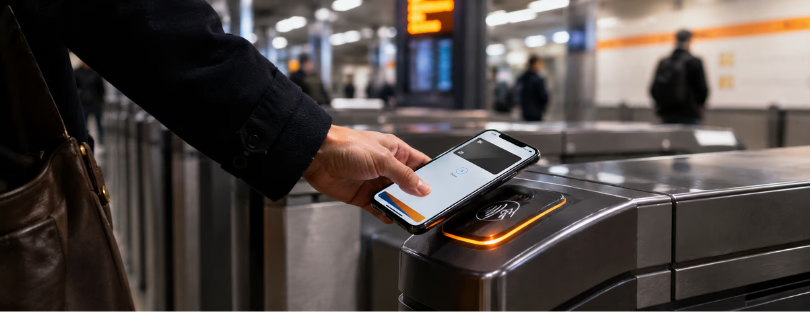
No app opening. No Face ID. No fumbling with a wallet while a queue forms behind you. You simply hold your iPhone or Apple Watch near the reader and move through the gate. Apple’s UK transport page sums it up neatly: Express Mode lets users pay for public transport without Face ID or Touch ID, using a selected payment card in Apple Wallet.
That sounds small. It is not.
In urban mobility, the biggest innovations are often the ones that remove tiny moments of friction. A tourist landing in London does not want to understand the fare zones before finding the train. A commuter changing from bus to tube does not want to unlock a phone three times during rush hour. A business traveller with luggage and a 7 percent battery does not want a payment ritual. Apple Pay Express turns public transport payment into something closer to infrastructure: invisible, fast, and expected.
What Apple Pay Express actually does
Apple Pay Express is not a separate ticketing product. It is a faster mode inside Apple Wallet for supported public transport systems. Users choose a card as their Express Travel Card, then use that card at compatible transport readers without unlocking the device or authenticating each time. Apple’s support documentation also notes that Express Mode can work with certain cards, passes, keys, and transport cards, depending on availability.
For London, the logic is especially clear. Transport for London already allows pay-as-you-go travel using contactless cards, devices, or Oyster. Passengers touch in and out, and the system calculates the right fare. Apple Pay Express simply removes one extra step from that already familiar contactless behaviour.
This is why London remains such an important reference point. TfL did not just digitise tickets. It trained millions of people to think of payment cards and phones as transport access tools. That shift matters far beyond London.
Why travellers should care
For regular commuters, Apple Pay Express is about speed. For travellers, it is about confidence.
That distinction matters. A local usually knows which gate to use, whether to tap out, and what fare rules apply. A visitor is still decoding the city. Every extra action creates uncertainty: Is this the right app? Do I need a local transit card? Will my bank card work? Do I need to buy a ticket before boarding?
Apple Pay Express does not solve every transport problem, but it removes one of the most annoying ones. It makes arrival smoother.
There is also a subtle travel-tech lesson here. The best traveller experience is not always another app. Sometimes it is the disappearance of an app. Open-loop contactless transport, where riders can use bank cards and mobile wallets directly, is becoming the cleaner model for many cities because it reduces the need for stored-value cards, ticket machines, and pre-trip planning. UITP has described open-loop payments as a route toward easier, safer, and more convenient public transport implementation.
That is the real story: ticketing is moving from “buy access” to “tap access.”
The bigger payment shift
Apple is not alone in this movement. Mastercard, Visa, transport authorities, ticketing vendors, and mobility platforms are all pushing public transport toward contactless, digital-first payment. Mastercard said contactless payments accounted for more than 75 percent of transactions on its network in 2025, and highlighted transit as one of the areas where tap-and-go behaviour is becoming default.
Vendors such as Worldline, Thales, Flowbird, Cubic, Littlepay, and Scheidt & Bachmann are also part of the wider modern ticketing layer. Some provide fare collection platforms. Some help transit agencies accept bank cards. Some work on account-based ticketing, fare media issuance, validators, and back-office systems. Apple sits closer to the consumer interface, but the magic at the gate depends on a much larger payment and transport infrastructure.
That is important because public transport is not like coffee retail. It has fare caps, inspections, refunds, concessions, network transfers, offline risk, accessibility needs, and political pressure. A tap must be instant, but the system behind it is anything but simple.
Apple’s advantage is that it owns the device experience. When Express Mode works well, the traveller does not think about tokenisation, NFC routing, bank authorisation, fare aggregation, or transport back offices. They just pass through.
Where the model still has limits
There are still practical issues. Express Mode only works where transport agencies support it, and Apple notes that availability depends on the agency and market. Some cities accept Apple Pay as a normal contactless payment method but do not necessarily support the full Express experience. Others still rely on closed-loop cards, local transport apps, QR tickets, or paper tickets.
There is also the familiar problem of card clash. Apple warns users to keep physical cards separate from Apple devices when using Express Mode, so the right payment method is charged. Anyone who has watched a tourist press a phone, wallet, and hotel key card against the same reader knows this is not theoretical.
Another issue is equity. Mobile wallet ticketing is excellent for people with modern smartphones, bank cards, and compatible devices. It does less for children, unbanked riders, older passengers, or people using concession fares. That is why the smartest transport systems do not treat mobile wallets as the only answer. They treat them as one layer in a wider access model.
Why does this belong in travel tech?
Apple Pay Express is not usually discussed in the same breath as eSIMs, digital identity, airport apps, or hotel check-in tools. It should be.
For travellers, connectivity, payments, transport, and identity are merging into one arrival experience. You land, connect, navigate, pay, authenticate, and move. The companies that control those first 30 minutes of arrival have enormous influence over the travel journey.
This is where Apple’s strategy becomes interesting. Apple Pay Express is not just a payment convenience. It strengthens Wallet as a travel interface. Boarding passes, hotel keys, car keys, IDs in some markets, payment cards, transit cards, and now frictionless public transport access all point in the same direction: the phone becomes the traveller’s operational layer.
Google Wallet is playing a similar game on Android. Local transport apps are defending their relevance. Banks want the payment relationship. Transit agencies want control over fare policy and rider data. Payment networks want open-loop acceptance. Ticketing vendors want to modernise legacy systems without breaking public infrastructure.
The winner is not necessarily the company with the flashiest app. It is the company closest to the moment of movement.
Final thoughts about Apple Pay Express
Apple Pay Express is easy to underestimate because it feels like a feature, not a product. But that is exactly why it matters.
The next phase of travel technology will not be won only by booking platforms, airline apps, or destination guides. It will be shaped by small, high-frequency moments where travellers either feel in control or feel stupid. Ticket gates are one of those moments.
Compared with traditional transit cards like Oyster, Apple Pay Express is lighter for visitors and more natural for smartphone users. Compared with local ticketing apps, it has less friction. Compared with standard contactless bank cards, it benefits from Apple’s device-level experience and Wallet integration. But compared with full transport agency platforms, it is still only one part of the stack.
That is the right way to see it. Apple Pay Express is not replacing public transport ticketing. It is pressuring ticketing to become invisible.
For Alertify readers, the bigger takeaway is simple: the future of travel tech is not just about selling travellers another digital product. It is about removing the tiny frictions that make travel feel heavier than it should. Apple understands that. So do the payment networks. Transport authorities are catching up at different speeds.
And once travellers get used to tapping through a city without thinking, they will expect the same simplicity everywhere else. Connectivity, hotel access, airport transfers, insurance, loyalty, even roaming. The bar is moving. Apple Pay Express is one quiet example of how high it is getting.
Driven by wanderlust and a passion for tech, Sandra is the creative force behind Alertify. Love for exploration and discovery is what sparked the idea for Alertify, a product that likely combines Sandra’s technological expertise with the desire to simplify or enhance travel experiences in some way.


 The bigger payment shift