20 Airport Hacks That Make Travel Smoother
Airports are not difficult. They’re just inefficient by default.
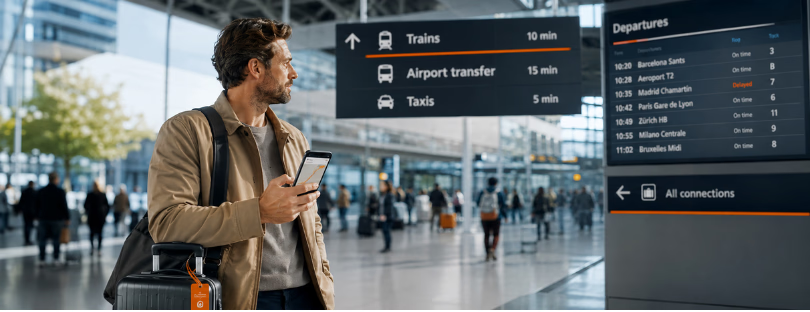
The difference between someone who glides through an airport and someone who feels overwhelmed is rarely experienced alone. It’s how many decisions they’ve already made before they even arrive.
Frequent travelers don’t rely on “tips.” They build routines that remove friction. Once you understand that, airports stop feeling chaotic and start feeling predictable.
Here’s what that actually looks like in practice.
1. Arrive early, but only to eliminate uncertainty
Arriving early is not about being safe. It’s about neutralizing variables you don’t control. Security queues, baggage delays, last-minute gate changes. Once those are cleared, the airport becomes manageable. Until then, time pressure amplifies everything.
2. Set up connectivity before you leave home
Landing without internet is still one of the most underestimated friction points in travel. You don’t notice it until you need a ride, directions, or a boarding update. With eSIM, that problem is avoidable. Install it before departure and you remove an entire layer of stress on arrival.
3. Stop relying on airport WiFi entirely
Airport WiFi works just well enough to make you depend on it, and fails just often enough to disrupt you. Boarding passes, hotel confirmations, transport bookings should all be accessible offline or through mobile data. Treat WiFi as optional, not essential.
4. Carry your own power source
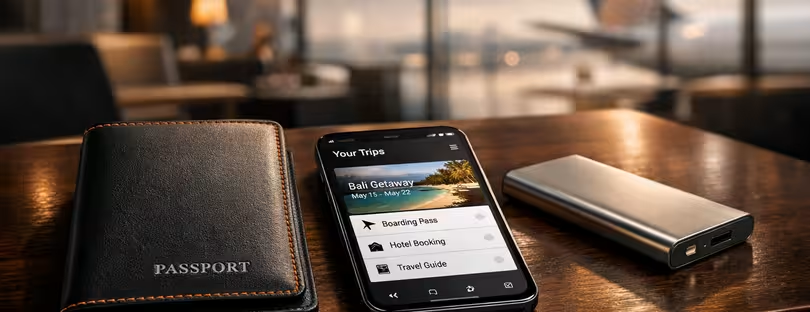
A dead phone at an airport is more than an inconvenience. It cuts you off from tickets, communication, and navigation. Power banks are not a backup anymore. They are part of your standard setup.

5. Choose queues based on behavior, not length
Not all lines move at the same speed. A shorter queue with unprepared passengers often moves slower than a longer one filled with frequent travelers. Look at how people are moving, not how many there are.
6. Learn the patterns of the airports you use
Every major airport has its own rhythm. Some are slow at security, others at boarding. Some require long transfers, others are compact but crowded. Once you understand these patterns, you stop reacting and start anticipating.
7. Standardize your security routine
Security becomes effortless when nothing is a decision. Liquids in the same pocket. Laptop in the same sleeve. Passport always accessible. The goal is to move through the process without thinking.
8. Download everything that matters
Air travel is full of small moments where you suddenly need access to something critical. Boarding passes, hotel addresses, tickets, visas. If it’s important, it should not depend on connectivity.
9. Dress for the entire journey, not the destination
Airports involve walking, waiting, temperature shifts, and long periods of sitting. Comfort is not about style. It’s about adaptability. Layers, breathable materials, and good footwear make a bigger difference than most people expect.
10. Use lounges when they solve a problem
Lounges are often presented as upgrades, but they are only valuable in specific situations. Long layovers, need for quiet, reliable food options. Otherwise, they can be just as crowded and slow as the main terminal.
11. Board late when you can
Boarding early doesn’t improve your experience unless overhead space is a concern. In most cases, it just means spending more time seated in a confined space. Waiting until the final call often makes the process smoother.
12. Choose seats based on what happens after landing
Seat selection is rarely about the flight itself. It’s about what happens when you arrive. If you have a tight connection, being closer to the front can save valuable time. That decision matters more than marginal differences in comfort.
13. Organize your carry-on for access, not capacity
Most people pack efficiently but access things inefficiently. Items you’ll need during the flight should be reachable without unpacking everything. Think in layers of access, not just in terms of space.
14. Avoid airport retail distractions
Airports are designed to capture attention and slow movement. If you don’t have a clear intention, you lose time without realizing it. Decide in advance if you need anything. If not, keep moving.
15. Bring food even if you don’t plan to eat it
Delays change plans. Airport food is expensive and often limited. Having your own options means you’re not forced into bad decisions when you’re tired or rushed.
16. Hydrate before the flight starts
Most people only think about hydration once they’re on the plane. By then, you’re already behind. Starting earlier helps reduce fatigue and makes the entire journey more comfortable.

17. Adjust to your destination time as early as possible
Switching your phone and mindset to the destination time helps reduce confusion and prepares your body for the shift. It’s a small step, but it makes transitions smoother.
18. Use packing cubes to reduce decision time
The real benefit of packing cubes is not organization. It’s speed. You can find what you need instantly without disrupting the rest of your bag.
19. Carry a small essentials kit
A few well-chosen items solve a disproportionate number of problems. Eye drops, medication, wipes, earplugs. These are not extras. They are safeguards against common travel discomforts.
20. Remove decisions before they appear
This is the principle behind all of it.
Check in online. Download documents. Pre-select seats. Arrange transport. Set up connectivity.
Every decision you make in advance is one less thing to deal with when you’re tired, rushed, or distracted.
Conclusion: airports don’t get easier, you get better
Airports haven’t become simpler. If anything, they’ve become more complex.
What changes is how you interact with them.
Frequent travelers don’t move faster because they’ve discovered secret tricks. They move faster because they’ve reduced the number of variables they have to deal with in real time.
Did you have a delayed or canceled flight? Get up to $700 compensation per passenger, no matter the ticket price.
That’s what these “hacks” actually are. Not shortcuts, but systems.
Once you start applying them, airports stop feeling like something you have to navigate.
They become something you’ve already solved.