ABB Bank, Azerbaijan’s Largest Bank, Embeds eSIM Into Its App
Azerbaijan’s largest bank just quietly made a move that says a lot about where eSIM distribution is heading.
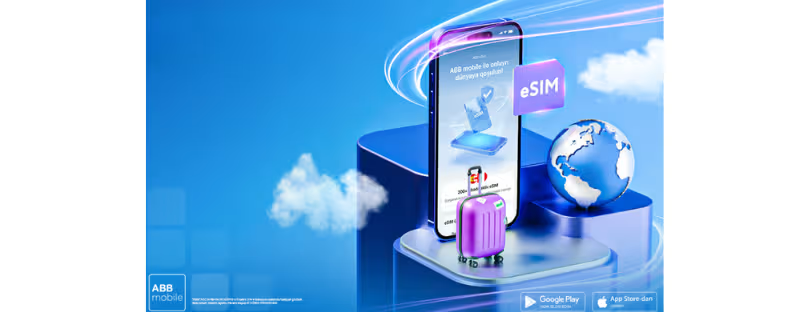
ABB Bank, the International Bank of Azerbaijan, has launched an eSIM service directly inside its mobile app.
The service is live, it is VAT-free, and it fits into a broader strategy ABB has been building for some time. This is not just a product launch. It is a distribution move, and one that deserves attention.
The lifestyle banking angle
ABB is not positioning eSIM as a standalone telecom product. It is positioning it as part of a wider lifestyle banking ecosystem.
The bank has already integrated travel insurance, visa application support, document services, and the ABB AZAL Miles card for earning travel rewards, all within the same mobile app. Adding connectivity is simply the next logical step.
That context matters more than it might seem at first.
We have seen elements of this approach from neobanks like Revolut and Wise, but ABB is not experimenting at the edges. It is a large, established institution serving millions of customers, and that makes this move less about innovation and more about adoption.
It also shows how far the eSIM API economy has already moved into mainstream infrastructure.
The logic behind the partnership is straightforward. There is no app install, no comparison process, and no search friction. Connectivity becomes something users access in a place they already trust.
What the service actually offers
From a user perspective, the ABB eSIM product is intentionally simple.
Users select a package inside the mobile app, activate it via QR code, and connect without replacing their physical SIM card. Coverage extends across more than 200 countries, with both prepaid bundles and unlimited plans available.
Hotspot sharing is included, which remains essential for business travelers and anyone using multiple devices.
The most visible differentiator is pricing. Purchases made through the ABB mobile app are exempt from Azerbaijan’s 18% VAT, which creates a clear cost advantage compared to standard eSIM marketplaces in the same region.
There is also a service layer that adds real value. The offer includes 24/7 customer support with fast response times, addressing one of the most common frustrations travelers experience when connectivity fails abroad.
None of these features is individually unique. What makes them powerful is how they are combined and where they are delivered.
The bigger picture: distribution is shifting
This service reflects a broader shift in how eSIM services reach users. The traditional model based on app store discovery, comparison platforms, and influencer-driven acquisition is becoming increasingly saturated. At the same time, adoption continues to grow rapidly as travelers look for more flexible and transparent alternatives to roaming.
In this environment, the competitive focus is changing.
It is no longer only about pricing or data volume. It is about distribution.
Banks, airlines, and large digital platforms already have direct access to millions of users. That is something most eSIM providers are still trying to build.
ABB’s move shows how that advantage can be used.
Instead of sending users out to find connectivity, it brings connectivity directly into an existing ecosystem.
The competitive lens
Different players in the eSIM market are approaching this shift in different ways.
Holafly has built its positioning around unlimited data and emotional travel messaging. Airalo dominates with scale and a marketplace model. Nomad focuses on transparency and performance. Ubigi has carved out a position through device integration and long-term plans.
The ABB partnership is a clear example of that strategy in action. Users do not need to search for an eSIM. They encounter it naturally within a product they already use.
That changes acquisition dynamics completely.
Retention, not just acquisition
One detail that stands out is how retention is built into the model. Users earn from their connectivity spend, remain within the same platform, and return for future trips without reconsidering alternatives.
The VAT exemption acts as a short-term incentive. The loyalty structure creates long-term stickiness.
Conclusion
ABB’s eSIM launch is a clear signal of where the market is heading.
Connectivity is moving away from being a standalone telecom product and becoming an embedded service within broader digital ecosystems.
Compared to traditional operators, this model is more flexible and easier to use. Compared to standalone eSIM apps, it removes friction and simplifies the decision-making process.
But the deeper shift is not about convenience.
It is about control over distribution. As the market continues to evolve, the defining advantage will not be who offers the cheapest data, but who controls the point where users access connectivity.