Anonymous eSIM With No ID Required? ZeroID Thinks It’s Time
A Wyoming-registered startup called ZeroID launched this week with a straightforward pitch: mobile connectivity, no identity required. No passport scan, no email address, no account — just pay in crypto, scan a QR code, and get online. The company is calling it an anonymous eSIM, and while the concept isn’t entirely new, ZeroID is betting that 2026 is finally the right moment for it to go mainstream.
The timing isn’t arbitrary. Mandatory SIM registration is now law in over 150 countries, cross-border data sharing between carriers and intelligence agencies is increasingly normalized, and telecom data breaches have become something of a quarterly event. For most travelers, the trade-off — hand over your identity, get connectivity — has always felt lopsided. ZeroID is trying to renegotiate that deal.
What ZeroID Is Actually Offering
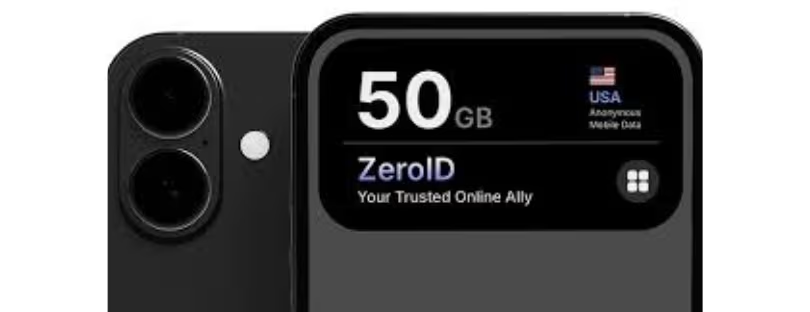
The model is simple: no ID, no email, no phone number. Pick a plan, pay with crypto — Solana, USDC, or ZeroID’s native token — scan a QR code, and connect. The company claims global coverage across multiple regions, though it hasn’t published a detailed carrier breakdown publicly. Plans appear to be data-focused, with at least two packages reportedly including a phone number for account creation on messaging platforms.
ZeroID originated from the Solana hackathon ecosystem, and its integration with Solana is central to the experience — near-zero transaction fees and fast confirmations make the checkout flow practical rather than clunky. That matters in this niche, where the barrier isn’t just identity — it’s the UX friction of crypto-native payments.
“Privacy should not be an afterthought — it should be embedded into the infrastructure itself,” a ZeroID spokesperson said. “Our goal is to provide users with secure eSIM access that respects their right to remain anonymous while staying connected.”
The target audience is familiar territory for privacy tools: journalists operating in sensitive environments, activists, digital nomads, travelers in countries with restrictive telecom policies, and anyone who has simply read enough about SIM swap fraud to want a cleaner setup.
The Regulatory Ceiling Nobody Talks About
Here’s the honest caveat: anonymous mobile connectivity is a regulatory minefield. ZeroID acknowledges this — its offering only applies “where legally permissible,” which in practice means it will face significant geographic constraints. In most major markets, including much of the EU, the US, and across Southeast Asia, some form of SIM registration is required at the carrier level, regardless of what resellers do or don’t collect.
The workaround that no-KYC eSIM providers rely on is operating as an MVNE or reseller that purchases capacity from carriers without passing identity requirements down to the end user. Whether that holds up at scale — or under regulatory scrutiny — is the open question hanging over the entire category.
This isn’t a ZeroID-specific problem. It’s the structural tension every player in this space navigates. But ZeroID’s marketing goes heavy on the “anonymous” framing, which will inevitably attract attention from regulators in jurisdictions where that claim is difficult to sustain.

Not the Only Game in Town
ZeroID is entering a market that already has a few established players, and the competitive landscape is worth examining honestly.
Silent.link — arguably the most recognized name in the no-KYC eSIM space — has operated a zero-KYC policy with no data required, not even an email address, accepting Bitcoin and Lightning payments for years. It covers 160+ countries on a pay-as-you-go model, with no data caps or expiration dates. The trade-off is price: Silent.link charges a notable premium over competitors, and some users find the interface less accessible.
VoidMob and PikaSim have also emerged as players, all skipping identity verification and accepting crypto — but the differences run deeper than shared basics. VoidMob, for instance, bundles eSIM with mobile proxies and SMS verification in a single dashboard, and discloses carrier and exit country information before purchase — a transparency detail that matters for users who need a specific IP routing location. Silent.link, by contrast, does not provide upfront routing selection or per-plan exit country information, which can create friction for anyone using the eSIM for anything beyond basic browsing.
ZeroID’s differentiation appears to sit at the intersection of ease-of-use and Solana-native payments. QR-based instant activation gets users online within minutes, without the email confirmation steps or manual delays that some competitors still impose.
The Bigger Picture
What ZeroID’s launch actually signals
The no-KYC eSIM segment is small but growing, and it’s attracting a more sophisticated user base than the early privacy-nerd demographic might suggest. Corporate travelers worried about corporate espionage, freelancers who work across geopolitical fault lines, researchers operating in authoritarian contexts — these aren’t fringe cases anymore.
What’s interesting about ZeroID’s timing is the crypto-native payment layer. Solana’s speed and low fees make micropayments viable in a way that Bitcoin on-chain never quite was, and USDC gives users who aren’t deep into crypto a practical on-ramp. If ZeroID executes well on distribution and keeps pricing competitive with Silent.link, it has a real opening.
The harder problem is trust. Silent.link has years of community-tested credibility, documented on platforms like Privacy Guides and KYCNOT.ME. ZeroID is new, incorporated in Wyoming (a common jurisdiction for privacy-forward US companies), and built on press release momentum. That’s not a disqualifier — every established player started somewhere — but it means the scrutiny from privacy-conscious users will be high, and the margin for broken promises is thin.
The broader trend here is real: users are layering privacy tools in ways that didn’t exist three years ago — no-KYC eSIM for connectivity, encrypted DNS, hardened mobile OS, privacy-first browser. ZeroID is positioning for a specific layer in that stack. Whether it becomes the go-to option, or another entry in a crowded comparison table, will depend on how its network quality holds up in practice, how transparent it gets about its carrier relationships, and whether its regulatory strategy is as robust as its privacy marketing suggests.
The demand is there. The execution is what’s unproven.