Sezzle Mobile Plan: More Than Just $29.99
The U.S. mobile market just got a new player. Not a carrier. Not a traditional MVNO brand. A fintech app.
Sezzle Inc. has launched Sezzle Mobile, a truly unlimited mobile phone plan starting at $29.99 per month. It runs on AT&T’s network and is powered by Gigs, one of the leading embedded connectivity platforms globally.
On paper, this looks like a low-cost wireless offer.
In practice, it’s a signal that telecom distribution is shifting again.
From Buy Now, Pay Later to Always Connected
Sezzle built its reputation around buy now, pay later services. It positioned itself as a financial companion for younger consumers who want more control, transparency, and flexibility in how they manage spending.
Now it’s moving into connectivity.
Sezzle Mobile allows users to activate and manage their phone plan directly inside the Sezzle app. The move extends the company’s ecosystem beyond checkout and into a daily-use service that touches nearly every aspect of modern life.
The offer includes:
- Unlimited, prioritized 5G data that stays fast
- Unlimited talk and text
- Unlimited HD streaming
- Canada and Mexico roaming included
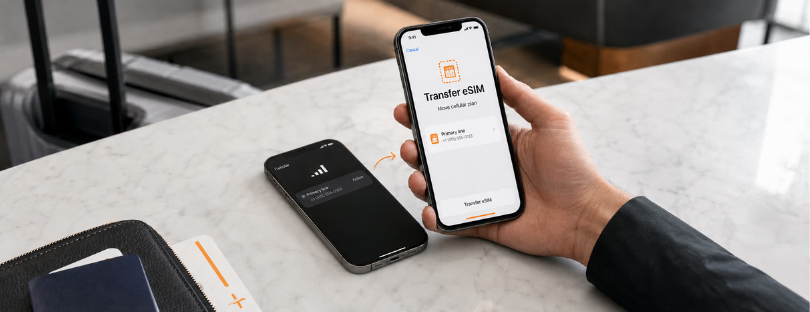
- Instant eSIM activation in the app
At $29.99 per month for Sezzle Anywhere subscribers, excluding taxes and fees, the pricing is positioned far below the average U.S. single-line plan, which typically ranges from $70 to $100 according to industry estimates and FCC data.
The value proposition is straightforward: fewer surprises, lower cost, managed in one place.
Transparent Pricing in a Complicated Market
The U.S. wireless market is not known for simplicity.
Multi-tiered plans, autopay discounts, promotional pricing that expires, device installment structures, hidden fees. The list is long. For many consumers, the final monthly bill rarely matches the advertised headline number.
Sezzle is leaning hard into the opposite narrative.
“With Sezzle Mobile, we’re extending our platform into another essential category by offering a straightforward mobile plan with transparent pricing and dependable coverage,” said Charlie Youakim, CEO and Co-Founder of Sezzle. “It’s the next evolution of how we help users manage their financial journeys while providing savings on essential services, all in one place.”
The positioning is not telecom-first. It is finance-first.
Sezzle is not trying to be perceived as a network innovator. It is presenting mobile connectivity as another financial lever inside a broader budgeting ecosystem.

Powered by Gigs, Running on AT&T
Behind the scenes, Sezzle Mobile is enabled by Gigs, a company that specializes in embedded connectivity for digital platforms. Gigs powers mobile infrastructure for brands such as Revolut, Nubank, LATAM Airlines, and NETGEAR, bridging the gap between traditional telecom carriers and modern apps.
“Sezzle’s move into mobile connectivity is a natural evolution of their mission to expand financial access,” said Rishi Sachdeva, Head of Fintech at Gigs. “By embedding wireless directly into their platform, Sezzle can now offer their millions of users seamless connectivity alongside the payment flexibility they already trust – all in one place.”
This infrastructure model is important.
Sezzle does not operate its own network. The plan runs on AT&T’s coverage footprint, meaning users benefit from a nationwide 5G network without Sezzle having to build spectrum assets or physical infrastructure.
Gigs handles carrier integration, provisioning, and operational complexity. Sezzle owns the customer experience.
That separation between infrastructure and interface is increasingly common across global telecom markets.
No Contracts, No Fine Print
One of the clearest differences in Sezzle’s messaging is simplicity.
One plan. Cancel anytime. Managed entirely within the app.
There are no cancellation fees. No multi-tier bundles. No requirement to visit a retail store. Activation is handled via eSIM, which removes shipping delays and physical SIM management.
This aligns with the expectations of younger, digital-native users who treat subscriptions as flexible utilities. If a streaming service can be canceled in two taps, why not a mobile plan?
From a behavioral standpoint, that flexibility reduces friction in adoption. Consumers are more likely to try a service if exit is easy.
A Bigger Trend: Platforms Owning Connectivity
Sezzle’s move is part of a broader structural shift.
Connectivity is becoming embedded inside platforms rather than sold exclusively by carriers. Financial apps, neobanks, airlines, and even retail brands are experimenting with bundled connectivity offers.
Analysts at IDC and GSMA Intelligence have noted the growth of digital MVNO and embedded connectivity models as carriers look for new distribution channels and brands seek recurring revenue streams.
For Sezzle, mobile is not just another product. It increases engagement frequency. A payment app may be used occasionally. A mobile plan is managed monthly and relied upon daily.
That changes the depth of the customer relationship.
It also creates cross-sell potential. If a user saves $40 to $60 per month on a phone plan, that perceived financial relief strengthens loyalty to the broader Sezzle ecosystem.
Expanding the All-in-One Financial Hub
Sezzle describes itself as an all-in-one financial app that enables users to shop, earn, and learn in one place. Its offerings already include point-of-sale financing, subscriptions, and discounts on everyday essentials such as gas and dining.
Adding wireless connectivity turns the platform into something closer to a utility hub.
A phone plan is infrastructure. It is recurring, essential, and deeply personal. Bringing that inside a fintech app signals a clear ambition: become the default control center for everyday spending.
This mirrors global super-app trends where financial services expand horizontally into lifestyle utilities.
Conclusion: Telecom Becomes Infrastructure, Platforms Become Brands
Sezzle Mobile is not redefining network technology. It is redefining distribution.
AT&T remains the infrastructure provider. Gigs provides the embedded connectivity backbone. Sezzle owns the interface and the financial relationship.
That layered model reflects where telecom is heading.
Carriers continue to control spectrum and network assets. But consumer-facing loyalty may increasingly belong to digital platforms that bundle connectivity with financial tools, subscriptions, and lifestyle services.
The question is not whether embedded connectivity will grow. Market indicators suggest it will.
The real question is whether consumers trust fintech brands enough to consolidate essential services like mobile into a single app.
Sezzle has decided that the future of financial empowerment includes connectivity.
And in a market where simplicity and cost control matter more than ever, that may prove to be a smart bet.