10 Essential Things You Must Know to Use eSIM
If you’ve traveled in the last two years, you’ve probably heard someone say it: “Just get an eSIM.” No kiosks, no tiny plastic cards, no awkward airport queues. It sounds simple. And it is. But only once you understand how it actually works.
At Alertify, we’ve seen the gap between expectation and reality. People think eSIM is plug-and-play. In practice, there are a few things that separate a smooth experience from a frustrating one.
Here’s what really matters before you hit “buy.”
1. What an eSIM actually is (and what it isn’t)
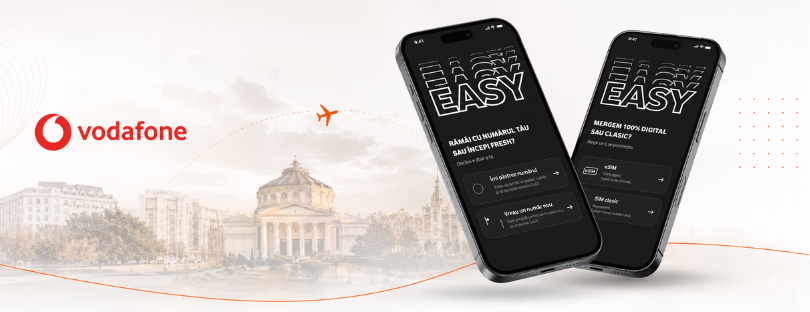
At its core, an eSIM is just a digital version of a SIM card. It’s built into your device, so instead of inserting a chip, you download a mobile plan directly to your phone.
That sounds trivial, but it changes the entire experience. No physical swap, no store visit, no waiting. You scan a QR code or install via app, and your device connects to a network almost instantly.
What it isn’t: a new network. eSIM is just the delivery method. The actual connectivity still depends on the provider behind it.
2. Device compatibility is still a real limitation
This is where most people get caught off guard.
Not every phone supports eSIM. Even today, compatibility depends on the model, region, and whether your device is unlocked.
You’d think this is obvious, but in reality, it’s the number one failure point. People buy a plan first, then check compatibility later.
And there’s a second layer. Even if your phone supports eSIM, some devices have limitations around how many profiles you can store or actively use at once.
Bottom line: always check before you buy.
3. You need the internet to get connected
Here’s a slightly ironic detail.
To install an eSIM, you need an internet connection. That usually means WiFi.
If you land in a new country expecting instant connectivity but skipped this step, you may end up hunting for airport WiFi anyway.
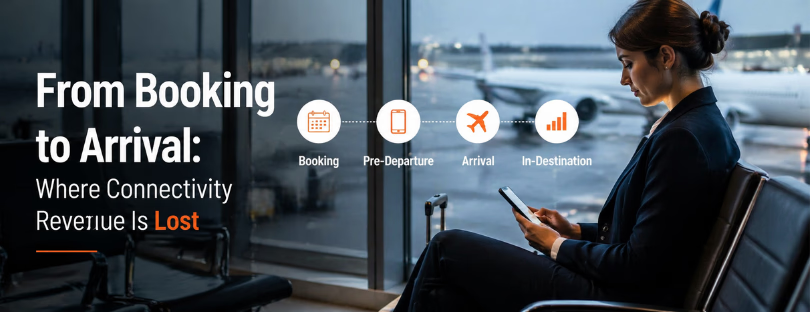
Experienced travelers install their eSIM before departure. That small habit removes 90 percent of potential friction.
4. Most eSIMs are data-only
This is one of the biggest misconceptions.
Many travel eSIMs don’t include a phone number. They’re built for data, not traditional calls or SMS.
That’s not necessarily a limitation. In reality, most communication already happens through apps like WhatsApp, Teams, or Slack.
Still, if you need a local number for business, bookings, or verification codes, you need to choose carefully. Some providers offer voice-enabled plans, but they’re not the default.
5. You can store multiple plans on one device
This is where eSIM starts to feel genuinely powerful.
You can keep multiple profiles on your phone and switch between them without swapping anything physically.
In practice, that means:
- One line for your home number
- One for travel data
- Another for a specific country or region
For frequent travelers or remote workers, this is a quiet game changer. You stop thinking in terms of “one SIM at a time.”

6. It’s built for multi-country travel
If you’re visiting one country for a month, a local SIM can still be cheaper.
But the moment your trip spans multiple countries, eSIM becomes the obvious choice. You can activate regional or global plans instantly without buying new cards in every destination.
This is why eSIM adoption is tightly linked to modern travel patterns. Shorter stays, more movement, less patience for friction.
7. Roaming vs eSIM is not even a close comparison anymore
Let’s be honest.
Traditional roaming is convenient but often expensive. Charges vary wildly and can escalate quickly without warning.
eSIM flips that model. You buy a fixed data package upfront. You know exactly what you’re paying.
That predictability is why so many travelers are switching. It’s not just about saving money. It’s about removing uncertainty.
8. There are still real limitations
For all the hype, eSIM isn’t perfect.
S8. ome key constraints still matter:
- You can’t easily transfer an eSIM between devices
- Once deleted, some profiles can’t be reinstalled
- Setup depends on your phone’s OS and settings
- Some countries restrict or limit eSIM usage
These aren’t deal-breakers, but they’re important. Especially if you frequently switch devices or rely on backup phones.
9. Security and privacy are underrated advantages
This part doesn’t get enough attention.
Because eSIM is embedded in your device, it’s harder to lose or physically steal. It also reduces risks like SIM swapping in certain scenarios.
And from a travel perspective, there’s another angle. You often avoid handing over your ID to buy a local SIM in unfamiliar markets.
It’s a small detail, but one that matters more in some regions than others.
10. The setup experience defines everything
Two people can use the same provider and have completely different experiences.
Why? Setup.
The process itself is simple on paper. Scan QR, install profile, activate. But in practice, issues usually happen here:
- Wrong activation timing
- Incorrect APN settings
- Confusion between primary and secondary SIM
Most providers offer guides, but not all guides are equal.
If there’s one takeaway from real-world usage, it’s this: the quality of onboarding matters more than the price.
Choosing the right provider is the real decision
People often treat eSIM as a product. It’s not.
It’s a layer. The real difference comes from the provider behind it.
Some focus on:
- Simplicity and unlimited plans
- Low-cost regional data
- Enterprise-level control and APIs
- Premium performance and predictable pricing
And this is where the market is quietly splitting.
What this really means for the eSIM market
eSIM is no longer just a travel hack. It’s becoming infrastructure.
We’re seeing clear segmentation:
- Consumer-first brands competing on price and ease
- Premium players redefining “unlimited” with performance and predictability
- B2B platforms embedding connectivity into products and services
Providers like Airalo and Holafly built early traction with accessibility and global reach. Others are pushing new models. Subscription-based connectivity, usage-based pricing, API-driven distribution.
Industry data backs this shift. eSIM adoption continues to accelerate, with hundreds of millions of profiles being downloaded annually and strong growth tied to travel and enterprise use cases.
And importantly, the conversation is moving beyond “how to stay connected” to “how connectivity fits into the broader travel and mobility ecosystem.”
Conclusion: eSIM is simple. The ecosystem isn’t.
The promise of eSIM is simplicity. And for the end user, it mostly delivers.
But behind that simplicity is a rapidly evolving ecosystem. Different pricing models. Different philosophies around unlimited data. Different approaches to distribution and control.
Compared to traditional SIM cards, eSIM removes friction. Compared to roaming, it removes unpredictability. But compared to other eSIM providers, the differences are becoming more strategic than technical.
This is where travelers need to pay attention.
Because choosing an eSIM is no longer just about getting online. It’s about choosing how you want to stay connected. Flexible, predictable, or deeply integrated into your digital life.
And that’s the bigger shift.
Connectivity is no longer a utility. It’s becoming part of the travel experience itself.