Why Social Media Now Drives Telco Decisions
Choosing a mobile carrier used to be a quiet, practical decision. You walked into a store, signed a contract, received a plastic SIM card, and stayed with the same operator for years. Switching was possible, but it required effort and usually happened only when something went seriously wrong. social media influence telecom purchase
That model is rapidly fading.
A new study from Snapchat and market research firm Alter Agents sheds light on how Gen Z and Millennials approach telecommunications today. The research examines the decision-making process behind choosing mobile, internet, and TV providers, and the results point to a major shift in how telecom services are discovered and purchased.
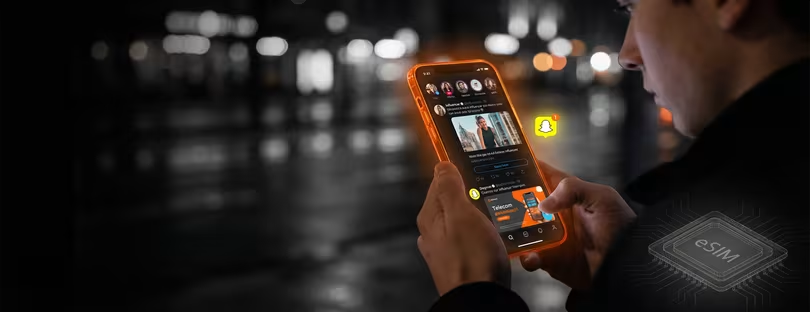
For younger consumers, the journey no longer starts with a carrier store or even a search engine. It starts on social media.
The New Telco Customer Journey
The telecommunications industry has always dealt with churn, but younger consumers appear far more willing to switch providers than previous generations.
According to the study, 69 percent of Snapchat users have changed their telecom provider since signing up for their first plan. That figure highlights how fluid the telecom market has become for digital-native consumers.
The data also shows that younger users are highly independent in their purchasing decisions. Seventy-eight percent of Gen Z respondents say they make their own decisions when choosing telecom services.
That autonomy matters. It means younger consumers behave more like technology buyers than traditional telecom customers. They compare plans, research providers online, and evaluate experiences shared by others before committing.
As Jeffrey Olgin, Senior Manager, Client Partner, Telco at Snapchat, explained:
“Younger consumers are more willing to switch and are more influenced by social signals than any generation before them. This study shows that social isn’t just driving awareness, it’s pivotal to driving action. Snapchatters turn to creators and their community to validate decisions, and that influence translates into measurable switching behavior. For carriers in a high-churn market, showing up authentically in these high-intent moments can drive real growth.”
For telecom operators, the implication is clear. Traditional marketing channels are losing their central role in the purchasing journey.

Social Media as the Research Engine
One of the most striking insights from the research is how much social platforms now influence telecom research.
The study found that 71 percent of Snapchat users rely on social media to research telecom providers and plans. That rate is nearly double the share among people who do not actively use the platform.
In other words, social media is no longer just a place where brands build awareness. It has become a primary discovery and evaluation channel.
This behavior mirrors broader trends across digital commerce. Younger consumers increasingly treat social platforms as search engines for real-world decisions. Instead of typing queries into Google, they scroll through creator content, short videos, and peer recommendations.
When someone discusses a mobile plan, reviews a provider, or explains a better deal, that content becomes part of the research process.
For telecom brands, this changes the rules of engagement. Visibility alone is not enough. The message has to feel authentic and credible within the community where it appears.
Ads That Trigger Immediate Switching
Another interesting finding in the study is how quickly social media advertising can translate into real telecom purchases.
According to the research, 55 percent of Snapchat users say they purchased a plan or switched carriers after seeing an advertisement on the platform.
That is a remarkable statistic for an industry where purchasing cycles have traditionally been slow.
The explanation lies partly in how ads are integrated into social environments. On platforms like Snapchat, TikTok, or Instagram, advertisements often blend with native content. They appear within stories, creator feeds, or short-form videos, making them feel less like traditional advertising and more like recommendations.
When users encounter an attractive offer in that context, they are far more likely to act immediately.
For telecom providers competing in a high-churn market, these moments of discovery can directly translate into switching behavior.
Creators and Community Validation
The study also highlights the growing influence of creators in telecom decision-making.
According to the data, Snapchat users are twice as likely as non-users to sign up with a telecom provider if they see a creator discussing it.
This reflects the broader expansion of the creator economy. Influencers already shape purchasing decisions in sectors such as travel, fashion, and technology. Telecom is now starting to follow the same pattern.
The research also found that 70 percent of Snapchat users consult friends and family first when researching telecom providers on social media.
Katie Zmijewski, research director at Alter Agents, summarized the cultural significance of this behavior:
“Selecting a wireless, tv or internet provider has become a key signal of adulthood for younger generations, and they rely on social validation to navigate that choice.”
Telecom choices are no longer purely technical decisions. They are social decisions, influenced by trust, community, and shared experiences.
Life Transitions Create Switching Moments
Beyond social influence, the study identifies several moments when consumers are especially likely to switch providers.
Major life transitions play a significant role. Graduating from school, starting a new job, or moving to a different city often prompts younger consumers to reevaluate their telecom services.
These moments create high-intent windows when users actively search for new plans.
For telecom companies, recognizing these moments is crucial. Marketing strategies that align with these life events can reach consumers precisely when they are ready to change providers.
Traditionally, telecom operators targeted contract renewal periods. Today, the signals are more behavioral and digital.


What This Means for the eSIM Era
The trends highlighted in the Snapchat and Alter Agents study align closely with the rise of eSIM technology.
eSIM removes one of the biggest barriers to switching telecom providers: the physical SIM card.
Instead of visiting a store or waiting for a new SIM to arrive, users can activate a new mobile plan digitally in minutes.
This makes switching providers dramatically easier. social media influence telecom purchase
For younger consumers already researching telecom services on social platforms, eSIM creates a natural extension of that journey. A recommendation seen on social media can quickly lead to immediate activation.
Many travel eSIM providers have already embraced this dynamic. Companies such as Airalo and Holafly rely heavily on digital marketing and creator partnerships to reach mobile-first audiences.
Their business models depend on instant installation and frictionless switching, which matches the behavior observed in the study.
A Connectivity Market Built on Social Discovery
The Snapchat and Alter Agents research, based on a survey of 864 respondents in the United States, reveals more than a shift in telecom marketing. It points to a deeper transformation in how connectivity services are chosen.
Younger consumers approach telecom like any other digital service. They discover options through social media, validate choices through creators and peers, and expect switching to be simple and immediate.
Industry organizations such as GSMA and Juniper Research have also highlighted the rapid adoption of eSIM and digital-first telecom models in recent reports.
The companies that succeed in this environment will likely be those that combine flexible digital infrastructure, strong social presence, and transparent pricing.
In other words, the telecom market is slowly starting to behave like the rest of the internet.
And for a generation raised on social platforms, that shift feels completely natural. social media influence telecom purchase