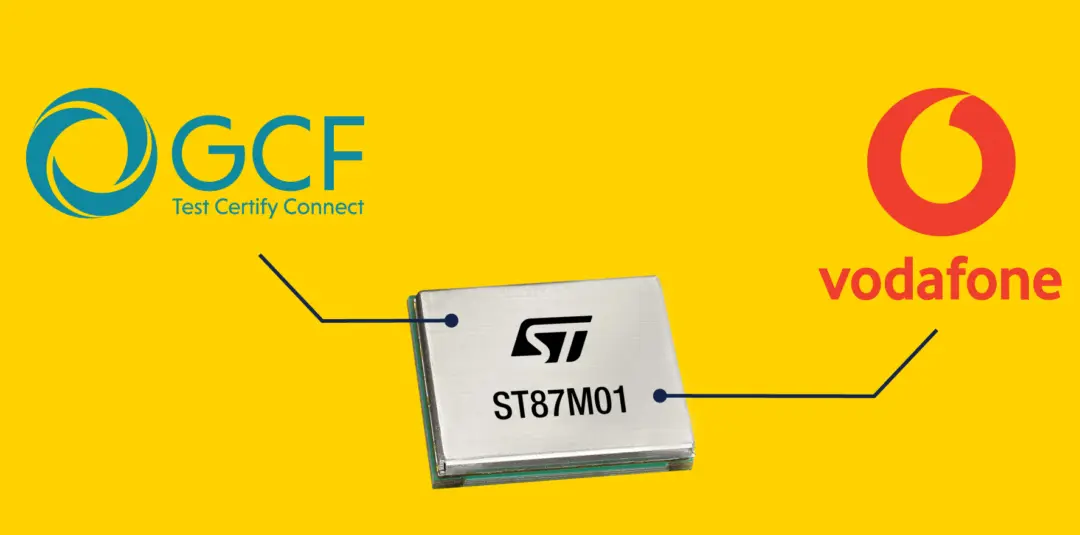
Vodafone NB-IoT certification for ST’s eSIM IoT module
The ST87M01 NB-IoT Release 15 module combines cellular connectivity and geolocation to support a new generation of IoT and smart infrastructure applications. The module has now also received NB-IoT certification from Vodafone, confirming compatibility with the operator’s global NB-IoT network.
Designed for industrial and large-scale IoT deployments, the module integrates connectivity, positioning and security features into a compact solution aimed at sectors such as smart mobility, smart metering and asset tracking.
Smart Emergency Lights Driving Early Adoption
One of the first major applications for the ST87M01 is emerging in Spain’s new road safety regulation, where connected emergency lights will replace the traditional roadside warning triangle by 2026.
Instead of placing a reflective triangle behind a broken-down vehicle, drivers will activate a connected emergency beacon on their car. The device automatically sends the vehicle’s geolocation to traffic control systems, allowing authorities to detect incidents faster and warn other road users in real time.
This approach aligns with broader European road safety initiatives that aim to reduce accident risks through connected infrastructure and real-time traffic data.
The ST87M01 module is designed specifically to support these types of always-connected safety devices, delivering low-power connectivity alongside integrated positioning capabilities.
Connectivity Architecture Built for IoT
The module supports a wide range of communication protocols used in IoT deployments, including:
Supported IoT Protocols
- IPv6
- TCP / UDP
- CoAP / LWM2M
- MQTT
- HTTP / HTTPS
- TLS / DTLS
These protocols enable developers to deploy the module across diverse IoT platforms while maintaining secure and reliable data communication.
The ST87M01 also supports standardized 3GPP AT commands, alongside enhanced commands developed by STMicroelectronics, allowing flexible integration into existing IoT architectures.
According to STMicroelectronics, the goal is to simplify the deployment of battery-efficient connected devices operating across different industrial and infrastructure environments.
Vodafone Certification Confirms Network Compatibility
Vodafone’s NB-IoT certification ensures that the ST87M01 module works seamlessly with the operator’s NB-IoT network infrastructure across Europe.
“Completing our test program with Vodafone assures our customers of a reliable and future-proof data connection for their IoT solutions that leverage this module’s novel and power-efficient features,”
said Domenico Arrigo, General Manager of STMicroelectronics’ Industrial and Power Conversion Division.
Arrigo also highlighted that the module was fully conceived, designed and industrialized by ST, which the company says ensures stronger supply independence, security and long-term product availability.
Vodafone also confirmed the performance of the module during certification testing.
“ST’s ST87M01 module has demonstrated flawless connectivity with our NB-IoT global infrastructure and offers an excellent option to connect to our network anywhere in Europe,”
said Sven Sobe, Senior Expert for IoT Innovation and Certification at Vodafone.
Global Certification and Multi-Region Coverage
Beyond Vodafone’s approval, the module has also received certification from the Global Certification Forum (GCF), which focuses on interoperability between mobile and IoT devices.
The ST87M01 complies with 3GPP Release 15 standards, ensuring extended LTE coverage across multiple regions and supporting future-ready NB-IoT deployments.
This makes the module suitable for global device manufacturers that need consistent connectivity across different markets.
Designed for Smart Metering Deployments
Another major opportunity for the ST87M01 lies in the rapid expansion of smart metering infrastructure.
Utilities around the world are accelerating the deployment of connected electricity, water and gas meters that transmit consumption data automatically. NB-IoT connectivity has become one of the preferred technologies for these deployments due to its long battery life and deep indoor coverage.
India represents one of the largest upcoming markets. The country’s smart meter rollout is expected to reach 250 million units within the next five years, creating strong demand for scalable and cost-efficient connectivity modules.
The ST87M01 is positioned as a suitable solution for these large-scale deployments.
Integrated eSIM and Security Architecture
The module includes ST’s ST4SIM embedded SIM (eSIM), certified under the GSMA eSA (Security Assurance) framework.
In addition to the eSIM, the module integrates a certified embedded secure element (eSE), helping protect device identity and data communications.
All components are packaged in a compact 10.6 mm × 12.8 mm LGA module, designed for integration into space-constrained IoT devices.
Low Power Operation for Battery-Driven Devices
Energy efficiency is a critical factor for IoT devices that may operate for years without battery replacement.
The ST87M01 includes several low-power features designed to maximize battery life. An integrated native GNSS receiver allows positioning functions to operate efficiently during NB-IoT sleep cycles, reducing power consumption during idle periods.
These capabilities make the module suitable for devices that require continuous connectivity with minimal energy usage.
Expanding IoT Applications
Beyond emergency lights and smart meters, the ST87M01 can support a wide range of connected device use cases.
Potential applications include:
IoT Deployment Scenarios
- pet and personal asset tracking
- industrial equipment tracking
- smart agriculture sensors
- connected infrastructure monitoring
- logistics and fleet tracking
The module also integrates with other components from STMicroelectronics’ portfolio, including MEMS sensors, actuators and interface solutions, allowing developers to build more complex IoT systems with integrated sensing and connectivity.
Availability
The ST87M01 module is currently sampling to major customers worldwide, with broader production expected as IoT deployments continue expanding across mobility, utilities and smart infrastructure sectors.