Verizon eSIM Explained: Prepaid, Travel & Setup
Verizon eSIM is not exactly new, but it is becoming much more important than a support-page feature. For years, eSIM was treated as something you used when your physical SIM was lost, your phone had no SIM tray, or you were upgrading to a newer iPhone. Now it points to a bigger shift: mobile service is becoming something you can activate, move and manage digitally.
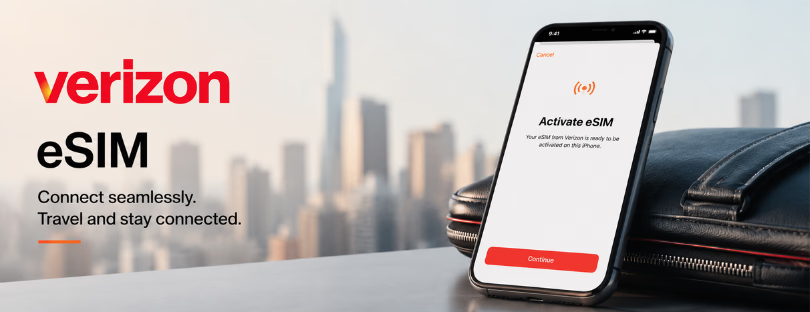
Verizon describes eSIM as a digital SIM built into mobile devices, allowing users to activate cellular service without inserting a physical SIM card. If the SIM is no longer a removable piece of plastic, the relationship between customer, device, and network becomes more flexible.
For U.S. customers, this is mostly about convenience. For visitors to the U.S., it can be the difference between landing connected and spending the first hour looking for a store.
Prepaid is the interesting part
The more telling development is Verizon Prepaid with eSIM. Verizon positions it as a way to activate a new plan on a smartphone in minutes, with multiple lines possible on the same device. The prepaid page also highlights no credit checks or activation fees, which matters because this is not just aimed at existing Verizon customers. It is useful for people who want U.S. connectivity without entering a long postpaid relationship.
That includes tourists, students, remote workers, and business travelers who need a local U.S. number for calls, texts, deliveries, ride-hailing, or work coordination. Verizon specifically presents prepaid eSIM as useful for visitors to the U.S., letting them keep their primary phone and number while adding a Verizon Prepaid plan for the stay.
This is where Verizon’s eSIM story becomes practical rather than shiny. It is not trying to be a cheap global travel eSIM marketplace. It is offering a local network plan on a major U.S. carrier, without the old SIM-card friction.
Verizon tourist eSIM & SIM: Plans and pricing
When you sign up for a Verizon tourist eSIM or SIM plan, you can choose from three options, each with a different data allowance and feature set.
|
|
|
|
Prices and features may change. Check Verizon’s official offer page before purchasing.
What users actually get
The current Verizon Prepaid eSIM page lists several plan options, including 15 GB, Unlimited, and Unlimited Plus tiers. The 15 GB plan is priced at $45 per month, while Unlimited and Unlimited Plus are listed at $60 and $70 per month, respectively, before applicable taxes and fees.
The small print matters. On the 15 GB plan, once high-speed data is used, including mobile hotspot, speeds are reduced for the rest of the month. On the Unlimited plan, Verizon says data may be temporarily slower than other traffic during congestion, and the mobile hotspot includes 5 GB of 5G or 4G LTE data before speeds are reduced. That is the type of detail travelers should read before buying.
READ MORE: AT&T Introduces eSIM Free Trial to Compete with T-Mobile, Verizon
The upside is clear: U.S. call, text, and data service, 5G access where available, and a real local number. The tradeoff is that this is a monthly carrier plan, not a lightweight travel eSIM you buy for three days in New York.
Where it fits in the market
Compared with travel eSIM providers such as Airalo, Holafly, Nomad eSIM, Saily, Ubigi, and GigSky, Verizon Prepaid eSIM sits in a different lane. Travel eSIM brands are usually built for short-term data access, fast checkout, and multi-country coverage. They are convenient, often cheaper for small data needs, and useful when you do not need local voice or SMS.
Verizon is stronger when the traveler needs a U.S.-first experience. Think of someone relocating for a semester, visiting family for a month, attending multiple conferences, or managing work calls across U.S. numbers. In that case, a domestic carrier eSIM can feel more complete than a data-only travel eSIM.
But it is not for everyone. A European traveler spending four days in Miami and only needing WhatsApp, maps, Uber, and email may find a travel eSIM simpler and cheaper. A digital nomad moving between the U.S., Canada, Mexico, and Europe may prefer a regional or global eSIM plan with broader flexibility.
What could be smoother?
The product itself is strong, but the buying journey could be clearer for international visitors. Verizon says users can download the My Verizon app to check compatibility, or check compatibility online. That is useful, but travelers often want a more direct promise: which foreign-bought phones work, what happens if activation fails, and whether identity or payment friction could appear for non-U.S. customers.
READ MORE: Verizon launches free 30-day 5G eSIM trials with 100GB data, unlimited talk and text
This is where travel eSIM brands still have an advantage. They usually explain compatibility, activation, refund terms, and setup steps in a more travel-native way. Verizon has the network credibility. Travel eSIM players often have the better tourist-friendly UX.
Try it free for 30 days
No hassle. No commitment. Test Verizon’s network with an eSIM trial before switching.
|
0
100% freeNo credit card required. No surprises when the trial ends. It’s truly $0.
|
#
Keep your numberYour number stays the same, and you can still access your other network.
|
✓
Zero commitmentNo contract. The eSIM expires on its own, so no cancellation is needed.
|
Get up and running in 3 minutes
|
Step 1
Input your informationSign up for your trial account. It’s free, so you won’t be asked for payment info.
|
Step 2
Check your IMEIUse your IMEI to check that your phone is unlocked and eSIM compatible.
|
Step 3
Activate your eSIMDownload your eSIM by text, then toggle between networks to compare.
|
Final take
Verizon eSIM is not trying to win the global travel eSIM beauty contest. That is what makes it interesting. It is a sign that major operators are learning from the eSIM market without fully copying it. The old operator model was built around contracts, stores, SIM cards, and account friction. The new model has to feel more instant.
For Alertify readers, the decision is simple. Choose Verizon Prepaid eSIM when you want U.S. carrier service, a local number, full-month use, and the comfort of a major domestic network. Look at Airalo, Ubigi, Nomad eSIM, GigSky, Saily, or Holafly when you mainly need quick data, short-trip flexibility, or multi-country coverage.
The bigger trend is more important than one product page. eSIM is pushing operators and travel connectivity brands toward the same customer expectation: no plastic, no waiting, no store visit, no confusion.