


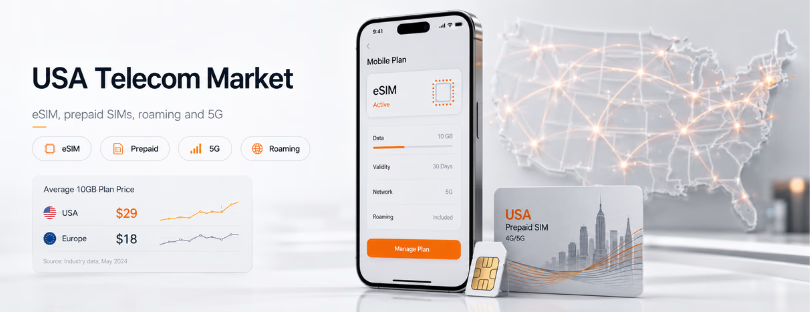
The US telecom market is a vibrant and rapidly evolving industry that plays a crucial role in connecting individuals and businesses across the nation. With the advancement of technology and the increasing reliance on digital communication, the telecom sector has witnessed significant growth and innovation in recent years. This article delves into the key aspects of the US telecom market, highlighting its current landscape, major players, emerging trends, and future prospects.
usa telecoms
According to a report by the International Telecommunication Union (ITU) from 2021, the United States ranked 22nd out of 185 countries in terms of mobile broadband prices, with an average price of $11.5 for 1 GB of mobile data.
Comparing this to some EU countries, the average price of 1 GB of mobile data in Germany is $3.7, in France is $2.7, in Italy is $3.3, and in the UK is $6.6, according to a report by Cable.co.uk from 2021. These prices are significantly lower than in the US.
Furthermore, the same report by Cable.co.uk found that the average cost of a broadband package (fixed-line) in the US was $58.0, which is higher than the average cost in some EU countries such as Germany ($40.8), France ($31.4), Italy ($33.1), and the UK ($31.7). This suggests that overall, telecom prices in the US are higher compared to some EU countries.
USA Telecom Companies


 Read more
Growth in the US mobile subscriber base remains strong, with a penetration rate of about 127%. Declining revenue from voice services is compensated for by high growth in mobile data use, itself supported by upgraded networks based on LTE technologies. Smartphone penetration is also high, which had encouraged mobile data use among subscribers. The major operators, led by AT&T, Verizon and T-Mobile US, have partnered with vendors to trial 5G technologies and services and will be expanding their commercial services into 2019 or 2020. In addition, operators are working on the potential of NB-IoT, LTE-U and LTE-A technologies, in some respects as complementary technologies supported by 5G.
eSIM and SIM cards for the United States
Visitors to the U.S. can choose between travel eSIM plans and local prepaid SIM options, depending on how long they stay, how much data they need, and whether they want a U.S. phone number.
|
Digital option
eSIM for the USAThe United States is well covered by travel eSIM providers, and eSIM is often the easiest option for visitors who want mobile data before arrival, without looking for a carrier store or airport SIM counter. Most USA travel eSIM plans are data-only, so regular calls and SMS are usually not included. Apps such as WhatsApp, FaceTime, iMessage, Google Maps, Uber, Lyft, email, banking apps and hotel apps work normally over mobile data. Travellers can choose small data plans for city breaks, larger bundles for road trips, unlimited-style plans for heavy use, or North America eSIMs that include the U.S., Canada and Mexico. |
Local carrier option
SIM cards for the USAPhysical prepaid SIM cards are still available in the U.S., but the buying experience can vary. Travellers usually find them through mobile carrier stores, large retailers, electronics shops, supermarkets and airport kiosks. A U.S. prepaid SIM card can be useful if you need a local number, voice calls, SMS, or a monthly plan from a major carrier. It is especially practical for longer stays, students, business travellers and people who need U.S.-based services. Before buying, check whether your phone is unlocked and compatible with U.S. networks. Some visitors may find eSIM faster, while others may prefer a prepaid SIM or carrier eSIM from providers such as Verizon, AT&T or T-Mobile. |
The U.S. telecom market is one of the most advanced and competitive connectivity markets in the world. With nationwide 5G expansion, growing eSIM adoption, connected devices, cloud services, private networks, and IoT, the sector is moving far beyond traditional mobile plans.
For travellers, businesses, and digital-first users, this shift means more flexible ways to connect, from prepaid SIM cards and carrier eSIMs to travel eSIM plans and embedded connectivity solutions. At the same time, the market remains complex. Device compatibility, network coverage, pricing, hotspot limits, roaming rules, and activation requirements can vary significantly between providers.
Major operators such as Verizon, AT&T and T-Mobile continue to invest heavily in 5G infrastructure, while digital eSIM providers are changing customer expectations around instant activation, short-term plans, and app-based connectivity. The result is a market where convenience, transparency, and network reliability now matter just as much as price.
For visitors to the United States, the best option depends on the type of trip. Short-stay travellers may prefer a travel eSIM for quick mobile data, while longer-stay visitors, students, business users, or anyone needing a U.S. phone number may benefit from a prepaid SIM or carrier eSIM plan.
USA Telecom Companies in fixed telephony:
| AT&T | Integra Telecom |
| BellSouth | Pac-West Telecomm |
| SBC Communications | Qwest Communications (Qwest): |
| Blue Casa Communications | Malheur Bell |
| CenturyLink | Verizon Communications |
| Cincinnati Bell | Vonage |
| Excel Communications | GTE |
| Fairpoint Communications | Windstream Communications |
| Frontier Communications |