utu and Weixin Pay Launch VAT-to-Spend Model in Milan
There’s a subtle shift happening in airport retail right now. VAT refunds are no longer just a post-trip admin task. They are being pulled into the moment of purchase. VAT refund travel fintech
The latest move from utu and Weixin Pay shows exactly where this is heading.
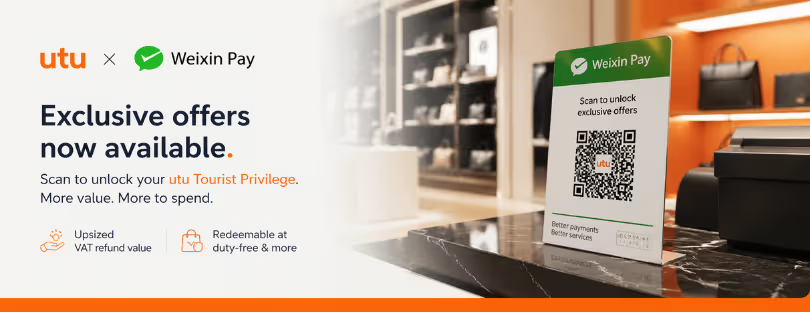
From 1 May 2026, Chinese travellers passing through Milan Malpensa Airport and Milan Linate Airport can scan a dedicated Weixin Pay QR code in-store to unlock utu offers. It sounds simple. But the mechanics behind it are much more strategic.
From refund to real-time value
Instead of waiting to process VAT refunds after leaving Europe, travellers can now convert that value instantly through utu’s web app into what the company calls a “Tourist Privilege.”
That conversion matters.
Rather than receiving a standard refund later, users get an upsized value they can immediately spend at duty-free or partner retailers. Money that would normally exit the airport ecosystem is instead redirected back into it and amplified.
This is not just a UX improvement. It changes behavior.
Built into existing habits
One of the smarter aspects of this partnership is where it lives: inside Weixin Pay.
Chinese travellers already rely heavily on the platform for payments, discovery, and daily services. By embedding utu directly into that flow, there’s no need to introduce new habits or apps. The interaction becomes almost invisible.
As Ameer Jumabhoy, Co-Founder of utu, puts it:
“Weixin Pay users have already been discovering utu on their travels, and that gave us a strong foundation to build on. This initiative takes the experience to a different level – it’s native, it’s fast, and it’s where our users already are. Milan is the right place to start, and we’re excited to roll this out together.”
That last part matters more than it sounds. Distribution is everything in this space.

Why Milan makes sense
Milan is not a random launch location.
It sits at the intersection of luxury retail, tourism, and high-spending international traffic. Chinese outbound travellers, in particular, have historically been one of the most valuable segments for European retail.
Queena Liu, General Manager, Italy, Weixin Pay Global, highlights that expectation shift:
“Today’s Chinese travellers expect a seamless, premium retail experience when visiting Europe. Our partnership with utu directly answers this by transforming standard VAT refunds into immediate, enhanced purchasing power.”
European retail has often struggled to match the seamless, app-driven experiences travellers are used to at home. This kind of integration starts to close that gap.
Small incentives, strong impact
To drive early adoption, the launch includes two promotions:
- A preferential exchange rate for users converting VAT refunds via utu (available monthly through December 2026)
- A “Spend & Save” offer, giving RMB 50 off transactions above RMB 600 during May
These are not massive discounts. But they are well-timed.
They appear exactly at the moment of decision, which is where they matter most. In retail, timing beats size when it comes to influencing behavior.
A different direction from traditional players
What makes utu interesting is how it differs from established VAT refund operators like Global Blue or Planet.
Those players have spent years optimizing the refund process itself. Faster claims, better coverage, smoother processing.
utu is shifting the focus entirely.
Instead of improving refunds, it turns them into a trigger for more spending. That places it somewhere between fintech and retail infrastructure rather than traditional tax-free services.
At the same time, Weixin Pay brings distribution power that most fintech players simply do not have.
What this unlocks for airports
Airports have been trying to solve the same problem for years: how to increase spend per passenger without increasing passenger numbers.
This model introduces a new lever.
Instead of relying on retailer-funded discounts, value is created by optimizing money that already exists in the system. VAT refunds become a funding mechanism for additional spending.
For retailers, that means higher conversion. For airports, more captured value. For travellers, a better perceived deal.

Where this could go next
The Milan rollout is likely just a starting point.
The obvious expansion path is other major European shopping hubs with strong Chinese tourist flows. But the bigger opportunity lies in deeper integration.
If this model moves upstream into travel apps, booking platforms, or even pre-trip planning, it could reshape how travellers think about spending before they even land.
Conclusion
This partnership is not really about VAT refunds. It is about owning the moment when travel spending decisions happen.
While traditional players like Global Blue and Planet continue to compete on efficiency, utu is reframing the category entirely by turning refunds into immediate purchasing power.
At the same time, platforms like Weixin Pay show where the real control sits. Not in payments alone, but in owning the full user journey.
Data from organizations like the UN World Tourism Organization and Statista consistently highlight the influence of Chinese outbound travellers on global retail.
The companies that adapt fastest to that expectation will capture the most value.
Milan just became a test case for what that future looks like.