Ubigi vs. Airalo: Which eSIM Provider is Better?
A few years ago, choosing a travel eSIM was mostly about one question: “Will it save me from roaming charges?” Today, that is only the entry ticket. Travelers want predictable coverage, clean activation, clear validity, hotspot rules, fast top-ups and support that does not vanish when the phone refuses to connect at the airport.
That is why the Ubigi vs Airalo comparison still matters. The original article compared the two brands around coverage, pricing, ease of use and support, and those are still the right buying criteria. But the sharper question now is: which provider fits the way you actually travel?
Two different personalities
Airalo feels like the classic travel eSIM marketplace. It is built for people who want to open an app, search a destination, buy a package and get online quickly. Airalo says it offers eSIMs for more than 200 destinations, with local, regional and global options. That breadth is its biggest advantage. It is simple, familiar and useful for short trips, city breaks and multi-country travel.
Ubigi feels slightly more infrastructure-minded. The brand is part of the Transatel ecosystem, which gives it a different position from many travel-only eSIM stores. Ubigi also promotes travel eSIM plans in 200+ destinations, but its story stretches beyond phones into tablets, laptops and connected cars. Travel connectivity is no longer only about the tourist with an iPhone. It is also about remote workers and people who expect every device to stay online across borders.
So the simple version is this: Airalo is easier to understand at first glance. Ubigi can feel more technical, but also more interesting for users who care about device breadth and network behavior.
Coverage is not a country count
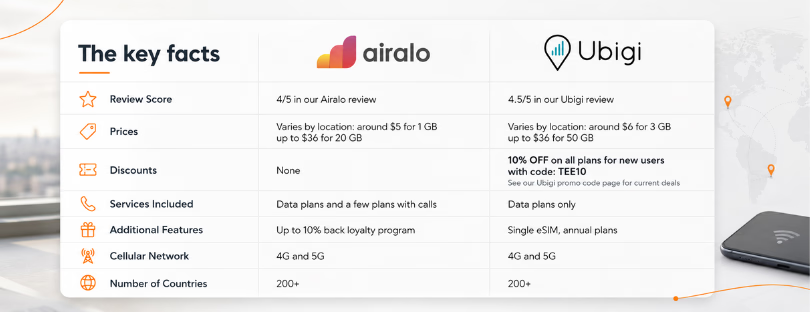
Both brands now speak in the language of “200+ destinations,” which sounds almost identical. But coverage should never be judged by a big number alone. A country list tells you where a plan exists. It does not tell you which local network you will use, how strong the signal is outside major cities, whether 5G is available, or how traffic is routed.
Travelers are learning that “works in Japan” and “works well on the train between cities in Japan” are not the same promise. The same applies to rural Spain, island Greece or business districts in the Gulf.
READ MORE: Ubigi’s SmartIP Is the Quiet Feature That the eSIM Industry Has Been Ignoring
Airalo’s advantage is discoverability. Ubigi’s advantage is that it often appeals to users who want a more stable, device-oriented setup. Neither automatically wins everywhere. Before buying, check the country, validity, network notes and user feedback for your route, not just the headline coverage claim.
Pricing depends on your habits
This is where many eSIM comparisons get lazy. They ask “Who is cheaper?” when the better question is “How do you use data?”
Airalo is usually attractive for travelers who know roughly what they need. If you are going to Italy for four days and want 3GB or 5GB, a fixed prepaid package is easy. You pay, activate, use it and move on. It fits the mainstream travel eSIM habit: short validity, fixed data, no commitment.
Ubigi can be more appealing for travelers who want flexible data across devices or prefer a more account-based setup. Depending on the destination and plan type, it can be competitive for regular travelers, laptop users and people who do not want to rebuild their setup every time.
The trap is buying too little data because the cheapest plan looks good. Maps, rideshare apps, video calls and hotspot use can burn through small packages quickly.
Support is the hidden differentiator
Support is where cheap eSIM brands can lose trust. When activation fails five minutes before boarding, support suddenly becomes the product.
Ubigi has historically been seen as strong on support options, while Airalo benefits from scale, app familiarity and a huge user base. But support quality can vary by issue: device settings, local partner networks, or installing the eSIM too early, too late, or on the wrong device.
READ MORE: Airalo Enters Airport Transfers — Kiwitaxi Embeds eSIM at Landing
The best providers explain limitations clearly before purchase: when validity starts, whether hotspot is allowed, what “unlimited” means, whether speeds may be reduced, and what refund conditions apply.
The market signal
Apple’s own support pages show why this category keeps growing: Dual SIM with eSIM lets travelers keep a home number active while adding a local or travel data plan abroad. GSMA Intelligence has also argued that travel eSIM gives consumers a visible reason to care about eSIM, especially because many people still need a practical benefit before changing behavior. Travel is the use case that makes eSIM obvious.
Airalo competes in a crowded field with Holafly, Nomad eSIM, Saily, Jetpac, Yesim and GigSky. Ubigi competes there too, but with a broader connectivity identity because of its Transatel background and connected-device angle. This comparison reflects where travel connectivity is going: from “cheap data abroad” to “frictionless connectivity across every device.”
Conclusion
If you want the easiest mainstream travel eSIM experience, Airalo is probably the safer first stop. It is broad, familiar and built around quick destination-based buying. If you travel often, use several connected devices, care about laptops or cars, or want a provider with a more infrastructure-shaped feel, Ubigi deserves serious attention.
The winner is not universal. Airalo is stronger for simplicity and marketplace convenience. Ubigi is stronger for travelers who think beyond the phone. The next phase will not be won only by the provider with the most destinations or the cheapest 1GB plan. It will be won by the brands that reduce uncertainty. Travelers do not really buy data. They buy confidence that the phone will work when the trip starts.
Check out and compare Ubigi vs Airalo eSIM offers: