Alertify Launches Weekly Connectivity Signals Hub
Connectivity used to sit quietly in the background of travel. You bought a roaming package, connected to airport Wi-Fi, hoped your hotel login worked, and moved on. That world is gone. travel connectivity market update
Today, connectivity is a live travel issue. It affects how business travellers work abroad, how airlines shape the passenger experience, how hotels support guests, how telecom operators defend revenue, and how eSIM providers compete in a market that is getting louder by the month.
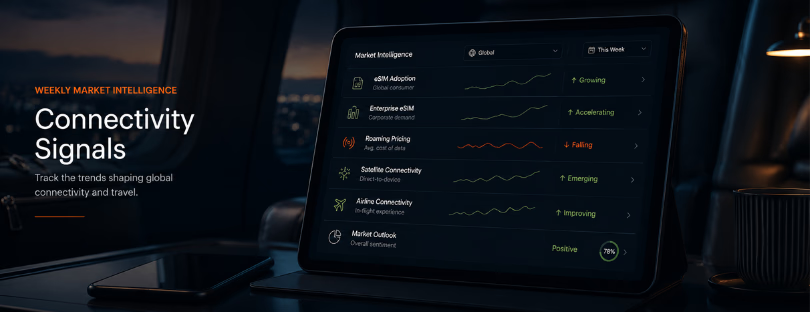
That is why Alertify is introducing Connectivity Signals, a weekly front-page asset designed to track the movement behind the headlines.
Updated every Monday, Connectivity Signals will give readers a fast, readable snapshot of where the market is moving across eight areas: eSIM adoption, enterprise eSIM, roaming pricing, satellite connectivity, airline connectivity, telecom consolidation, regulation, and overall market outlook.
Not another “weekly roundup.” Not a recycled news feed. A signal board.
Why now?
The travel connectivity market is changing in several directions at once.
Consumer eSIM adoption is no longer just a device story. It is becoming a behaviour story. GSMA Intelligence reported that gIobal eSIM smartphone penetration reached 5% at the end of 2025, with expectations of 10% by the end of 2026 and further acceleration toward 2030. At the same time, GSMA has also noted that adoption has been uneven, with the US moving much faster than many other markets because of eSIM-only iPhones and stronger operator support.
That tension matters. It means eSIM is growing, but not evenly. A traveller in one market may already treat eSIM as normal. Another may still see it as a backup option. For Alertify readers, that difference is exactly where the story sits.
Enterprise eSIM is also becoming harder to ignore. Companies are starting to look beyond “cheap data abroad” and toward control, visibility, compliance, employee safety, pooled usage, and procurement simplicity. The question is no longer whether a team can get online. It is whether the company knows who is connected, where, at what cost, and under which policy.
That is a very different conversation from the one most travel eSIM brands are having.
What we will track
Connectivity Signals will not try to explain the whole industry every week. That would be too much noise. Instead, it will track movement.
eSIM Adoption will look at whether consumer usage is growing, slowing, or shifting by region, device, provider, or travel behaviour.
Enterprise eSIM will follow corporate demand, workforce mobility, travel risk management, IoT use cases, and the rise of SaaS-style connectivity platforms.
Roaming Pricing will monitor whether international data costs are falling, becoming more transparent, or simply being repackaged in cleverer ways.
Satellite Connectivity will track direct-to-device momentum, hybrid networks, and the slow but important move from emergency-only satellite features toward broader mobile coverage.
Airline Connectivity will follow onboard Wi-Fi, embedded travel connectivity, loyalty integrations, and the race to turn passenger attention into digital service revenue. IATA reported that global international air connectivity increased 9% year-on-year in 2025, which matters because more routes, more passengers, and more connected journeys raise expectations around digital continuity before, during, and after the flight.
Telecom Consolidation will watch mergers, infrastructure pressure, wholesale models, MVNO movement, and the uncomfortable question of whether traditional telcos can move fast enough.
Regulation Watch will follow policy changes that shape the market. In Europe, the proposed Digital Networks Act aims to simplify and harmonise connectivity rules, including a “Single Passport” authorisation and EU-level satellite spectrum authorisation. Reuters also reported that the proposal would move toward unlimited-duration radio spectrum licences, although the law still needs political approval.
Market Outlook will bring it together in plain language: positive, cautious, accelerating, fragmented, or under pressure.
Why is this different?
Most connectivity coverage is either too technical or too promotional.
Telecom reports often speak to operators. Travel media often treats connectivity as a convenience feature. eSIM comparison pages usually focus on price, country coverage, and data size. Those things matter, but they do not tell the full story.
The real market is sitting between all of them.
A roaming price drop can affect eSIM demand. A new airline Wi-Fi partnership can change passenger expectations. A satellite announcement can pressure mobile operators. A regulation update can reshape wholesale economics. A consumer eSIM trend can become an enterprise procurement signal six months later.
Connectivity Signals will connect those dots.
It will be useful for travellers who want to understand what is changing. It will be useful for eSIM providers to watch the competitive landscape. It will be useful for travel brands, airlines, hotels, fintechs, OTAs, and corporate mobility teams trying to understand where connectivity is becoming a product layer, not just a cost line.
A weekly habit, not a one-off feature
The value of Connectivity Signals is not only in the first edition. It is in the pattern.
One week, satellite connectivity may be “emerging.” Three months later, it may become “accelerating.” Roaming prices may fall in one region while enterprise connectivity costs rise because companies need more control and support. Airline connectivity may look positive from a passenger experience angle, but fragmented from a commercial integration angle.
That is why the Monday rhythm matters.
Markets do not move in perfect quarterly summaries. They move through product launches, regulatory drafts, quiet partnerships, pricing changes, device updates, airline trials, and customer frustration. A weekly signal board gives those small moves a place to live.
What readers should expect
Connectivity Signals will be direct. No over-explaining. No forced hype.
Each Monday, Alertify will update the signal direction and add context where it matters. Some weeks will be driven by data. Some by regulation. Some by provider behaviour. Some by travel demand. The goal is not to predict everything. The goal is to make the market easier to read.
And that is where Alertify has a role.
Not as another site listing eSIM plans. Not as a generic travel tech blog. But as a specialist media platform, watching the connectivity layer that now sits underneath modern travel.
The bigger picture
Connectivity Signals is Alertify’s answer to a market that has become too important to follow casually.
GSMA, IATA, the European Commission, operators, satellite players, airlines, and eSIM platforms are all looking at different parts of the same shift. Alertify’s job is to translate those movements into something readable, useful, and commercially relevant.
The strongest players in this space will not be the ones shouting “global coverage” the loudest. They will be the ones who understand how eSIM, roaming, satellite, airline connectivity, regulation, and enterprise mobility are starting to overlap.
That is the real signal.