Top Travel Destinations for 2026: Where Smart Travelers Go
The year 2026 is shaping up to be a genuinely interesting moment for travel. Not in a hype driven, buzzword-heavy way, but because destinations are evolving in response to how people actually want to travel now. More meaning, better design, stronger sustainability credentials, and experiences that feel rooted rather than manufactured.
Across Latin America and the Caribbean, several destinations are quietly pulling ahead by doing exactly that.
Costa Rica: where sustainability meets elevated luxury
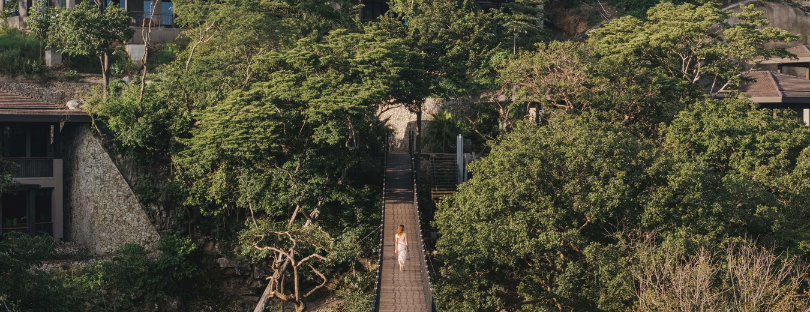
Costa Rica has long been a favorite, but what keeps it relevant in 2026 is how well it balances environmental responsibility with a growing appetite for refined travel. This is not about eco buzzwords anymore. It is about resorts that genuinely integrate into their surroundings while still delivering world-class comfort.
W Costa Rica – Reserva Conchal reflects this shift perfectly. It speaks to travelers who want contemporary design, strong culinary concepts, and curated activities without losing touch with Costa Rica’s laid-back, nature-first identity. It is stylish, yes, but still unmistakably local.
Nekajui, a Ritz-Carlton Reserve takes things further. This is Costa Rica’s answer to ultra-discreet, experience-led luxury. Set in the Papagayo Peninsula, it appeals to travelers who value privacy, personalized service, and immersive wellness over spectacle. This type of property mirrors a broader trend seen across destinations like the Maldives and Seychelles, where high-net-worth travelers are trading visibility for meaningful seclusion.
Los Sueños Marriott Ocean & Golf Resort and The Westin Reserva Conchal round out Costa Rica’s appeal by serving different segments equally well. Families, golfers, wellness travelers, and slow travel enthusiasts all find strong options here. Costa Rica’s continued success lies in this diversity. It does not force one type of traveler into a single mold.
Panama: urban energy with a natural escape button
Panama’s rise is tied to its dual identity. It offers a serious city experience without disconnecting travelers from nature. Few destinations manage this balance as effectively.
W Panama captures the city’s creative and financial pulse. It is bold, urban, and unapologetically modern. This is the kind of hotel that appeals to younger business travelers and digital nomads who want personality along with convenience.
JW Marriott Panama takes a different approach. Classic luxury, calm interiors, and sweeping bay views position it closer to properties in Miami or Dubai, but with a Latin American soul. Renaissance Panama fills the middle ground, offering functionality and local flavor for travelers who mix work and leisure.
On the Pacific coast, The Buenaventura Golf & Beach Resort, Autograph Collection shows Panama’s softer side. Quiet beaches, outdoor activities, and sustainability initiatives give the destination depth beyond its skyline. This coastal contrast is what keeps Panama competitive against cities like Cartagena or Lima.

Colombia: culture forward and design led
Colombia’s tourism narrative has matured. The country is no longer being discovered. It is being curated.
The Brown, Autograph Collection in Guatapé is a strong example of this evolution. Design driven, landscape focused, and experience led, it speaks to travelers who want destinations with a sense of place. Guatapé’s rise mirrors similar secondary destinations globally, places close to major cities but offering a distinct rhythm and visual identity.
Colombia’s strength lies in its range. From Caribbean coasts to Andean towns, it offers layered travel that rewards curiosity rather than speed.
Peru: depth, heritage, and culinary authority
Peru continues to outperform expectations because it delivers substance. Ancient history, dramatic geography, and one of the world’s most respected culinary scenes make it a destination that appeals across generations.
The Westin Lima anchors the capital’s modern face, offering wellness focused hospitality in a city increasingly positioned as South America’s food capital. Outside Lima, Cusco remains unmatched in emotional impact.
JW Marriott El Convento Cusco and Palacio del Inka, a Luxury Collection Resort, do not simply offer accommodation. They offer continuity with history. Preserved walls, art collections, and spiritual atmospheres reflect a broader trend where heritage hotels outperform generic luxury builds. Tambo del Inka in the Sacred Valley completes this circuit by placing nature and wellbeing at the center of the experience.

Guyana: the next serious ecotourism contender
Guyana is still under the radar, and that is precisely its advantage. With vast rainforests and low tourism density, it offers something increasingly rare.
The Guyana Marriott Hotel Georgetown provides international standards without overpowering local identity. The Courtyard at Cheddi Jagan International Airport and Four Points by Marriott Guyana signal growing confidence in the destination. These hotels are not about indulgence. They are about access, reliability, and enabling exploration. This aligns with a global rise in purpose driven travel, particularly among younger, sustainability conscious audiences.
Ecuador: diversity without distance
Ecuador’s appeal lies in efficiency. Few countries allow travelers to move between ecosystems, cultures, and climates so quickly.
JW Marriott Quito stands out by offering a refined base in a capital that often surprises first-time visitors. Quito’s positioning as both a cultural hub and a gateway makes it increasingly relevant as travelers prioritize depth over distance.
Conclusion: Where 2026 travel is really heading
What connects these destinations is not branding or luxury labels. It is alignment with how travel is changing. According to UNWTO data and Skift’s recent travel outlooks, travelers are prioritizing authenticity, sustainability, and flexibility over volume and speed. Latin America, in particular, is benefiting from this shift by offering rich experiences without the saturation seen in parts of Europe or Southeast Asia.
Compared with traditional hotspots like Bali or Barcelona, these destinations feel less performative and more lived in. They compete not by being louder, but by being smarter. For travelers planning 2026, the message is clear. The most rewarding trips will be those that respect place, people, and pace. And the destinations leading that charge are no longer emerging. They are setting the standard.