The Hotelification of Work: Why Offices No Longer Feel Like Offices
Modern offices no longer want to feel like offices. And that is not a throwaway line or a branding gimmick. It is one of the most consistent signals coming out of workplace design reporting across Europe, North America, and Asia in 2024 and 2025. hotelification of the workplace
Across international design media, business publications, and architecture journals, a clear narrative has formed. The workplace is being redesigned through the lens of hospitality. Not corporate hospitality as a buzzword, but very literal inspiration taken from boutique hotels, lifestyle hotels, and serviced apartments. The result is what many now openly call the hotelification of the office.
The office as a destination, not a duty
For decades, the office was built around efficiency. Desks, meeting rooms, corridors, and compliance. The assumption was simple. People had to be there, so the space only needed to function.
Hybrid work broke that logic almost overnight. When employees can work anywhere, the physical office has to earn its relevance. According to coverage by outlets such as Fast Company and Dezeen, offices are now increasingly designed as destinations rather than obligations.
This shift reframes the office as a place people choose to visit because it offers something their home or a café cannot. Social energy, collaboration, high-quality amenities, and a sense of belonging. In this context, the hospitality industry becomes the most obvious design reference point.
Hospitality principles move in
One of the most visible changes is the way people enter an office. Traditional reception desks are disappearing. In their place are lobby-style spaces that resemble hotel entrances remarkably closely.
International workplace coverage shows reception zones adopting concierge-style services, warm lighting, comfortable seating, curated artwork, and even scent branding. The goal is to replace the transactional feeling of arrival with one that is more welcoming.
This is not accidental. Boutique hotels have spent years refining first impressions because they understand that arrival sets the emotional tone for the entire stay. Offices are now borrowing that same logic.
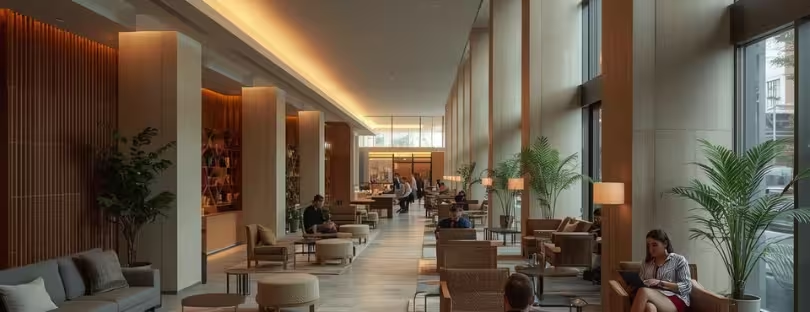
Shared areas follow the same philosophy. Instead of rigid breakout rooms, companies are building lounge-style spaces that support casual meetings, solo work, and spontaneous conversations. Sofas replace task chairs. Coffee tables replace boardroom tables. The space feels less programmed and more lived in.
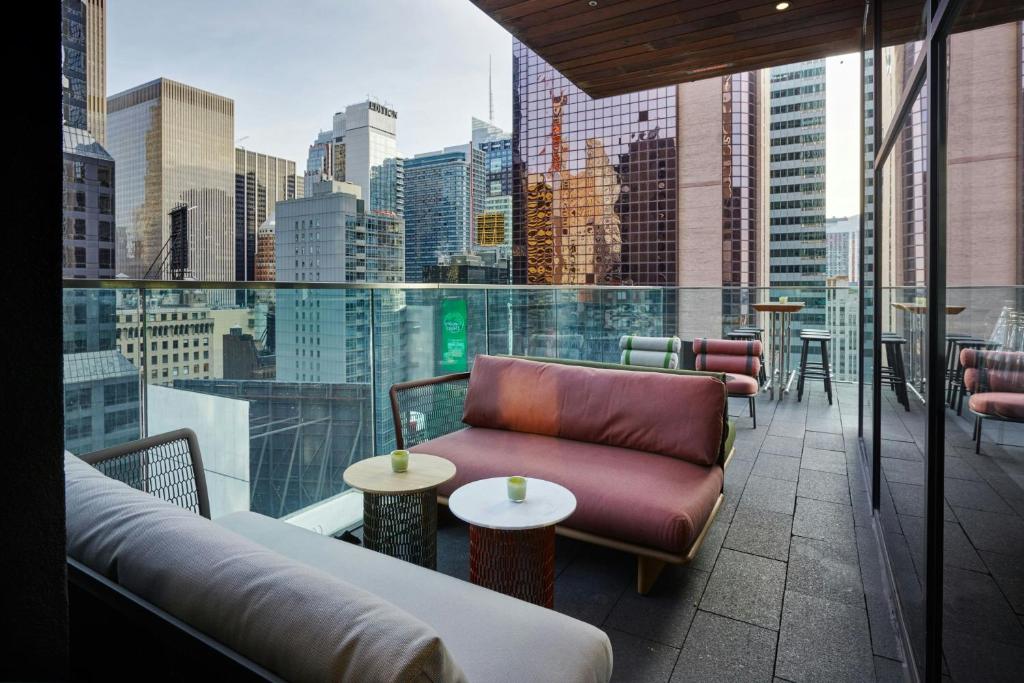
citizenM New York Times Square in New York
Food, drink, and the longer stay mindset
Food and beverage is another area where the hospitality influence is impossible to miss. Reporting from The Guardian and Forbes highlights how cafés, micro-markets, and all-day dining concepts are becoming central to office design.
These are not token coffee machines tucked into a corner. They are intentionally designed spaces, often run in partnership with professional operators, offering barista-quality coffee, fresh food, and flexible seating.
The logic mirrors hotel design again. If you want people to stay longer, feel comfortable, and move naturally between activities, food becomes an anchor. In hotel-inspired offices, the café is not a perk. It is infrastructure.
Sensory design and the human experience
Beyond furniture and amenities, the biggest influence of boutique hotels may be sensory design. Hotels have long understood how lighting, acoustics, textures, and materials shape mood and behaviour. Offices are now applying the same thinking.
Natural materials, softer colour palettes, indirect lighting, and acoustic zoning are replacing harsh overhead lights and uniform finishes. According to design analysis published in Monocle, this approach is about making workspaces feel human rather than institutional.
Noise control is a particularly important theme. Just as hotels carefully separate lively lobby areas from quiet rooms, offices are learning to zone spaces for different energy levels. Focus zones, social zones, and transition spaces coexist without competing.
Flexibility becomes non-negotiable
Another shared principle between hotels and modern offices is flexibility. Hotels design spaces to change function throughout the day. Breakfast areas become work lounges. Lobbies host meetings, drinks, and events.
Workplace reporting shows offices adopting the same mindset. Furniture is modular. Rooms can be reconfigured quickly. Spaces support individual work in the morning and group collaboration in the afternoon.
This is not just about aesthetics. It reflects how people actually work now. Hybrid schedules, project-based teams, and fluid working hours require environments that adapt without friction.
citizenM Amsterdam
When hospitality brands shape workspaces
One of the clearest examples of this convergence is the collaboration between IWG and YOO. International coverage frequently points to this partnership as a reference case for hospitality-led workspace design.
By combining YOO’s experience in lifestyle hotels and branded residences with IWG’s flexible workspace model, the result is environments that blur the line between work, social life, and wellbeing.
These spaces are not positioned as offices first. They are positioned as places. Places where work happens naturally alongside connection and comfort.
A wider market shift, not an isolated trend
What is important to understand is that this is not limited to premium coworking brands or flagship headquarters. Traditional corporate offices, regional business hubs, and even public sector buildings are adopting elements of hotel-inspired design.
Coverage from the Financial Times notes that the pressure is structural. Talent expectations have shifted. Companies that fail to evolve their physical environments risk turning offices into empty real estate rather than productive assets.
At the same time, the hospitality industry itself is influencing the market in reverse. Hotel brands are increasingly offering work-friendly environments, memberships, and hybrid hospitality-work models. The boundary is dissolving from both sides.
Conclusion: the office learns from hospitality, not imitates it
The most interesting part of this shift is not that offices are starting to look like hotels. It is that they are learning why hotels work.
The strongest players in this space, from hospitality-led coworking operators to corporate headquarters working with hotel designers, are not copying lobbies or sofas for style points. They are applying decades of hospitality knowledge around flow, comfort, emotional response, and choice.
Compared to earlier waves of office design focused on open plans or productivity metrics, this phase is more mature. It recognises that work is a human activity shaped by mood, energy, and environment.
Looking at how brands like IWG approach design compared to lifestyle-driven coworking players and even hotel groups experimenting with workspaces, a clear pattern emerges. The future office is not a desk with benefits. It is an experience ecosystem.
For businesses, the implication is clear. Offices that fail to evolve will struggle to justify their existence. Those who embrace hospitality principles thoughtfully will not just attract people back. They will redefine why people come in at all.
And that may be the most hotel-like idea of all. Making people want to stay.