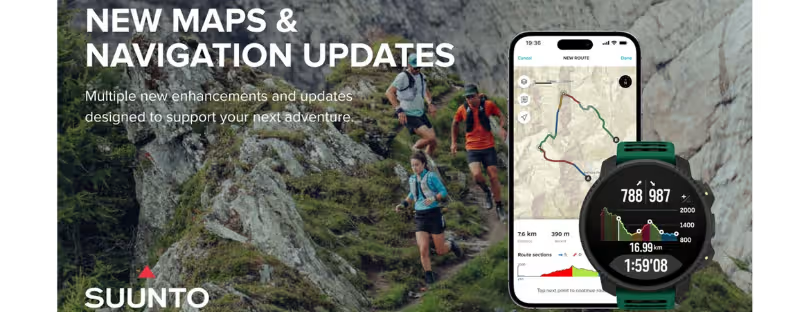
Suunto Pushes Offline Navigation Further With New App and Watch Updates
If you’ve ever lost signal halfway up a mountain or somewhere between airport Wi-Fi zones, you already know the problem: most “smart” navigation still depends on being connected. suunto offline maps
Suunto is trying to fix that.
Starting April 2026, the Finnish sports tech brand is rolling out a significant set of updates across its watches and mobile app, with one clear theme running through everything: navigation that actually works when you need it most, not just when you’re online.
And that shift matters more than it sounds.
Smarter Navigation, Right on Your Wrist
The biggest upgrades land directly on Suunto’s latest watches, including the Vertical 2, Race 2, and Race S.
On paper, the improvements sound incremental. In practice, they solve real friction.
Turn-by-turn guidance is now clearer and more intuitive. Route awareness has been upgraded, meaning your watch better understands where you are in relation to your planned path. If you drift off course, alerts are more precise and actionable, not just generic “you’re off route” warnings.
Track back functionality has also been refined. That’s the feature you rely on when things go wrong. Instead of guessing your way back, your watch can guide you along the exact route you came from, with improved clarity.
Mapping itself gets a visual upgrade too. Labels are easier to read, terrain is better defined, and overall map readability has been tuned for quick glances rather than deep inspection. That matters when you’re moving, not standing still.
Climb tracking is another area Suunto is leaning into. The new updates improve how elevation changes are detected and presented, giving users clearer insight into how much effort is still ahead. For hikers, trail runners, and cyclists, that’s not just data. That’s a pacing strategy.
And importantly, these views are now customizable. Users can adjust what they see during navigation, which brings Suunto closer to a more personalized, performance-driven experience.
Offline Navigation Moves to the App
The more interesting shift is happening on the mobile side.
For the first time, Suunto is bringing full offline maps and routing into its app. That means you can now plan routes, access maps, and navigate entirely without a network connection, directly from your phone.
This is a bigger deal than it looks.
Most fitness and navigation ecosystems still treat the phone as a connected planning tool and the watch as the offline fallback. Suunto is closing that gap. Now both devices can operate independently of connectivity.
Download maps once, and they’re yours. Build routes offline. Navigate without worrying about signal drops.
And unlike many competitors, Suunto is keeping this free.
No subscriptions. No locked features. No “premium map layers” upsell.
That decision alone positions Suunto differently in a market that is increasingly moving toward paywalled features.

A More Connected Ecosystem Without Connectivity
What ties these updates together is continuity.
You can plan a route on your phone, sync it to your watch, and follow it in the field. Or skip the sync entirely and use your phone offline. Either way, the experience is becoming more seamless across devices.
That’s exactly where the industry is heading.
“We’re making navigation clearer, more dependable, and fully functional even without connectivity,” said Janne Kallio, Head of Digital Ecosystem at Suunto.
“Navigation has been at the core of Suunto since 1936.”
It’s a strong statement, but it’s also grounded in reality. Unlike newer smartwatch players, Suunto’s heritage is not notifications or lifestyle features. It’s navigation under pressure.
Why This Matters Now
Zoom out, and this update is part of a bigger shift.
Outdoor users are becoming more data-driven, but also more skeptical of cloud dependency. Whether it’s privacy concerns, battery limitations, or simply unreliable coverage, the expectation is changing.
Navigation should just work.
Competitors like Garmin and COROS have been pushing offline capabilities for years. Garmin, in particular, has built a strong reputation around detailed offline maps and route planning. But many of those features are tied to higher-end devices or specific ecosystems.
Meanwhile, platforms like AllTrails and Komoot have popularized route discovery, but often rely heavily on connectivity or paid tiers for offline access.
Suunto is threading a different path.
By making offline maps and routing free and extending them across both watch and app, they’re removing friction rather than adding layers.
And that aligns with a broader trend we’re seeing across travel tech and connectivity: resilience over convenience.
In a world where everything is connected, the real differentiator is what still works when you’re not.
What to Expect Next
These updates started rolling out on April 7, 2026, with immediate availability on newer devices and gradual expansion across the lineup.
And if this direction continues, expect Suunto to double down on offline-first experiences.
Not just as a feature, but as a philosophy.
Conclusion suunto offline maps
The smartwatch and outdoor navigation space is getting crowded, but also more predictable. More sensors, more metrics, more subscriptions.
Suunto is quietly doing something different.
Instead of adding complexity, it’s removing dependency.
Compared to players like Garmin, which still leads in depth and ecosystem scale, and COROS, which focuses heavily on performance athletes, Suunto is carving out a clear position around reliability and simplicity.
And in today’s environment, that’s not a small advantage.
Because when you’re standing at a trail junction, halfway through a trip, or navigating a new city without a signal, you don’t care about features.
You care about whether it works.
Suunto is betting that’s what matters most.