Regional eSIM vs Single-Country eSIM: Which One Wins?
It sounds like a simple question. Regional or local? One eSIM or several? But if you’ve ever stared at a checkout screen while planning a multi-country trip, you know the answer isn’t always obvious — and picking wrong can mean overpaying, running out of data mid-trip, or fumbling with profile switches at a border crossing. regional eSIM vs single-country eSIM
Let’s cut through the noise.
The Core Difference (And Why It’s Often Misunderstood)
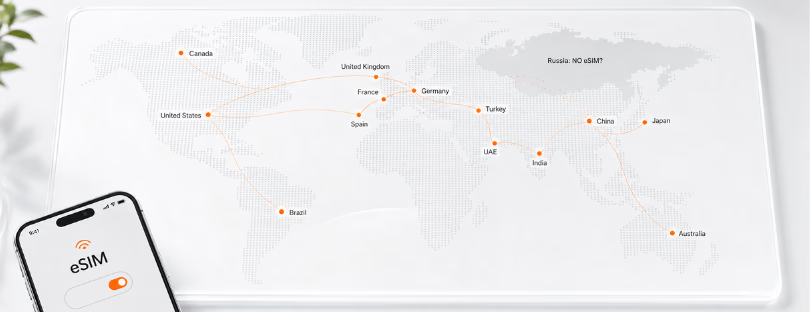
A regional eSIM covers a defined set of countries under a single data pool. You buy it once, install it once, and it follows you across borders. A single-country eSIM does exactly what it says — one plan, one country, and when you cross into the next, you’re on your own.
The misunderstanding most travelers fall into is treating this as a binary of “better vs. worse.” It’s not. It’s a question of fit.
A regional plan makes obvious sense if you’re doing a multi-stop Europe run, backpacking through Southeast Asia, or island-hopping in the Caribbean. But if you’re flying direct to Tokyo for two weeks and coming straight home, a Japan-specific plan will almost certainly be cheaper and offer stronger local network prioritization. Regional coverage is a trade-off — you gain convenience, but you sometimes sacrifice the granular network selection that a local MVNO or telco partnership can offer in a single market.
The nuance that rarely gets discussed: regional eSIMs are only as good as the roaming agreements behind them. Two plans that both say “Europe” may route through entirely different networks in, say, Romania or Albania — and the quality difference can be significant.
The Data Management Problem Nobody Talks About
Here’s where regional plans quietly win the practical argument: data pooling.
With multiple single-country eSIMs, you’re managing separate allocations per destination. That’s fine if your itinerary is predictable, but travel rarely is. Burn through your Italy data in three days because you were streaming maps and calling home? You’re buying another plan. Meanwhile, someone on a regional plan just keeps scrolling.
A shared pool across countries removes that friction. It also tends to come out cheaper on a per-GB basis when you’re covering more ground. That’s not marketing — it’s basic math. Providers can offer regional plans at a discount because they’re selling volume upfront and betting on average usage across a broader user base.
The flip side: if you’re visiting only one or two countries and you’re a light data user, local plans often undercut regional pricing considerably. There’s no universal answer — it depends on itinerary length, data intensity, and how much you value simplicity.


Cost vs Coverage
Pricing Strategies
- Regional eSIMs:
- Generally more affordable if traveling through several countries.
- Saves you the hassle of buying multiple eSIMs.
- Local eSIMs:
- Might be cheaper if you’re only visiting one or two countries.
- Requires individual purchases that could add up.
What Airhub Is Building
Among the eSIM providers actively investing in the regional angle, Airhub has made it a core part of their product architecture. They currently cover 200+ countries and offer eight distinct regional plans — which is a meaningful structural choice, not just a catalog expansion.
Regional segmentation matters because it signals how a provider thinks about network partnerships. Eight regions mean eight different sets of roaming agreements, quality benchmarks, and pricing models. That’s operationally complex to do well.
Beyond geography, Airhub has moved into product categories that most travel eSIM providers haven’t touched: cruise packages (satellite-adjacent maritime data is notoriously expensive and underserved), family plans that bundle multiple SIMs under shared data, and student-oriented offerings. These aren’t gimmicks — they’re distribution moves. Each vertical opens a different acquisition channel and reduces reliance on the increasingly competitive solo traveler market.
Tethering and data sharing support across all plans is also worth noting. It sounds basic, but a surprising number of travel eSIM plans still throttle or restrict hotspot use. For remote workers and digital nomads, that’s a dealbreaker.

Signal Quality: The Variable Nobody Advertises
Both regional and local eSIMs run on the same underlying infrastructure — mobile towers, roaming agreements, and carrier partnerships. But the specific network your eSIM latches onto varies by provider, and this is where fine print matters.
When evaluating any eSIM plan, the key question isn’t “does it cover my country” — it’s “which network does it connect to in my country.” In markets like Germany, Japan, or the US, the network difference between a top-tier and second-tier operator can be dramatic in terms of 5G availability and indoor coverage. Some eSIM providers publish their network partners; many don’t. Always worth digging.
Key questions to ask before buying any eSIM:
- Which specific carriers does it partner with in each country?
- Is 5G included, or is it capped at LTE?
- Are hotspot/tethering permitted?
- What happens if you run out of data — can you top up without switching plans?
The Bigger Picture
How This Market Is Actually Evolving
The regional vs. local debate is becoming increasingly interesting as the eSIM market matures and consolidates. The space is no longer just Airalo and a handful of challengers — it’s a fragmented but rapidly professionalizing ecosystem that includes Holafly (strong in Europe and Latin America, unlimited-data focus), Ubigi (enterprise and device-level embedded connectivity), Nomad (clean UX, solid Asia-Pacific coverage), Yesim (VPN bundling as a differentiator), and newer API-first players building white-label infrastructure for travel apps and fintech.
The trend worth watching: annual and unlimited plans. Holafly has pushed hard on unlimited data positioning, which appeals to a specific traveler profile, even if the actual throughput often gets throttled after a certain threshold. Airhub’s move into family and cruise packages suggests a different strategic bet — that the next growth frontier isn’t individual travelers, but group and vertical-specific products that command higher average order values and build stickier retention.
According to GSMA Intelligence, the global eSIM market is expected to surpass 300 million connected devices by 2025, with travel data plans representing one of the fastest-growing consumer segments. That growth is attracting capital, which means the pricing pressure on individual country plans will continue — likely forcing smaller providers to either specialize or consolidate.
For travelers, that’s mostly good news. But it also means the default advice — “just buy a regional plan” — is becoming less reliable as a blanket recommendation. The quality gap between providers is widening, not narrowing. A regional eSIM from a well-resourced operator with strong carrier partnerships is a genuinely excellent product. A regional eSIM from a thin reseller with weak agreements is a frustrating experience that gives the category a bad name.
The question isn’t really regional vs. local anymore. It’s who’s behind the plan — and whether they’ve done the infrastructure work to back it up.