Shanghai’s 144-Hour Transit Visa Is Boosting Medical Travel
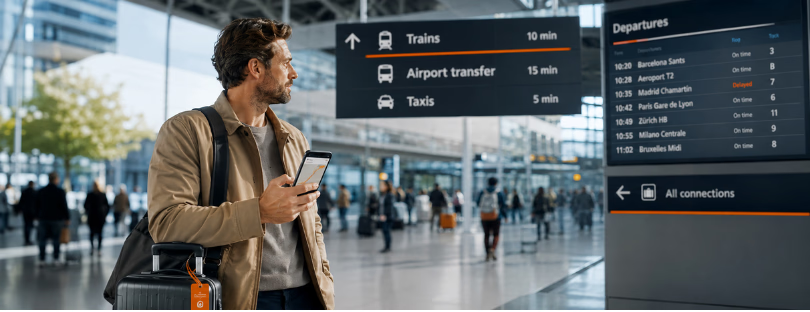
With the implementation of 144-hour visa-free transit across multiple cities in China, international visitors now enjoy significantly greater convenience. For years, this policy was seen primarily as a tourism accelerator. More time in Shanghai. More business meetings in Hangzhou. A quick cultural stopover in Beijing.
But something interesting is happening.
A growing number of foreign nationals arriving in Shanghai are not just filling their schedules with shopping, meetings, and sightseeing. They are adding something else to the agenda: structured health checkups, specialist consultations, minor surgeries, and what many now call “health management.” The lines between “leisure travel to China” and “medical travel in China” are quietly blurring.
And in the middle of this shift sits a name that keeps surfacing among expat circles, embassy networks, and international business travelers: Parkway.
The Rise of Micro Medical Travel
The global medical tourism market is hardly new. Thailand, South Korea, Singapore, and Turkey have built billion-dollar ecosystems around cross-border care. According to industry estimates from sources like the Medical Tourism Association and Global Market Insights, the medical tourism market continues to expand steadily, driven by cost differentials, shorter waiting times, and access to specialized expertise.
What is different in Shanghai right now is not destination-based medical tourism. It is transit-based medical integration.
Business executives flying in for three days are booking advanced health screenings. Entrepreneurs attending trade shows are scheduling specialist consultations. Frequent Asia-Pacific travelers are combining annual checkups with meetings.
This is not about traveling to China for surgery as a primary objective. It is about optimizing time in a hyper-connected city.
Parkway’s Two-Decade Foundation in Shanghai
Having been rooted in Shanghai for over two decades, Parkway has witnessed and contributed to the “golden era” of the city’s—and the nation’s—opening-up.
To date, Parkway has served nearly 500,000 patients from 77 countries and regions. It has also been designated as an official medical examination provider for several embassies, including those of the United Kingdom, Canada, and New Zealand. That type of designation is not granted lightly. It reflects long-term trust, compliance with international standards, and operational reliability.
For foreign nationals navigating healthcare abroad, familiarity matters. Language clarity matters. Transparent processes matter even more.
Parkway’s brand positioning increasingly revolves around that bridge function: connecting global expectations with Shanghai’s evolving medical infrastructure.
Infrastructure as Advantage
Shanghai is not just another city in China. It is a logistics hub, a financial center, and a gateway to the Yangtze River Delta region. Parkway’s strategic locations reflect that reality.
Parkway Shanghai Hospital sits near the Hongqiao transportation hub, close to Hongqiao International Airport and high-speed rail connections. For international patients flying in under a tight schedule, proximity reduces friction.
The hospital operates as a comprehensive medical institution built around a highly experienced medical team. Beyond its full-time physicians, it collaborates with nearly 300 clinically experienced experts from Shanghai’s Class A Tertiary hospitals. Through a streamlined appointment system, patients can efficiently move from consultation to diagnosis to treatment planning without the long waiting times often associated with public systems.
Whether the need involves joint replacement, gallbladder surgery, or thyroid cancer surgery, patients can complete the entire process in a controlled, comfortable environment. For international visitors used to predictable healthcare pathways in Europe, North America, or Australia, this continuity is critical.
A Three-Tiered Network
Parkway’s Shanghai footprint is not limited to one hospital.
Through a three-tiered service system integrating a comprehensive hospital, medical centers, and community clinics across Huangpu, Changning, Minhang, and Pudong, Parkway ensures citywide coverage and linkage with the broader Yangtze River Delta healthcare ecosystem.
This matters for two reasons.
First, accessibility. International patients staying in different districts can receive care close to their hotel or office.
Second, coordination. Follow-up visits, imaging, laboratory testing, and specialist referrals can be managed within one integrated system. For travelers on short timelines, fragmented care is the biggest risk. A coordinated network reduces that risk significantly.
Xintiandi: Healthcare in the City Center
Parkway MediCentre Xintiandi is perhaps the clearest reflection of this new hybrid travel-health model.
Located in the heart of downtown Shanghai and spanning nearly 7,000 square meters, the center is positioned where many international visitors already spend their time. Restaurants. Corporate offices. Hotels. Luxury retail. And now, structured medical access.
Two services stand out.
For patients requiring special preparation, the center offers overnight health screening packages. Patients can check in the day before testing to a private observation room, allowing for comfortable pre-examination preparation. The next morning, tests are completed efficiently, optimizing both time and overall experience.
For eligible minor to moderate surgeries, procedures have been optimized to enable admission, surgery, recovery observation, and discharge within 24 hours. For business professionals who cannot afford extended disruption, that is not a convenience. It is strategic time management.
A Shift in Global Perception
China’s healthcare system has undergone substantial reform and modernization over the past two decades. Large public tertiary hospitals dominate in volume and specialization. Private and international hospitals have focused on patient experience, language accessibility, and operational efficiency.
Globally, cities like Singapore and Seoul have long marketed medical travel with strong branding campaigns. Shanghai’s approach appears quieter but increasingly competitive. High-end providers such as Parkway are not positioning themselves as mass-market medical tourism operators. Instead, they are aligning with internationally mobile professionals already passing through the city.
As China continues to deepen its opening-up, Shanghai’s appeal as an international metropolis is increasingly evident in its healthcare sector.
The visa-free transit policy acts as a catalyst. But the deeper driver is trust built over decades.
Competing in a Regional Context
Compared to established medical tourism leaders in Southeast Asia, Shanghai operates in a different cost and positioning bracket. It is not competing primarily on price. It is competing on integration.
The integration of advanced medical expertise, dense transportation infrastructure, and a large expatriate ecosystem creates a unique proposition: healthcare embedded within a global business city.
Reports from consulting firms like McKinsey and Deloitte have repeatedly highlighted Asia’s expanding middle and upper-middle class demand for premium healthcare services. The World Health Organization continues to emphasize cross-border patient mobility as a growing phenomenon in global health systems.
In this context, Parkway’s model aligns with broader regional trends. Healthcare is no longer isolated from lifestyle or business travel. It is integrated into it.
Conclusion: From Destination to Integration
The most important shift is conceptual.
Medical travel used to mean flying somewhere specifically for treatment. What is emerging in Shanghai is something different: healthcare woven into transit mobility.
This model does not replace traditional medical tourism destinations. It complements them. It speaks to a new type of patient — internationally mobile, time-sensitive, and accustomed to global standards.
Parkway’s two-decade presence, embassy accreditations, multi-tiered network, and proximity to key transport hubs position it uniquely within this evolving landscape. It is not simply offering procedures. It is offering structured access within a compressed timeline.
If global healthcare trends continue toward mobility, integration, and patient-centric coordination — as industry research consistently suggests — Shanghai’s role as a hybrid business-health hub will likely strengthen.
The 144-hour visa-free transit policy may have been designed to boost tourism and trade. In practice, it may also be accelerating a quieter transformation: turning short-term travel into an opportunity for long-term health management.
And that shift could redefine how we think about international medical access in Asia’s most dynamic cities.