Soracom Launches SGP.32 Connectivity Hypervisor for IoT
The eSIM industry often moves quietly until a technical standard suddenly becomes unavoidable. Over the past year, that moment has increasingly centered on SGP.32, the GSMA’s new specification for IoT remote SIM provisioning. While consumer eSIM standards have been around for years, the IoT world has struggled with fragmented implementations, roaming limitations and long device lifecycles that demand far more flexibility. SGP.32 IoT eSIM Soracom
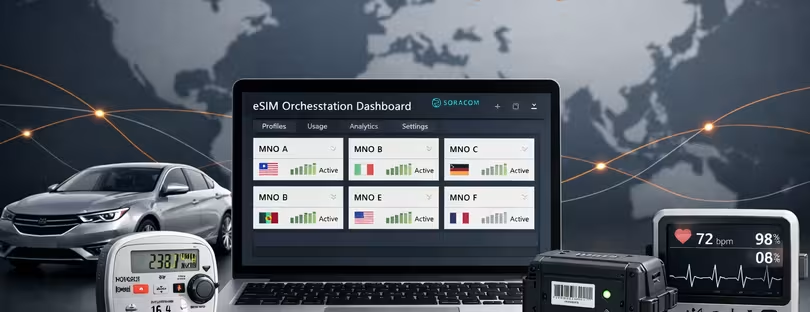
Now, Soracom is stepping into that conversation with a new infrastructure layer. The company has opened pre-orders for its Connectivity Hypervisor, an SGP.32-compatible capability designed to dynamically manage and switch between multiple operator profiles on a single IoT eSIM.
At first glance, that may sound like a technical upgrade. In reality, it represents a deeper shift in how global IoT connectivity will be orchestrated.
From connectivity provider to orchestration layer
For years, IoT connectivity strategies have been shaped by a fundamental limitation. Devices deployed globally often relied on a single mobile network operator profile, usually with roaming agreements layered on top.
That worked, but only to a point.
Permanent roaming restrictions, changing regulations and evolving data economics have made that model increasingly fragile. Enterprises deploying connected vehicles, smart meters or medical devices now need the ability to switch operators dynamically based on where the device actually operates.
This is where Soracom’s new Connectivity Hypervisor enters the picture.
Instead of treating connectivity as a static SIM profile embedded in a device, the platform acts as a control layer capable of orchestrating multiple carrier identities on a single eSIM. Devices can activate initially on a Soracom profile and later switch to a local operator or a use-case-specific carrier depending on region, regulation or application logic.
That orchestration model is becoming essential in global IoT deployments.
Why SGP.32 matters for IoT deployments
The technology enabling this shift is the GSMA’s SGP.32 specification, designed specifically for IoT remote SIM provisioning.
While consumer eSIM standards such as SGP.22 enabled smartphone profile downloads, IoT deployments present very different requirements. Devices may operate for ten to fifteen years, often in remote environments, and frequently move across borders.
SGP.32 introduces a more scalable architecture for remotely managing eSIM profiles across these long device lifecycles.
According to Soracom, the standard is quickly moving from an emerging specification to a baseline requirement in enterprise procurement processes.
In particular, the automotive industry is accelerating this shift. Connected vehicles require continuous connectivity across multiple countries, while complying with local regulations that often restrict permanent roaming.
The result is a growing demand for infrastructure capable of dynamically switching network identities.

Live field testing in automotive environments
Unlike many technologies that appear suddenly at launch events, Soracom says its infrastructure has already been running in real deployments.
The company reports that its Connectivity Hypervisor has been validated through live automotive field testing since mid-2025. This matters because automotive deployments represent one of the most demanding IoT environments, combining strict reliability requirements with large-scale global distribution.
If a connectivity orchestration platform can operate successfully inside vehicles, it signals a level of maturity that enterprises typically look for before committing to long lifecycle deployments.
In a statement, Kenta Yasukawa, Chief Technology Officer and Co-founder of Soracom, said:
“SGP.32 is rapidly becoming a requirement in automotive and enterprise IoT RFPs, and we made the decision early on to build the infrastructure rather than wait for the market. We have been in live field testing for months while the MNO ecosystem has been catching up.”
That comment reveals something interesting about the timing of this launch.
Rather than waiting for the mobile operator ecosystem to fully standardize around SGP.32, Soracom appears to have built the orchestration layer in advance, anticipating where enterprise requirements were heading.
Dynamic profile switching and regulatory compliance
One of the most important features of the platform is dynamic switching between operator profiles.
This capability allows a device to begin its life using a Soracom profile for initial activation and provisioning. Once deployed, the device can switch to a local operator profile depending on geography, regulatory requirements or performance considerations.
In practical terms, this enables several important deployment models.
Single SKU global device deployment
Manufacturers can produce a single hardware variant for global distribution rather than creating different SIM configurations for each market.
Compliance with permanent roaming restrictions
Devices operating long-term in a specific country can switch to a local network identity to comply with regulations that limit roaming.
Use-case-specific connectivity
Certain applications may require specific operator relationships for coverage, latency or private network integration.
These capabilities become especially relevant for sectors with long device lifecycles, including:
Automotive
Connected vehicles require persistent connectivity across multiple regions over many years.
Utilities
Smart meters and grid infrastructure often remain deployed for more than a decade.
Asset tracking
Global logistics systems rely on devices moving continuously across borders.
Healthcare
Medical equipment increasingly depends on reliable connectivity for remote monitoring.
For these industries, the ability to manage operator profiles dynamically can dramatically simplify global deployment strategies.
 The rise of the connectivity control plane
 The rise of the connectivity control plane
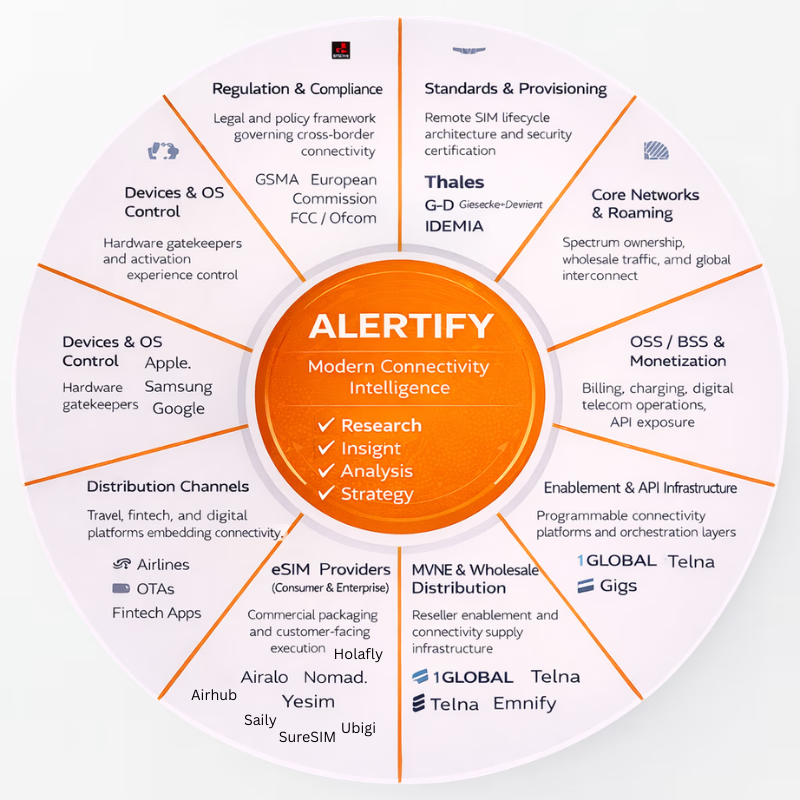
Perhaps the most interesting aspect of Soracom’s approach is how the company describes the Connectivity Hypervisor.
Rather than positioning it as another eSIM management system, Soracom frames it as a platform orchestration layer operating from a unified control plane.
In other words, the platform sits above individual operator relationships and manages them collectively.
This architecture reflects a broader shift in the telecom ecosystem.
Connectivity is gradually becoming software-defined infrastructure, where orchestration platforms determine how networks are selected, managed and monetized.
Companies that control this orchestration layer can potentially influence the entire connectivity supply chain.
We are already seeing similar concepts emerge across the industry.
1NCE has built a global IoT connectivity model based on a single flat-rate lifetime SIM. Eseye focuses heavily on multi-network resilience and global device management.
Meanwhile, Truphone has explored programmable connectivity architectures that blur the lines between operator infrastructure and enterprise connectivity platforms.
Soracom’s Connectivity Hypervisor fits into that same strategic space, but with a stronger emphasis on SGP.32-native orchestration.
The bigger shift is happening in IoT connectivity
Stepping back from the product announcement, it becomes clear that this launch reflects a much larger transformation.
For most of telecom history, connectivity was tied directly to physical SIM cards and individual operator relationships.
The emergence of eSIM technology began separating network identity from hardware, allowing profiles to be downloaded remotely.
Now, with standards like SGP.32 and orchestration layers like Soracom’s Connectivity Hypervisor, connectivity is moving one step further.
It is becoming programmable infrastructure. SGP.32 IoT eSIM Soracom
Enterprises deploying IoT devices no longer want to negotiate dozens of operator relationships. They want a platform that can manage those relationships dynamically while ensuring regulatory compliance and performance optimization.
That shift turns connectivity into something closer to a cloud service.
Conclusion: the quiet infrastructure race behind IoT
The most important battle in IoT connectivity is not happening at the device level. It is happening at the orchestration layer.
Companies like Soracom are positioning themselves not just as connectivity providers but as control platforms that manage how connectivity is delivered globally.
This is an increasingly competitive space. Providers such as 1NCE, Eseye and other IoT connectivity specialists are all experimenting with different models for global device management. At the same time, traditional mobile operators are working to integrate SGP.32 capabilities into their own infrastructure.
Industry organizations like the GSMA are also accelerating standardization efforts, recognizing that IoT deployments require far more flexible connectivity frameworks than traditional telecom architectures.
What Soracom’s announcement shows is that the industry is entering a new phase.
The conversation is no longer just about SIM cards or even eSIM profiles. It is about who controls the software layer that orchestrates global connectivity.
As SGP.32 adoption expands across automotive, utilities and enterprise IoT, platforms capable of dynamically managing operator identities may become one of the most valuable pieces of infrastructure in the entire connected device ecosystem.
And if Soracom’s early field testing proves successful, the Connectivity Hypervisor could signal the beginning of a much larger shift toward fully programmable global IoT connectivity.