Roamless Coupon Guide: Save on Travel eSIM Data
A Roamless coupon sounds like a simple search query. You type it into Google, hope for a working discount, paste it at checkout, and feel mildly victorious if the price drops. But in the travel eSIM market, coupons are becoming more than a small shopping trick. They are turning into a very visible signal of how competitive this category has become.
Roamless has leaned into this quite directly. The company has an official promo code page, and its help center explains that Roamless promo codes can unlock different types of rewards, including free data plans, pay-as-you-go credits, discounts, or bonuses at checkout. In other words, this is not just a random affiliate coupon floating around a coupon site. Roamless is treating promo codes as part of its acquisition and partner strategy.
Why travelers care
For most travelers, the appeal is obvious. Roaming is still one of those annoying travel costs people do not fully trust. You know the feeling: your operator says you have “international options,” but the pricing page looks like it was written by a lawyer with a telecom background and a bad mood.
That is why travel eSIM discounts work so well. They reduce the first-purchase hesitation. A traveler may not yet know whether Roamless performs better than Airalo, Holafly, Ubigi, Yesim, Nomad, GigSky, or the mobile operator’s own roaming pass. But if there is a coupon, the risk feels smaller. Try it once, test the app, see if the connection is decent, and decide later.
READ MORE: Roamless Adds Calls, SMS and Phone Numbers — Is This the All-in-One Travel eSIM?
This is especially relevant for Roamless because its model is not only about buying a one-off country plan. Roamless presents itself as a global mobile connectivity app with mobile data, phone numbers, international calling, and SMS in one app, covering 200+ destinations. It also promotes the idea of one global eSIM that can be used across countries, rather than installing a new eSIM every time you travel.
That matters. A coupon on a disposable one-trip eSIM is nice. A coupon on a product that wants to become your ongoing travel connectivity wallet is more strategic.
What Roamless is really selling
The more interesting part of Roamless is not the coupon itself. It is the product logic behind it.
Roamless has two broad usage ideas: fixed data plans and pay-as-you-go credits. Its own pages describe a single global eSIM that works across destinations, with fixed plans activating when you connect in the plan’s country and pay-as-you-go starting automatically when you connect in another supported country.
This is a subtle but important shift. Many travel eSIM providers still behave like online ticket sellers. You go to the site, choose France, Japan, Turkey, or the US, buy a package, install it, use it, and then start again next time. Roamless is closer to the “connectivity account” model. You install once, keep balance, use when needed, and avoid the mental admin of buying a fresh plan for every small trip.
That is where the coupon becomes clever. It is not only a price cut. It is an onboarding tool. Get the traveler into the app, make them comfortable with the global eSIM, encourage them to leave balance inside the ecosystem, and suddenly, Roamless is not competing only at checkout. It is competing for a place on the phone.


The coupon – trap?
Still, travelers should be careful. A Roamless coupon can be useful, but it should not be the only reason to choose the service.
The first question is simple: what exactly is being discounted? Some Roamless help content says discount codes can apply to pay-as-you-go credit purchases or data plan purchases unless specified otherwise. That “unless specified otherwise” matters. A coupon may not apply to every product, every market, every new user, or every payment flow.
READ MORE: Roamless – Global Travel Connectivity Startup – Raises $12M to Fix Broken Roaming
Second, compare the discounted price with your real usage pattern. If you are going to one country for seven days and need a predictable 10 GB plan, a fixed package from another provider may still be cheaper. If you travel often, cross borders, take weekend trips, or hate wasting unused data, Roamless’ pay-as-you-go approach can become more attractive.
Third, look beyond price. Network routing, local partner quality, throttling behavior, hotspot rules, app reliability, support speed, and refund policy can matter more than a 10 or 20 percent discount. A cheap eSIM that fails when you are trying to call a ride at midnight is not cheap. It is a travel tax with better branding.
Where Roamless fits
Compared with the wider market, Roamless sits in an interesting middle lane.
Airalo is still one of the best-known names for destination-based travel eSIMs. Holafly has built strong consumer awareness around unlimited-style plans and convenience. Ubigi has long been strong in connected devices, cars, tablets, and frequent-traveler use cases. Yesim has moved toward persistent connectivity ideas with options such as balance-based use and broader app-led travel connectivity. Roamless is playing in that same “always-ready” direction, but with a strong emphasis on a single global eSIM, pay-as-you-go balance, and app-based calling or number features.
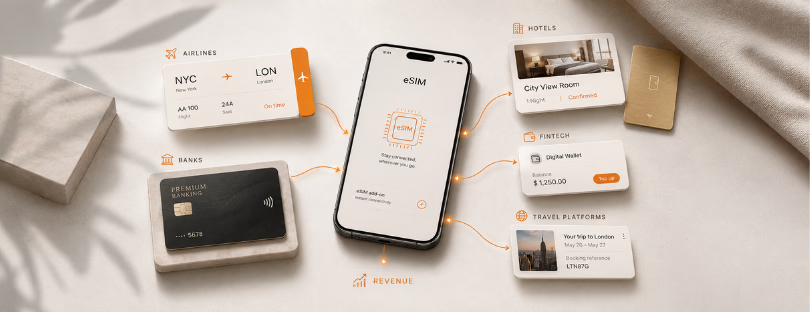
That is not a small difference. The market is moving away from “download a SIM for Spain” and toward “keep a connectivity layer ready whenever you travel.” Juniper Research estimates travel eSIM revenue at $1.8 billion in 2025 and forecasts it could reach $8.7 billion by 2030. That kind of growth explains why coupons are everywhere. Providers are fighting for the first install, because the first install can become a long-term customer relationship.
There is also more pressure from traditional operators. Juniper has noted that travel eSIMs are becoming a direct challenge to traditional roaming players, and more operators are expected to respond with their own travel eSIM products.
Final thoughts
A Roamless coupon is worth using, but the smarter question is not “how much do I save today?” It is “does this product reduce the friction of staying connected every time I travel?”
That is where Roamless becomes more interesting than a normal discount search. The best travel eSIM products are no longer just cheaper alternatives to roaming. They are trying to become permanent travel utilities: installed once, topped up when needed, quietly ready in the background. Roamless understands that direction. So do several of its strongest competitors.
For travelers, that is good news. More competition means better pricing, more flexible plans, and fewer excuses for old-school roaming shock. But it also means coupons should be treated as the entry point, not the decision. Use the Roamless coupon if it fits your trip. Then judge the service on what really matters: how quickly it connects, how clearly it prices data, how well it works across borders, and whether you would keep it installed after the discount disappears.