Revolut single-use card: the quiet feature changing how we pay online
If you’ve ever hesitated before entering your card details on a random website, you already understand the problem Revolut is trying to solve with its single-use card.
This isn’t a flashy feature. It doesn’t come with cashback campaigns or loyalty points. But in a world where card leaks and subscription traps are still surprisingly common, the “disposable” card is quietly becoming one of the most important tools in digital finance.
And yes, it’s more interesting than it sounds.
What a single-use card actually is
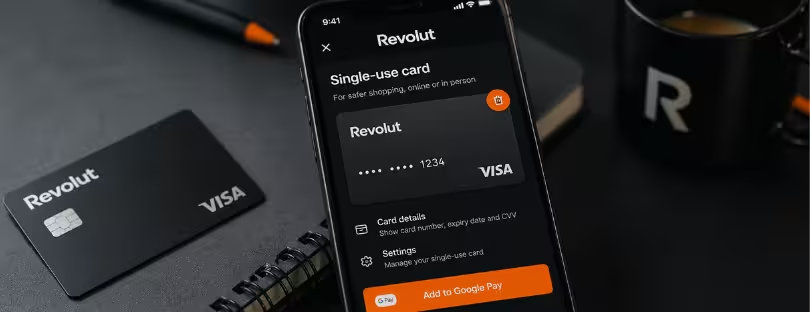
At its core, a Revolut single-use card is a virtual debit card that self-destructs after one payment. Not literally, but close enough.
You generate a card inside the app, use it for a purchase, and then the card details are instantly replaced with a new set. The old ones become useless.
From the merchant’s perspective, it looks like a normal Visa or Mastercard transaction. From your perspective, it’s a layer of protection sitting between your real account and the internet.
That distinction matters more than most people realize.
Why does this exist in the first place?
Online payments haven’t fundamentally changed in decades. You still type in a 16-digit number, expiry date, and CVV. If that data gets compromised, you’re exposed.
Single-use cards flip that model.
Instead of protecting one permanent card number, you constantly rotate disposable ones. Even if a website stores your details poorly or gets breached later, there’s nothing valuable to steal.
READ MORE: The Revolut Card: Still the Smartest Travel Money Tool?
Revolut describes this as isolating your real financial data from merchants entirely.
It’s not just security theater. It’s a different architecture.
Where it actually makes sense to use
This is where things get practical.
Single-use cards aren’t meant for everything. In fact, they’re quite limited by design.
That alone is a surprisingly strong use case.
Where it doesn’t work (and this matters)
This is where a lot of users get caught off guard.
Single-use cards cannot be used for:
- Subscriptions like Netflix or Spotify
- Hotel reservations or car rentals
- Any payment that needs pre-authorisation
- In-store or contactless payments
So while it sounds like a universal solution, it’s actually a very specific tool. Think of it more like a “secure checkout mode” rather than your everyday card.
The user experience is almost too simple
The real strength of Revolut here isn’t just the idea. It’s the execution.
You open the app, tap “add card,” choose disposable, and you’re ready in seconds. No fees, no waiting, no friction.
That matters because most security features fail when they’re inconvenient.
This one doesn’t.
A subtle shift in consumer behavior
What’s interesting is how this feature changes how people think about payments.
Instead of trusting the merchant, you assume risk by default and protect yourself proactively.
That’s a very different mindset compared to traditional banking.
And it aligns with a broader trend we’re seeing across fintech:
- Privacy-first financial tools
- User-controlled security layers
- Disposable digital identities (cards, emails, even phone numbers)
Revolut didn’t invent this concept, but they’ve made it mainstream in Europe.
How does it compare with similar players?
Revolut isn’t alone here, but the implementation differs.
Wise offers virtual cards, but not true single-use disposable ones. Their focus is more on currency conversion and global spending efficiency.
READ MORE: Revolut Mobile Launches £12.50 Unlimited 5G Plan in the UK
N26 and Monese provide virtual cards as well, but typically multi-use, not auto-refreshing after each transaction.
Some traditional banks have started experimenting with temporary card numbers, but the experience is usually clunky. You generate a number via desktop banking, not instantly in-app.
Revolut’s edge is that this feels native. Fast. Almost invisible.
The catch nobody talks about
There is one subtle limitation worth mentioning.
Because the card disappears after use, some merchants struggle with refunds or follow-up processes. While Revolut still routes refunds back to your account correctly, you may need to explain the situation to customer support on the merchant side.
READ MORE: Revolut Acquires AI Travel Startup Swifty to Reinvent Smart Travel Banking
It’s not a dealbreaker, but it’s a friction point.
Also, based on user discussions, some websites reject disposable cards altogether, especially those with stricter fraud filters.
So it’s not bulletproof.
Why this matters more than it seems
This feature sits at the intersection of fintech, cybersecurity, and consumer trust.
We’re moving into a world where:
- Data breaches are expected, not exceptional
- Subscription models are everywhere
- Cross-border payments are routine
In that context, static card numbers feel outdated.
Single-use cards are a glimpse of what payments might look like in the next phase. More dynamic, more controlled, and less dependent on blind trust.
Conclusion
Revolut’s single-use card is one of those features that doesn’t look revolutionary until you actually use it.
Then it’s hard to go back.
Compared to competitors like Wise or N26, Revolut is pushing further into what you could call “programmable payments” where the user defines the rules, not the merchant. And that aligns with broader fintech trends toward privacy, control, and modular financial tools.
Reliable sources, including Revolut’s own documentation and fintech comparisons, consistently highlight the same thing: the value here isn’t convenience, it’s risk reduction.
The real takeaway is simple.
Single-use cards won’t replace your main card. They’re not supposed to. But they quietly solve one of the most persistent problems in digital payments.
And in a space full of overhyped features, that’s actually rare.