Revolut eSIM Canada: Worth It for Travelers?
It’s not often that a banking app quietly enters the telecom space and actually makes sense. But that’s exactly what Revolut has been doing with its eSIM product—and Canada is one of the more interesting test cases.
Canada, for context, is one of the most expensive mobile data markets in the world. Roaming there can feel like stepping back into 2010 billing nightmares. So when Revolut positions its eSIM as a frictionless, app-native solution for travelers, it’s worth taking a closer look.
Let’s break down what “Revolut eSIM Canada” actually is, how it performs, and where it fits in today’s increasingly crowded eSIM ecosystem.
What Revolut is actually offering in Canada
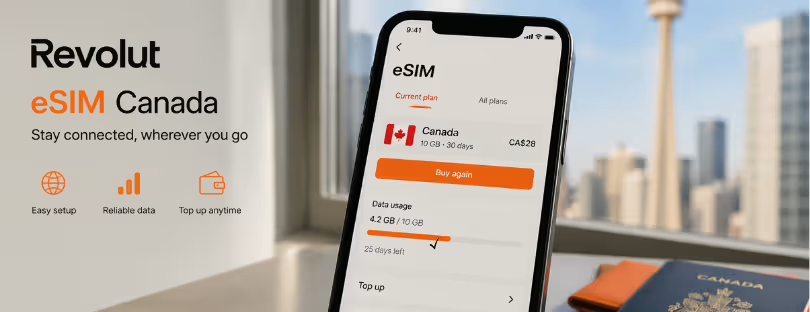
At its core, Revolut’s eSIM is simple: a data-only travel eSIM that you buy and manage inside the app you already use for payments.
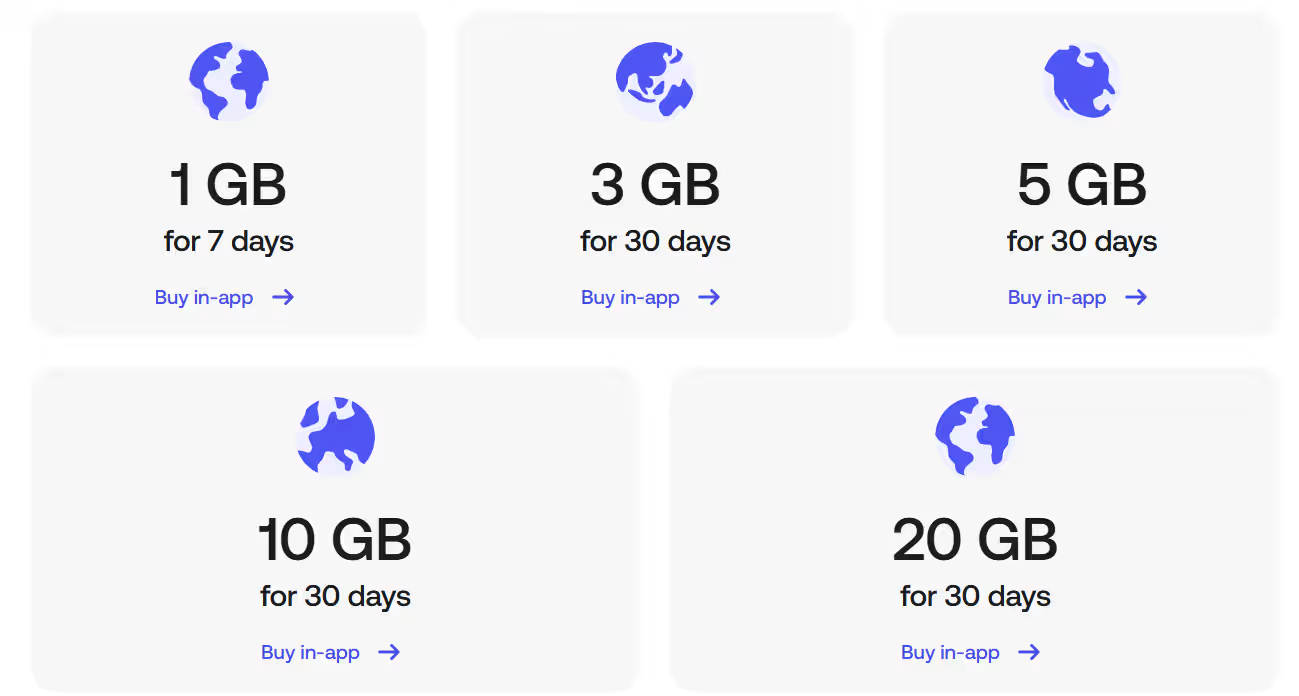
For Canada specifically, Revolut offers a range of prepaid data bundles:
- 1 GB (7 days)
- 3 GB, 5 GB, 10 GB, 20 GB (30 days)
No contracts. No local SIM hunting. Just install once and top up when needed.
And that’s really the product: convenience.
You install the eSIM once, and then you can keep reusing it across trips, switching countries or regions without changing profiles.
The experience: frictionless, but not revolutionary
Where Revolut gets it right is the experience layer.
- Activation is done directly in-app
- Data usage tracking is built in
- Top-ups take seconds
- You keep your main SIM active for calls (dual SIM)
If you’re already a Revolut user, this feels almost too easy. And that’s intentional.
This is telecom becoming a feature, not a product.
But here’s the thing: technically, this isn’t a new category. It’s a repackaging of what eSIM aggregators have been doing for years.
Under the hood: it’s still an aggregator model
Revolut doesn’t operate its own mobile network. Like most travel eSIM providers, it relies on partner infrastructure—specifically platforms like 1GLOBAL.
That means:
- Your connection in Canada depends on local partner networks
- Speeds and latency can vary by region
- You’re essentially roaming on wholesale agreements
In practice, that’s fine for most users. But it explains why performance can feel inconsistent compared to local SIMs or telco-backed eSIMs.
A Reddit user summed it up pretty well:
“Worked like a charm… video calls and YouTube 720p no problem.”
That’s a good baseline expectation. Not exceptional. Not terrible. Just solid.
The biggest limitation: no voice, no unlimited
This is where things get more interesting.
Revolut eSIM is strictly data-only. No phone number. No native voice or SMS.
For some travelers, that’s fine. WhatsApp, FaceTime, Teams… everything runs on data anyway.
But for business users, or anyone needing:
- local calls
- OTP verification via SMS
- reliable fallback communication
…it’s a limitation.
Then there’s the second issue: no unlimited plans.
Unlike some competitors, Revolut sticks to capped data bundles.
And in Canada, where heavy usage is common (think maps, hotspots, remote work), that matters.
Where it fits in the market
This is where you need to zoom out.
Revolut isn’t trying to compete head-on with traditional eSIM providers like Airalo or Holafly.
It’s doing something slightly different.
Think of the current eSIM market in three layers:
|
BASIC
Basic data bundles
Revolut, Airalo, Nomad
|
PREMIUM
Unlimited / premium layer
Holafly, Fairplay Mobile
|
INFRASTRUCTURE
Programmable layer
1GLOBAL, Gigs
|
Revolut sits right between layer one and three.
It’s not the cheapest. It’s not the most powerful. But it’s the most integrated.
Canada as a use case: where it works… and where it doesn’t
Canada is actually a perfect stress test for this product.
|
Why?
|
Revolut works well if you:
|
It struggles if you:
|
That’s where telco-backed or multi-network premium providers start to make more sense.
The bigger trend: fintech is eating telecom
This is the part most people miss.
Revolut launching eSIM isn’t just a feature. It’s a signal.
Fintech apps are slowly absorbing telecom functionality:
- payments → Revolut
- banking → Revolut
- connectivity → now also Revolut
And it aligns perfectly with what GSMA and industry reports have been hinting at for years: connectivity is becoming embedded, not standalone.
You won’t go “buy an eSIM” anymore.
You’ll just… tap a button inside an app you already use.
Conclusion
Revolut eSIM in Canada is not the most advanced solution on the market. It’s not the cheapest either. And for power users, it’s clearly not enough.
But that’s missing the point.
What Revolut is doing is redefining where connectivity lives.
Compared to players like Airalo or Holafly, it trades depth for simplicity. Compared to infrastructure players like 1GLOBAL, it abstracts complexity into a consumer-friendly layer.
And that’s exactly why it matters.
Because if this model scales, the future of travel connectivity won’t be dominated by eSIM brands at all. It’ll be controlled by platforms that quietly integrate telecom into a broader digital experience.
Revolut is one of the first to make that shift visible.
Not perfect. Not complete.
But directionally? Very hard to ignore.