Ooredoo eSIM: How It Works Across 9 Markets
For a long time, buying mobile service in many Ooredoo markets meant doing something very familiar: finding a store, showing ID, getting a plastic SIM card, and hoping the line worked before you needed it. eSIM changes that rhythm. Not perfectly everywhere, and not in exactly the same way across every Ooredoo country, but enough to say this is no longer a side feature.
Ooredoo operates across Qatar, Oman, Kuwait, Iraq through Asiacell, Palestine, Algeria, Tunisia, the Maldives and Indonesia through Indosat Ooredoo Hutchison. That footprint matters because these are not identical markets. Qatar is a premium travel and events hub. Oman and Kuwait have strong app-based customer journeys. The Maldives is a tourism-heavy destination where arrival connectivity is not a luxury. Indonesia is a huge, competitive mobile market with very different scale.
So when we talk about “Ooredoo eSIM”, we are really talking about a regional operator group trying to move SIM activation from counter service to digital service.
How activation works
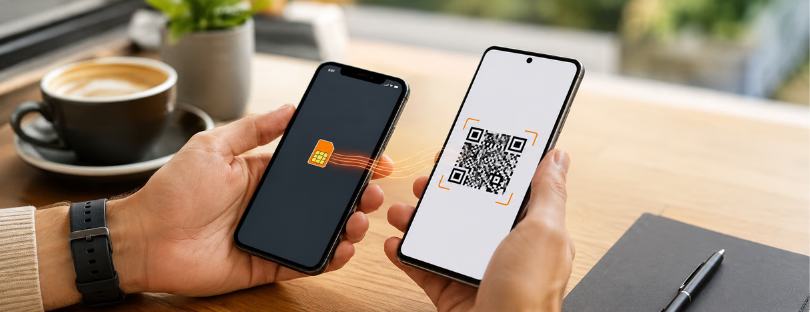
Instead of inserting a physical SIM, the customer downloads a mobile profile to an eSIM-compatible phone by scanning a QR code or completing the flow in the local Ooredoo app.
For existing customers, the most practical route is usually conversion. In markets such as Oman and Kuwait, users can switch from a physical SIM to eSIM through the Ooredoo app, typically under SIM replacement, SIM swap, or “switch to eSIM” options. Some customers will still prefer a store visit, especially if they are moving phones, dealing with ID checks, or unsure whether their device is supported.
For new customers, the flow depends more on the country. Ooredoo Qatar, for example, lets visitors buy a Visitor SIM as an instant eSIM online, while airport kiosks at Hamad International Airport remain available for people who still want human help after landing. That mix is important. The future may be digital, but airport counters are not disappearing overnight.
Ooredoo Oman also positions eSIM for prepaid, postpaid and tourist plans, which is where eSIM makes sense: quick setup, no delivery, and easier switching between lines.
Why travelers notice it first
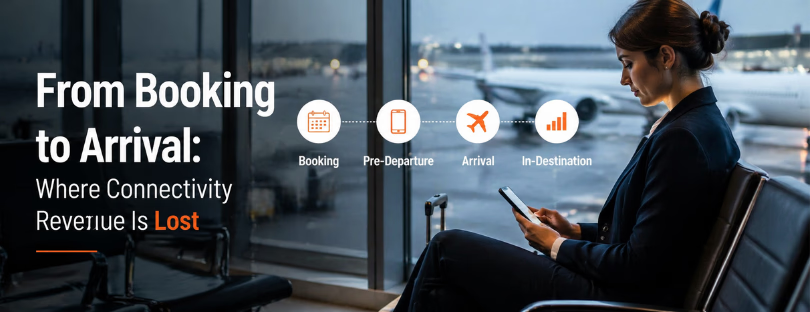
The traveler use case is the easiest one to understand. You land in Doha, Muscat, Kuwait City or Malé. Before immigration is even finished, your phone becomes the trip control panel: hotel address, WhatsApp, ride-hailing, maps, card verification, boarding pass, family messages. Connectivity is not something you “sort out later” anymore.
That is why operator-led tourist eSIMs are becoming more interesting. For years, travel eSIM apps such as Airalo, Holafly, Nomad eSIM, Ubigi and Yesim built growth around one clear pain point: operators made visitor connectivity too slow or too local. Travelers wanted to buy before departure and connect on arrival.
Ooredoo’s advantage is different. It owns, operates, or is directly tied to the local network in many of these markets. That can mean stronger local integration, more familiar customer support, and sometimes better plan alignment with local prepaid offers. The downside is fragmentation. A travel eSIM app gives you one interface across many countries. Ooredoo gives you strong local options, but the experience can vary by market, app, ID rules and plan availability.
The multi-line benefit
For local customers, eSIM is not only about travel. It is also about managing life more neatly. A dual-SIM phone can hold a personal number and a business number. Someone can keep their main Ooredoo line active and add a temporary travel eSIM. A freelancer can separate client calls from family calls without carrying two phones.
This is where eSIM quietly changes customer behavior. The SIM card used to feel permanent. eSIM makes mobile plans feel more modular. You can add, remove, test and switch more easily, although not always as freely as marketing pages suggest. Some operators still charge for replacements. Some QR codes cannot be reused indefinitely. Some phone transfers require extra steps. The user experience is improving, but it is not yet as invisible as downloading an app.
Enterprise and IoT angle
The more strategic part of Ooredoo’s eSIM story may actually sit outside consumer phones. Ooredoo Qatar has been positioning IoT eSIM for businesses that need to connect fleets, sensors and devices without managing thousands of plastic SIMs. That is not glamorous, but it is where eSIM becomes infrastructure.
For logistics, smart meters, connected equipment or remote monitoring, physical SIM handling becomes expensive and messy. eSIM lets enterprises provision, manage and update connectivity more centrally. The GSMA’s eSIM standards matter here because large-scale IoT cannot depend on improvised activation flows. It needs security, remote provisioning and operational control.
This also fits the wider Ooredoo Group direction. The company has been investing in digital infrastructure, data centres and enterprise services, which suggests eSIM is not just a consumer convenience feature. It is part of a bigger operator shift from selling access to managing connectivity layers.
Final view
Ooredoo eSIM is most convincing when you see it as a bridge between two worlds. On one side, there is the old operator model: local SIM, store visit, manual activation. On the other, there is the travel eSIM app model: buy in minutes, scan, connect, move on. Ooredoo is trying to bring operator credibility into the second model.
That is a smart move, especially in travel-heavy markets such as Qatar, Oman and the Maldives. Still, the group has work to do if it wants the experience to feel consistent across all nine markets. A traveler should not need to understand each country’s app, process and ID flow from scratch. A cleaner regional Ooredoo eSIM experience would be powerful.
Compared with pure travel eSIM providers, Ooredoo has the network-side advantage. Compared with digital-first players, it still has the complexity of being a telecom operator. That tension is exactly what makes this story interesting. The winners in eSIM will not simply be the cheapest brands. They will be the ones that make connectivity feel instant, trusted and boring in the best possible way.