Ooredoo eSIM: How It Works Across 9 Markets
For a long time, buying mobile service in many Ooredoo markets meant doing something very familiar: finding a store, showing ID, getting a plastic SIM card, and hoping the line worked before you needed it. eSIM changes that rhythm. Not perfectly everywhere, and not in exactly the same way across every Ooredoo country, but enough to say this is no longer a side feature.
Ooredoo operates across Qatar, Oman, Kuwait, Iraq through Asiacell, Palestine, Algeria, Tunisia, the Maldives and Indonesia through Indosat Ooredoo Hutchison. That footprint matters because these are not identical markets. Qatar is a premium travel and events hub. Oman and Kuwait have strong app-based customer journeys. The Maldives is a tourism-heavy destination where arrival connectivity is not a luxury. Indonesia is a huge, competitive mobile market with very different scale.
So when we talk about “Ooredoo eSIM”, we are really talking about a regional operator group trying to move SIM activation from counter service to digital service.
How activation works
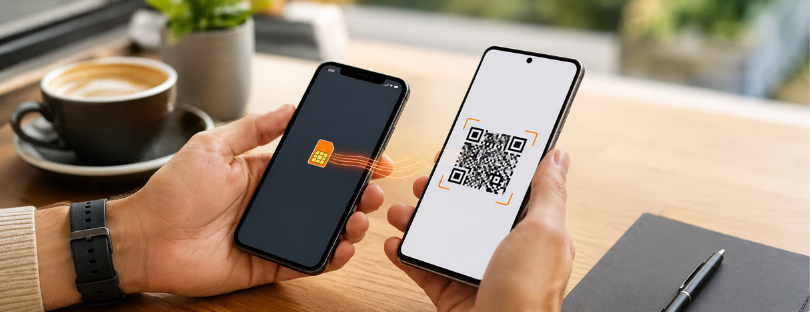
Instead of inserting a physical SIM, the customer downloads a mobile profile to an eSIM-compatible phone by scanning a QR code or completing the flow in the local Ooredoo app.
For existing customers, the most practical route is usually conversion. In markets such as Oman and Kuwait, users can switch from a physical SIM to eSIM through the Ooredoo app, typically under SIM replacement, SIM swap, or “switch to eSIM” options. Some customers will still prefer a store visit, especially if they are moving phones, dealing with ID checks, or unsure whether their device is supported.
For new customers, the flow depends more on the country. Ooredoo Qatar, for example, lets visitors buy a Visitor SIM as an instant eSIM online, while airport kiosks at Hamad International Airport remain available for people who still want human help after landing. That mix is important. The future may be digital, but airport counters are not disappearing overnight.
Ooredoo Oman also positions eSIM for prepaid, postpaid and tourist plans, which is where eSIM makes sense: quick setup, no delivery, and easier switching between lines.
Why travelers notice it first
The traveler use case is the easiest one to understand. You land in Doha, Muscat, Kuwait City or Malé. Before immigration is even finished, your phone becomes the trip control panel: hotel address, WhatsApp, ride-hailing, maps, card verification, boarding pass, and family messages. Connectivity is not something you “sort out later” anymore.
That is why operator-led tourist eSIMs are becoming more interesting. For years, travel eSIM apps such as Airalo, Holafly, Nomad eSIM, Ubigi and Yesim built growth around one clear pain point: operators made visitor connectivity too slow or too local. Travelers wanted to buy before departure and connect on arrival.
Ooredoo’s advantage is different. It owns, operates, or is directly tied to the local network in many of these markets. That can mean stronger local integration, more familiar customer support, and sometimes better alignment of plans with local prepaid offers. The downside is fragmentation. A travel eSIM app gives you one interface across many countries. Ooredoo offers strong local options, but the experience can vary by market, app, ID rules, and plan availability.
The multi-line benefit
For local customers, eSIM is not only about travel. It is also about managing life more neatly. A dual-SIM phone can hold a personal number and a business number. Someone can keep their main Ooredoo line active and add a temporary travel eSIM. A freelancer can separate client calls from family calls without carrying two phones.
This is where eSIM quietly changes customer behavior. The SIM card used to feel permanent. eSIM makes mobile plans feel more modular. You can add, remove, test and switch more easily, although not always as freely as marketing pages suggest. Some operators still charge for replacements. Some QR codes cannot be reused indefinitely. Some phone transfers require extra steps. The user experience is improving, but it is not yet as invisible as downloading an app.
Ooredoo Maldives
Ooredoo Maldives is one of the clearest examples of why local tourist connectivity still matters. For many visitors, mobile data is needed immediately after landing, for hotel transfers, WhatsApp, maps, resort communication, payments and travel updates.
Ooredoo offers tourist SIM access at Velana International Airport Terminals 1 and 2, so travelers can connect within minutes after arrival. Plans are designed around high data usage, with options that include regular data, voice minutes, local credit and extra social data for apps such as WhatsApp, Instagram, Viber and TikTok.
READ MORE: Ooredoo Maldives eSIM: A Practical Way to Stay Connected in Paradise
The main tourist options include a $40 plan with 20GB data, 150 voice minutes and MVR 100 credit, and a larger $50 plan with 100GB total data and 300 voice minutes, including 30GB regular data and 70GB social data. Travelers who need more can add 30-day data packs, with options ranging from 18GB to 40GB.
For Maldives-only travel, Ooredoo is a practical local option, especially for visitors who want airport pickup, local support and large data allowances. Global travel eSIM apps may be easier for multi-country trips, but for a stay focused on the Maldives, Ooredoo’s tourist offer is simple, local and arrival-friendly.
Data only plans
Ooredoo Tunisia
Ooredoo Tunisia’s Holiday SIM is designed for visitors who want a local prepaid option with mobile data, local calls, international minutes and SMS included. The plans can be pre-ordered online and are also available as eSIM, with pickup/support details handled through Ooredoo airport boxes. Ooredoo says the offer gives travelers up to 40GB on its 5G network, with local and international calls valid for up to 30 days.
The entry 15 TND pack is best for short stays or light users, with 3.5GB, 35 minutes of local calls, 10 international minutes, 15 SMS and 15 days’ validity. The 30 TND pack extends the offer to 10GB and 30 days, while the 40 TND pack is a stronger mid-range option with 25GB, 3 hours of local calls and 25 international minutes. The largest 60 DT pack gives travelers 40GB, 4 hours of local calls, 40 international minutes and 50 SMS for 30 days.
For Tunisia-only travel, this is a practical local option because it combines data with voice and SMS, not just internet access. It is especially useful for visitors who still need to call hotels, drivers, local contacts or family abroad. For multi-country trips, a regional travel eSIM may still be easier, but for staying mainly in Tunisia, Ooredoo’s Holiday SIM is a simple arrival-friendly choice.
Ooredoo Tunisia Tourist Plans
Call home and stay connected during your trip to Tunisia.
Ooredoo Qatar
Ooredoo Qatar’s eSIM offer on this page is focused on IoT and enterprise connectivity, not tourist mobile plans. It is built for businesses that need to connect large numbers of devices, vehicles, sensors or remote assets without managing physical SIM cards.
The solution is based on GSMA standards and is designed to support instant activation, remote profile management, secure lifecycle control and global connectivity. In practice, that means companies can deploy connected devices faster, update profiles remotely, reduce SIM logistics, and manage connectivity across fleets or large-scale infrastructure projects.
Ooredoo highlights use cases such as connected infrastructure, fleet and connected vehicles, smart healthcare, remote asset monitoring and predictive maintenance. For Qatar, this positions eSIM less as a traveler convenience feature and more as part of Ooredoo’s wider business and IoT strategy.
Stay connected while visiting Qatar
Visitor plans with data, local calls and selected international minutes.
* USD prices are indicative and subject to exchange-rate changes.
** International minutes are valid for 120 countries.
Ooredoo Palestine
Ooredoo Palestine supports eSIM as a digital replacement for the physical SIM card, allowing users to activate a mobile line without inserting a plastic SIM. The service is mainly positioned for local customers who want a cleaner digital setup, with the ability to add an eSIM by scanning a QR code and manage more than one number on the same device. Ooredoo notes that users can store multiple eSIMs on one phone and activate up to two numbers at the same time, depending on device support.
For travelers, the situation is a little different. Ooredoo Palestine does not appear to promote a dedicated direct-to-consumer tourist eSIM package in the same way as Ooredoo Qatar or Ooredoo Maldives. Visitors going to the West Bank can still use travel eSIM providers that connect through local Palestinian networks such as Ooredoo Palestine and Jawwal, but the easiest tourist path is often through third-party travel eSIM apps rather than buying directly from Ooredoo online.
For this reason, Ooredoo Palestine is best presented on the group page as a local eSIM-capable operator, not as a full tourist eSIM storefront. It is relevant because it supports modern digital SIM activation, but travelers should check network coverage, device compatibility and whether they need calls/SMS or data-only access before choosing between a local SIM, Ooredoo eSIM support, Jawwal, or an international travel eSIM.
Ooredoo Oman
Ooredoo Oman’s tourist offer is built for visitors who want a quick local connection after arrival, with both physical SIM and eSIM options available under its Hala tourist setup. The current tourist page highlights plans with local data, local voice, international voice, SMS, and unlimited calls between tourist numbers, making it more than a simple data-only travel package.
Tourists can get the SIM at airport stores or Ooredoo stores across Oman, and the line is valid for 30 days only. Included data, minutes and SMS are for local use, with no roaming included, while international minutes cover selected destinations. Ooredoo also notes that 5% VAT applies on SIM activations.
For Oman-only trips, this is a practical local operator option, especially for travelers who need calls as well as data. It suits visitors who want airport availability, local support and a straightforward short-stay plan. For multi-country Gulf travel, a regional travel eSIM may still be easier, but for staying mainly in Oman, Ooredoo Oman’s tourist pack is a solid arrival-friendly choice.
Ooredoo Kuwait
Ooredoo Kuwait positions eSIM as a fully digital alternative to the physical SIM, mainly for customers who want faster activation, easier line management and less dependence on plastic SIM cards. Users can buy a new eSIM, switch their existing Ooredoo number from physical SIM to eSIM, or transfer an Ooredoo eSIM to another device.
The process is strongly app-led. Customers can open the Ooredoo App, choose the number they want to convert, manage their SIM cards, authenticate through the Kuwait Mobile ID App, and then receive or download the eSIM QR code for activation. Ooredoo also says a new eSIM can be activated online quickly after choosing a prepaid or postpaid plan, completing Kuwait Mobile ID verification, receiving the QR code by verified email, connecting to Wi-Fi and scanning the code.
The main benefits are practical: users can keep multiple numbers on one compatible device, avoid swapping SIM cards while traveling, activate service instantly, and reduce the risk of losing or damaging a physical SIM. Ooredoo also notes that eSIM services should work like a normal SIM, including national and international roaming.
For the group page, Ooredoo Kuwait is best presented as a mature digital eSIM market within Ooredoo’s regional footprint. It is less about a tourist package and more about everyday digital SIM management for local prepaid, postpaid, smartwatch and smartphone users.
In Iraq, Ooredoo operates through Asiacell, which offers eSIM for compatible devices and supports online purchase or activation of a new SIM/eSIM line. For the group page, it is best framed as a local operator eSIM option rather than a tourist-first offer.
In Indonesia, Ooredoo is present through Indosat Ooredoo Hutchison, where eSIM is available under the IM3 brand for users who want mobile access without a physical SIM card. Indonesia is also a major digital telco market, so this fits more into everyday prepaid and digital mobile use than a simple tourist eSIM story.
Enterprise and IoT angle
The more strategic part of Ooredoo’s eSIM story may actually sit outside consumer phones. Ooredoo Qatar has been positioning IoT eSIM for businesses that need to connect fleets, sensors and devices without managing thousands of plastic SIMs. That is not glamorous, but it is where eSIM becomes infrastructure.
For logistics, smart meters, connected equipment or remote monitoring, physical SIM handling becomes expensive and messy. eSIM lets enterprises provision, manage and update connectivity more centrally. The GSMA’s eSIM standards matter here because large-scale IoT cannot depend on improvised activation flows. It needs security, remote provisioning and operational control.
This also fits the wider Ooredoo Group direction. The company has been investing in digital infrastructure, data centres and enterprise services, which suggests eSIM is not just a consumer convenience feature. It is part of a bigger operator shift from selling access to managing connectivity layers.
Final view
Ooredoo eSIM is most convincing when you see it as a bridge between two worlds. On one side, there is the old operator model: local SIM, store visit, manual activation. On the other hand, there is the travel eSIM app model: buy in minutes, scan, connect, move on. Ooredoo is trying to bring operator credibility into the second model.
That is a smart move, especially in travel-heavy markets such as Qatar, Oman and the Maldives. Still, the group has work to do if it wants the experience to feel consistent across all nine markets. A traveler should not need to understand each country’s app, process, and ID flow from scratch. A cleaner regional Ooredoo eSIM experience would be powerful.
Compared with pure travel eSIM providers, Ooredoo has the network-side advantage. Compared with digital-first players, it still has the complexity of being a telecom operator. That tension is exactly what makes this story interesting. The winners in eSIM will not simply be the cheapest brands. They will be the ones that make connectivity feel instant, trusted and boring in the best possible way.